
A new review article examining the current state of deep-sea research in the Northeast Pacific has been published in Progress in Oceanography. This work was developed by the Northeast Pacific Regional Working Group of the U.N. Ocean Decade program Challenger 150, with contributions from Dr. Amanda Kahn, a member and past coordinator of the group.
Title: State of deep-sea science and conservation in the Northeast Pacific: implications for policy and management
Abstract: Spanning from the North American continent to the Hawaiian Ridge and from the Aleutian Ridge to the tip of the Baja California Peninsula, the deep Northeast Pacific (>200 m depth) hosts a high diversity of species and habitats. While relatively well studied in comparison to other regions, deep-sea ecosystems of the Northeast Pacific still hold many unknowns. This review provides an overview of the current state of knowledge of deep pelagic and benthic ecosystems in the Northeast Pacific in the context of climate change and increasing anthropogenic pressures. Regional trends in biodiversity, area-based management measures and research effort are synthesized to identify gaps in scientific knowledge, management and conservation. Based on the compilation of available literature and data extracted from open access databases, we found that scientific knowledge and research effort were unevenly distributed among habitats, with the most widespread habitats (e.g., abyssopelagic and abyssal plains, areas beyond national jurisdiction – ABNJ) being the most undersampled. Similarly, the distribution and level of protection of marine protected areas varied between countries and deep-sea habitat types, with virtually no protection in ABNJ. This review provides a comprehensive summary for scientists and managers, including recommendations on how to fill remaining scientific knowledge gaps, expand deep-sea observations to ABNJ and poorly known habitats, increase capacity for deep-sea research, improve data sharing and better support conservation and management. These recommendations aim to prioritize future research and improve sustainable management in alignment with the goals of the United Nations Decade of Ocean Science for Sustainable Development.
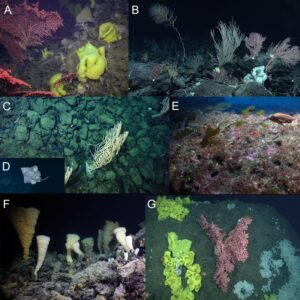
There are amazing deep sea habitats images:
Figure 8
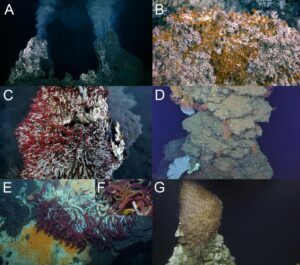
Figure 7