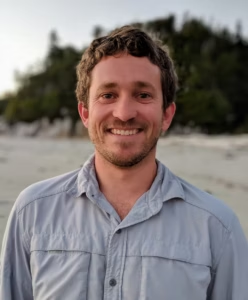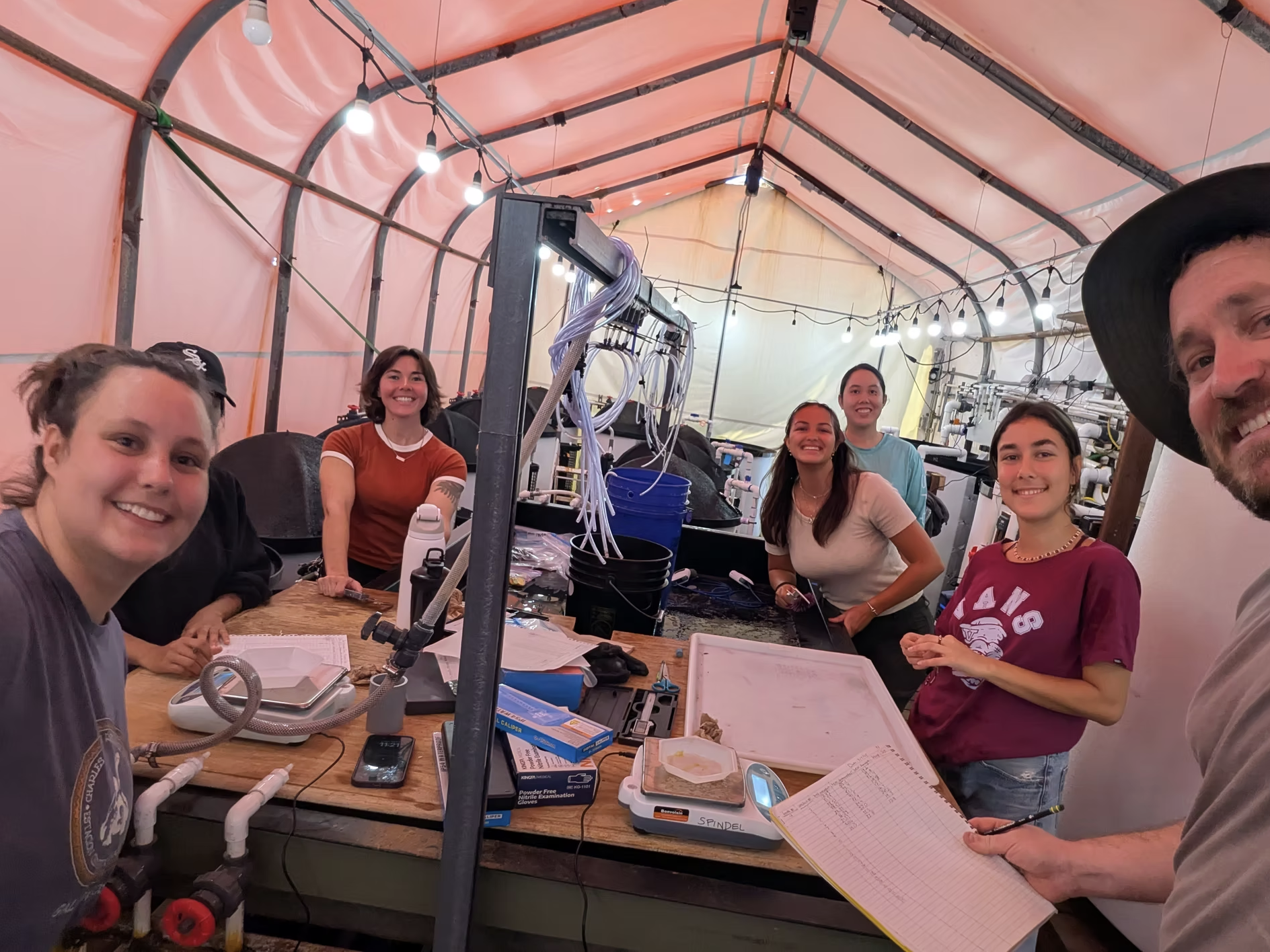

A new study led by MLML Postdoctoral Researcher Nathan Spindel was recently published in Ecological Applications. His research focuses on red sea urchins, and many MLML graduate students are currently working with him on related projects!
Nate is especially grateful to Moss Landing Marine Laboratories and San José State University for covering the open-access publication charges, which allowed the article to be made freely available.
The paper, titled “Consumer resilience suppresses the recovery of overgrazed ecosystems,” can be read here: https://doi.org/10.1002/eap.70196.
A brief overview of the paper:
A new study led by Nathan (Nate) Spindel, published in Ecological Applications, shows that red sea urchins can endure prolonged food scarcity by lowering their metabolic demands and then rapidly resume grazing and reproduction when food becomes available. Using field observations and controlled experiments, the study found that both food quantity and quality strongly influence urchin performance. Urchins collected from adjacent kelp forests and food poor urchin barrens exhibited reciprocal physiological and dietary shifts when subjected to kelp, mixed algae, or starvation treatments. Metabolically depressed barren urchins recovered when re-fed, while kelp forest urchins depressed their metabolism under starvation. Feeding trials also validated the use of fatty acid biomarkers to reconstruct diet composition, revealing parallel reciprocal changes in assimilated nutrients. Barren urchins incorporated kelp derived fatty acids when fed algal diets, while starved kelp forest urchins increasingly assimilated biofilm biomarkers associated with bacteria and diatoms. By calibrating fatty acid biomarkers against known diets, the study provides a stronger framework for estimating wild diet composition and tracing how shifts in primary production reshape the nutritional seascape, offering a practical tool for evaluating habitat quality and guiding kelp forest restoration and management decisions."