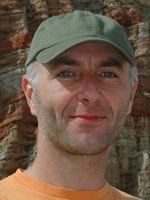
Infrared laser-scanning robots may sound like something straight out of Star Wars, but lucky top-notch scientists get to play with them too. Come hear Professor Ivano Aiello of the Geological Oceanography Lab talk about how these cool tools can continuously monitor our shifting coastline of beaches and sea cliffs, capturing the effects of both pounding storms and sneaky erosion. It’s free!
June 2, 2008. Dutch Harbor, Alaska and the R/V Oscar Dyson – We arrived in Dutch Harbor very late, indeed. I think it was after 1 am when I finally unlocked the door to my room. Outside, the dusky, midsummer light of an Aleutian evening was still slowly fading in the fog. I closed the curtains and sank happily into bed.
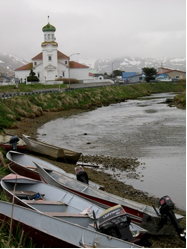
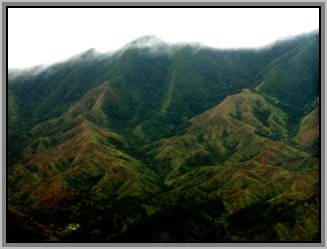
Boats amid mountains in Dutch Harbor, Alaska (photo by NMJ)
In the morning, I had just a couple hours free to take a stroll around Dutch Harbor, but I’ll be back again more than once this season; like many of the commercial fishing vessels, most all the research ships doing work in the Bering Sea must stop to exchange supplies or crew members in Dutch. This is a working town, in the truest sense. And, although it’s surrounded by beautiful wilderness, Dutch Harbor itself doesn’t see too many tourists!
Nonetheless I am fascinated and engaged by the sort of raw beauty that can be found in the industry of humankind. Although Dutch Harbor has gained an outsized, ribald reputation, I find it is also earnest, industrious, and indomitable. There is a certain honesty in the worn deck lines, rusty rails, towers of shipping containers, and acres of crab pots: This is how fish is brought to your dinner plate.
Regular 4 a.m. wakeup calls are brutal even for the coolest fishing survey. Once the boat is steaming towards our destination, very few things can come between me and my precious snooze time. But this morning I heard words that had me on my feet in a hurry: “Killer whales!”
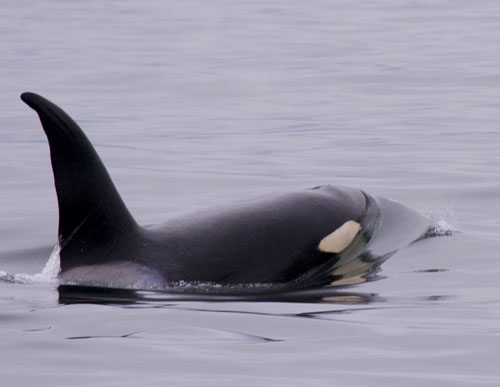
Science crew and volunteer fishermen alike clamored onto the deck and pressed ourselves against the boat railings, scanning the early morning horizon as our captain maneuvered us in for a closer look. Suddenly we saw them – two black jackknives of dorsal fins appeared over the rolling swells. We spotted two small orcas (another term for killer whale), their heads surging forward through the waves. Their characteristic white eye spots stood out like warpaint in fearsome contrast against their sleek black bodies. I watched in disbelief and euphoria as their heads broke the water’s surface once, twice, and again before they disappeared from sight.
Photo by Chad King (SIMoN)
Since I wasn’t able to snap a decent photo of my own, this one is courtesy of SIMoN and the Monterey Bay Sanctuary, who generously host a marine photo library for public use.
Though orcas are found in all the world’s oceans and are not unheard of in Monterey Bay, to actually see them here is rare and really quite special. Orcas are voracious hunters – as far as their prey are concerned, they earn their nickname, “wolves of the sea,” and probably the Latin meaning of their scientific name, Orcinus orca: “from hell!” Orcas near Monterey, like the ones I saw, sometimes hunt gray whales passing through on their migration from Mexico to Alaska with their new calves (ie, easy targets).
But even their ruthless reputation just added to my enthusiasm, which somehow always gets the best of me around whales and charismatic wildlife. Cheering and clapping at the sight of my first orcas, I threw my fist in the air and shouted “Jump!,” – you know, like in Free Willy? Apparently these orcas had never seen the movie, since they missed their cue.
Still, it was a good miniflashback for me, remembering how I used to dream of being like the kid in that movie, who lived by the ocean and got to spend time with awesome marine life, lucky duck. And now I am that kid, getting to see the real deal on days like this, roaming free. Such sweet job perks even make the 4 a.m. wake-up call worth it – at least until tomorrow morning.
Editor’s Note: Graduate student Kyle Reynolds describes her experience in the South Pacific, where she participated in a 2006 research cruise to study organisms living on the hydrothermal vent system of the Lau Basin.
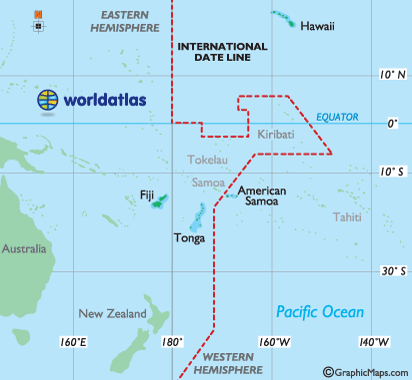
Looking out of the airplane as it began its descent toward Fiji, I remember feeling like I was having an out-of-body experience.We had crossed the equator and the International Date Line during this flight – two firsts for me!Once the plane touched down and we made our way to Suva, the capital, I would be embarking on a multidisciplinary research expedition with several teams of scientists from around the world to study the biology, chemistry, and geology of hydrothermal vents in the Lau Basin.My heart was in my throat as I elatedly took in the sights and sounds of my last moments on dry land for the next 30 days.
Once onboard the R/V Melville (the Scripps Institute of Oceanography ship we’d be using), the scientists quickly went about the task of securing their own cargo in their lab spaces to keep anything from spilling or breaking in transit.Our research would involve multiple deployments of a remotely operated vehicle (ROV) named the Jason II, or “Jason” for short.Jason would be working almost non-stop over the next month to take videos as well as animal, geological, and chemical samples for the various researchers’ projects.I was there to obtain snail samples for my thesis research, and would be using them to study their reproductive adaptations.Being the newbie, I was given the midnight to 4:00 a.m. shift to stand my watch in the Jason control van each night.The control van is a large metal container from which the crew can pilot Jason, while scientists record the data, log notes, and direct the collection efforts.
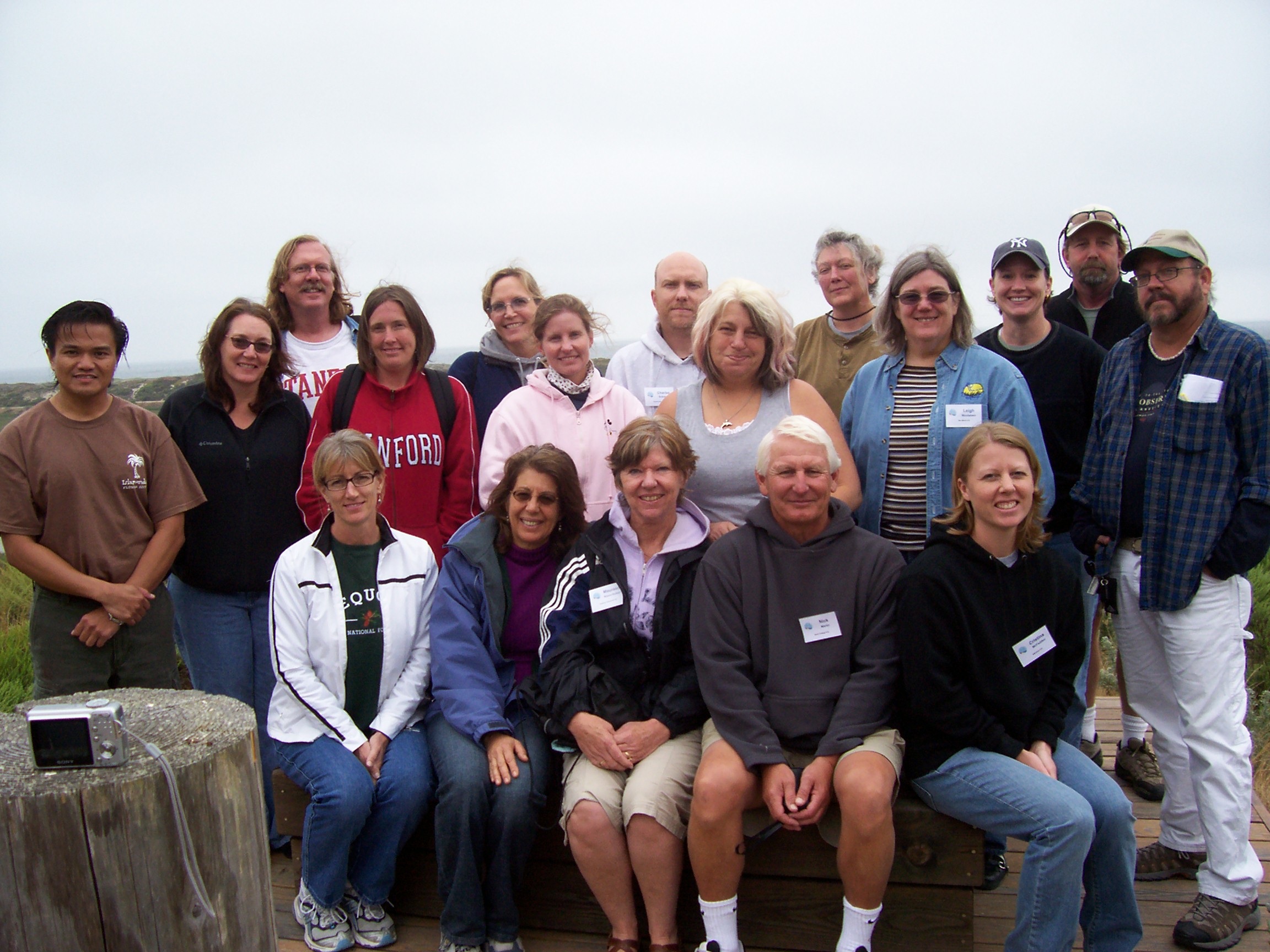
Grad students at MLML work with adjunct professor Dr. Simona Bartl through the Teacher Enhancement Program to help teachers incorporate the resources of a marine lab into their classrooms. This June, 20 teachers from around California participated in the week-long Lab and Field Explorations summer workshop, learning activities ranging from water quality and invasive species to sand crabs and sharks. Kathy Diver, a teacher at Los Osos High School in Rancho Cucamonga, CA, contributed the following account of her experiences with the Lab and Field Workshop.
Teachers ready to explore the lab and field of MLML!Kathy Diver, Los Osos HS teacher
I am writing from home a day after my week at the Teacher Enhancement Program in Monterey Bay at the Moss Landing Marine Labs (part of the Cal State University system). I had a very good time, but I am pretty tired after all that work and fun. Simona Bartl, the Project Director is a serious scientist with a great sense of humor. She seems to understand the need to bridge the gap between research science in the laboratory and students’ understanding when we are in the classroom.
We had a variety of presenters from various levels of education and research in the Monterey area. What an honor! Some were MLML teaching assistants (aka graduate students), others were instructors from the Monterey Bay National Marine Sanctuary, Hopkins Marine Station and the Elkhorn Slough Estuarine Research Reserve. All presenters led activities both in the field and in the lab that let us see first hand how we can participate in scientific research with our own students.
Monday (6-23-08) we were at the Moss Landing Marine Laboratories all day. We toured the facility with Elsie and learned what the week was going to look like. We did an activity with Sacha (from MERITO) in which we modeled the shape of the Monterey Canyon in clay, and another in which we pretended to discover a deep sea organism. We had to list the adaptations to the environment and give it a scientific name according to normal naming conventions. This curriculum focuses on multi lingual learners who live near the oceans, but since I have used similar activities in my class, I think it’s just good teaching.
Teachers inspect invasive snails for parasites
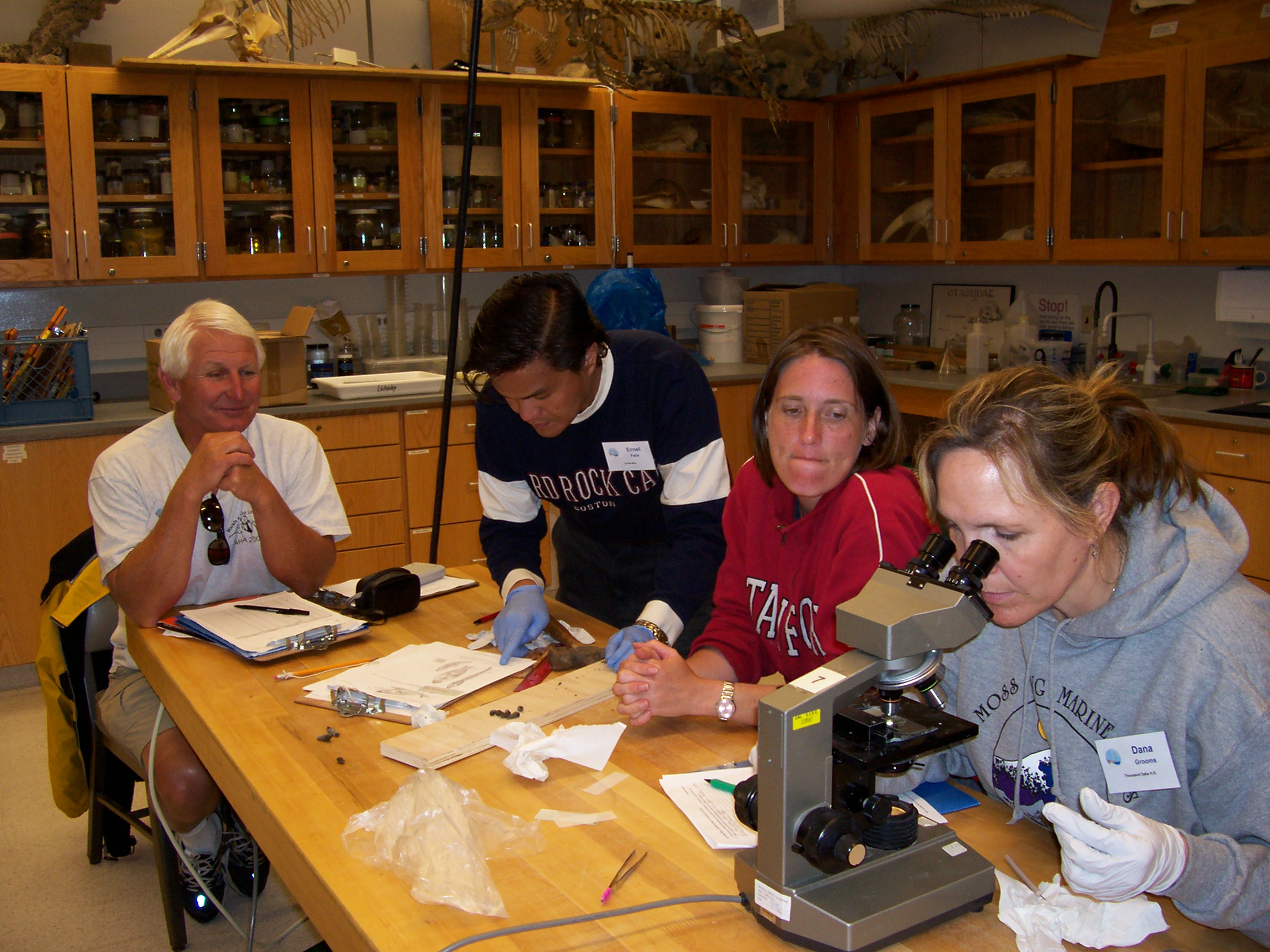
Tuesday (6-24-08) we went to the Elkhorn Slough with Kenton, Danielle and Elsie to study, count and collect an imported (invasive) species of snails. We later compared our numbers to last year’s research data. The original native species in the area has not been seen in over 35 years. The invader was brought in during the 30’s with the oyster cultures that were brought to the area for pearls and oyster meat. We also used microscopes to observe the parasites that are infecting this snail. We spent some time with Simona in the afternoon discussing and sharing lesson plans, activities and resources we use in our own practices. Since the 20 participating teachers cover a variety of curricula we got to discuss marine science with respect to our own classes and get some idea on how to enhance what we already do.
Braving the surf to sample sandcrabs
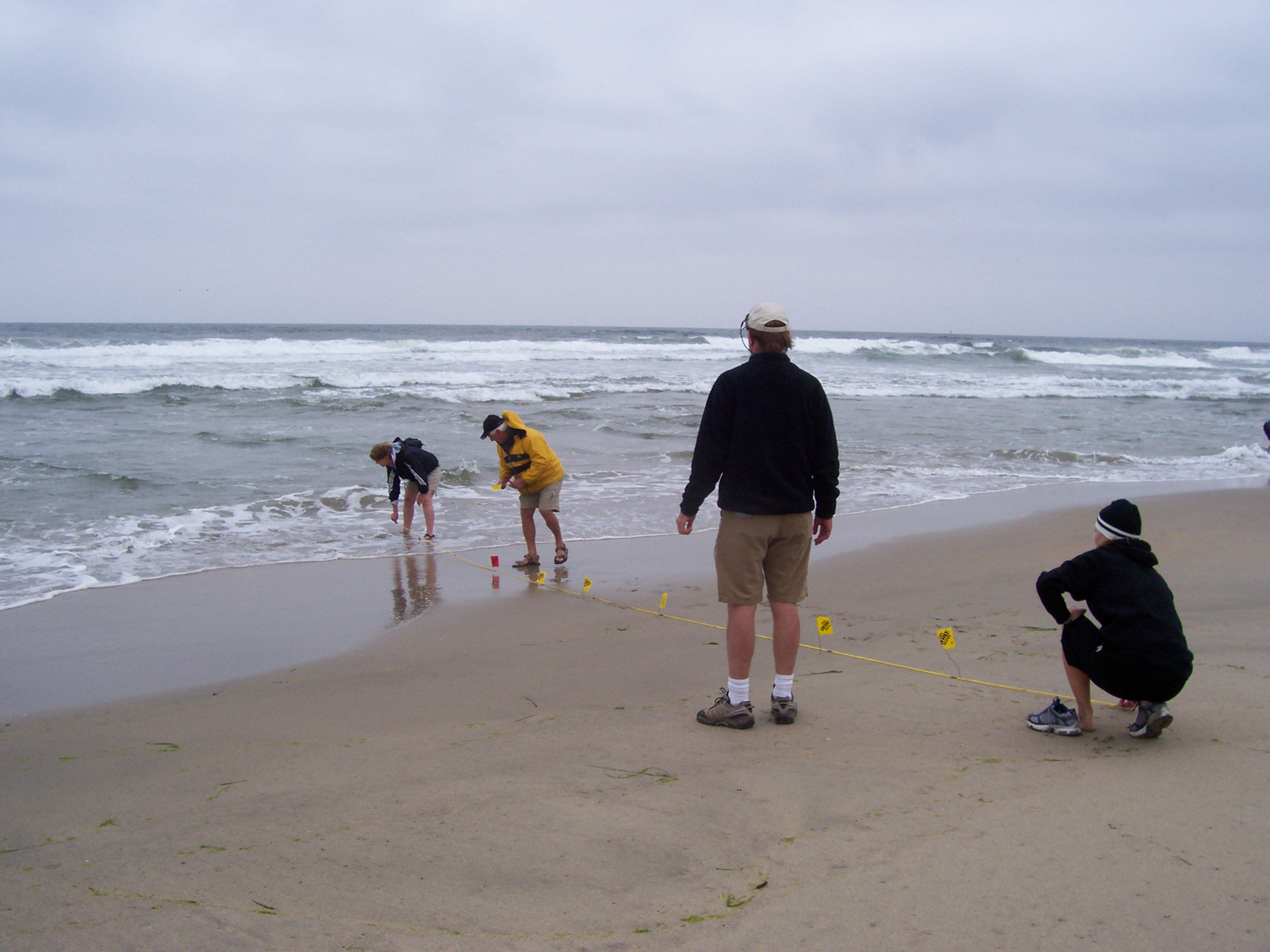
Wednesday (6-25-08) we went with Lisa and Erin to the Salinas River Beach to do a population study on the sand crabs there. It was cold and wet, but I loved being on the shore and in the water. We caught, measured, and recorded data on sand crabs. Later, we put in our numbers to an online sand crab-monitoring site (LiMPETS). We also checked some sand crabs for parasites while in the lab. These parasites actually harmfully infect shore birds and otters, so the scientists and agencies are keeping a close watch on the number of parasites found in a given area. I loved this day!!! Read more →
Editor’s note: Graduate student Nathan Jones will be spending summer 2008 aboard a research vessel studying seabirds in the Alaskan Bering Sea. During his occasional access to internet, he will send back dispatches that we will post here. This is his second “Birds of the Bering Sea” installment.
May 31, 2008, 8am. Anchorage, Alaska – The sun is shining this morning in Anchorage, Alaska. Today will be another in a week of days marked by growing warmth. The mountains to the east are greening in a rush as winter snows retreat, and summertime is arriving with a certainty that is felt by every living thing.
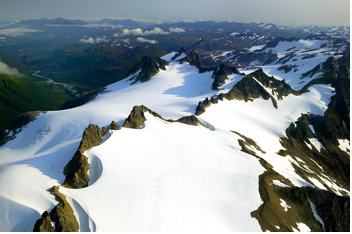
Alaska (USFWS)
At this latitude it seems like the daylight is endless, and I sit reveling in this feeling as I wait for news of my flight to Dutch Harbor. I am scheduled to fly out tomorrow on a twin engine prop that has been chartered by NOAA to carry a group of biologists to meet our research vessel, the Oscar Dyson. Dutch Harbor is a bustling fishing port, tucked in the protective, folding coastline of Unalaska Island at the base of the Aleutian Island chain. It is a major hub for all the fishing activity that goes on in the Bering Sea, and has recently been made famous by the Discovery Channel’s “Deadliest Catch” series.
After breakfast I get the call. It is not sunny in Dutch Harbor. In fact, it is blowing 25 knots and raining sideways, with visibility down to a few hundred meters! This kind of weather might seem difficult to imagine at the end of May, but such rough conditions are not that uncommon for the Bering Sea, even in summertime. And, although Alaskan pilots are some of the most skilled aviators in the country, they are wise enough to know when it’s just too dangerous to fly. So the airport in Dutch is closed, and I will have to wait in the sun here in Anchorage, hoping for better weather…
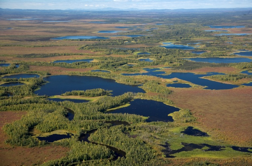
Alaska (USFWS)
June 1, 2008, 5pm. Enroute from Anchorage to Dutch Harbor, Alaska – The weather in Dutch Harbor has cleared somewhat, and we’re all ready to go! It will be a full flight – 26 scientists, sitting shoulder to shoulder – all going to meet ships to do their research on the Bering Sea. Because the plane is small we’re limited in what we can bring; most of these people have shipped their bags ahead, and are bringing less than 20 pounds each! Luckily, my coworker Marty and I have been granted an exception, because our reference books, computers, binoculars and other equipment weigh almost 30 pounds already. I have reduced my personal baggage to some basics: 22 pounds of clothes, shoes, and gear to last me three weeks. The props on the engines are turned, and begin to spin. They whir. Then they roar. I put in some earplugs to dull the noise, and the plane races down the runway and launches into the air. We’re off!
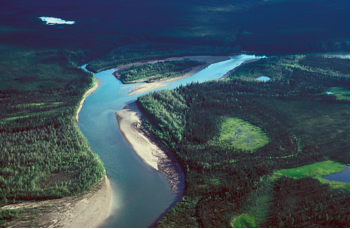
Alaska (USFWS)
I’ve always been impressed when flying, and it’s a pleasure to peak out of the windows and watch the rugged, snowy mountains divided and sculpted by living glaciers that are melting into turquoise rivers heavy with silt, then spreading wide into vast stretches of wetlands that sweep to the horizons in all directions under the plane. It’s almost too immense for words. These pictures depict the landscape that I am flying over, courtesy of the US Fish and Wildlife Service.
We must stop in King Salmon to refuel. This should be a routine task, but once on the ground the pilots inform us that the plane is in need of an emergency inspection; a smoke detector in the cargo hold has been lighting up for no apparent reason. It is already 8 pm, and we still have a couple more hours to fly to get to Dutch Harbor, but no one here is going to complain about any inconvenience. Better to be safe than to risk plummeting in a fireball into an untracked wilderness, I say! There’s now enough time to unfold myself and get out of the little plane to grab a sandwich from the (only) store. Better to eat now, because I suspect it’s going to be a late night…
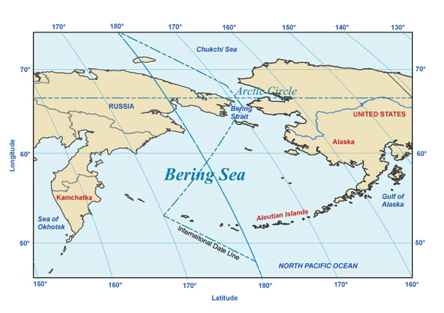
May 25, 2008. Moss Landing, California – The Bering Sea is a long way from Moss Landing, California. It’s a long way from most anywhere, actually. To begin my summer of field work, I must first fly from San Francisco, California to Seattle, Washington. In Seattle I will change planes and fly to Anchorage, Alaska. From Anchorage I’ll catch a small propeller plane and fly low over the mountains, glaciers, and the vast wilderness of Southwest Alaska to stop briefly in King Salmon, where we will refuel, and then continue on out along the foggy Aleutian Island chain to land in Dutch Harbor, Alaska. I will then board a research vessel that will motor for fifteen hours out into the Bristol Bay portion of the Bering Sea and there, at last, I will begin my work. It will probably take me three long days.
Map of the Bering Sea near Alaska (NOAA)
Humans are not the only animals that eat fish, of course! Seabirds flock by the millions to feed on fish in the Bering Sea, and also on energy-rich krill (tiny crustaceans, similar to a shrimp). These krill grow to become so numerous in summer that they form dense undersea clouds that can stretch for miles. Krill, known to scientists as euphausiids, are eaten by fish; in fact, we feed them to our own pet goldfish, in dried and flaked form! They are also the favorite food of many whales, which use their thick baleen plates to strain these tiny creatures from the water in huge, lunging mouthfuls.
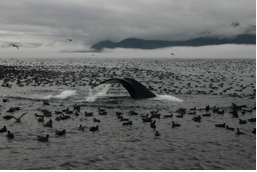
Birds and whales feed together in Alaska
Because they like to eat similar kinds of food, whales and seabirds can oftentimes be seen congregating to feed together in productive areas that contain especially large amounts of fish and euphausiids. Such places are usually characterized by turbulence and the mixing of cold(er) and warm(er) ocean water. What is it about the turbulent combination of cold and warm water that attracts the euphausiids and fish?
During the next two months I will spend most of my time on the ocean. I will be taking special interest in these foraging hotspots, trying to learn more about how seabirds find and exploit them.
If you’re interested in learning more, Nate recommends the following websites:
Hi, my name is Danielle. I am a graduate student in the Vertebrate Ecology lab, and I need your help with a problem we are having in our ocean right here off the coast of California. I noticed this problem when I was working on a whale watch boat in Monterey Bay.
The winter months (December through April) is gray whale season here in California. Gray whales spend the summer in Alaska, where they feed in cold, nutrient rich waters. At the end of the summer they head down to Mexico, to give birth to their calves and mate in the warm, shallow waters of Baja California. Here in California we are lucky, because they travel right along our coast on their way to and from Mexico. On February 15th and 16th I was out on the whale watch boat, looking for gray whales. We found whales, but we also found balloons. LOTS of balloons.
Each time we saw a balloon, we stopped the boat, and our deckhand used a gaff hook (a long pole with a hook on the end that is normally used for grabbing the lines we use to tie the boat to the dock) to grab the balloon out of the water. During those two days alone, we picked up 14 balloons! Each balloon was either pink, or a heart shaped Mylar balloon, which means they were all probably released on Valentine’s day, either accidentally or on purpose. We only traveled across a small part of Monterey Bay, and if we had traveled across more of the bay, I do not know how many more we would have found!
Fourteen balloons is a lot to find in only two days. It is not unusual, however, to see one or two balloons on an average day of whale watching in Monterey Bay.
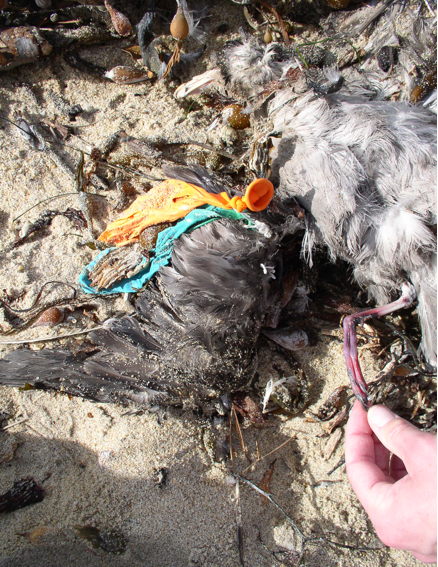
Balloons can kill marine wildlife like this Northern fulmar. Note the balloons wrapped tightly around its wing, and hemorrhaged leg (BeachCOMBERS)
One of the problems with balloons is that they can look a lot like jellies. Animals like endangered sea turtles eat jellies, and they can accidentally eat balloons, thinking they are jellies. This seems surprising, that a balloon could be mistaken for food. More than once though, I have looked over the side of my whale watch boat to see a large jelly floating near the surface, but as we got closer, I
realized that it was not a jelly at all, but a big Mylar balloon. If I, with my human brain, can mistake a balloon for a jelly, it is easy to understand how a hungry turtle can make the same mistake!
I don’t only see balloons out in the ocean. Almost every time I go for a walk on the beach, I see balloons all tangles around kelp, driftwood, and even wildlife, like the northern fulmar in this photograph.
I need you to help me figure out how the balloons get out into the ocean. Also, I need you to help me figure out how the balloons affect wildlife like sea turtles, birds, and marine mammals. I would also like you to help me figure out what we can do to help decrease the number of balloons that make it out into the ocean.
You can use these websites to answer the following questions, and help me keep our oceans free of balloons!
1. How do balloons get into the ocean?
2. Give three examples of how marine animals are affected by balloons.
3. What are the laws in California regarding balloons?
4. What can you do to help prevent balloon from harming marine wildlife?
Have you ever wondered what it's like to be a marine biologist? I mean, really like?
Well, you’ve dropped in to a community of marine scientists who want to show you just that. Welcome to the blog for the Moss Landing Marine Labs (also known as MLML), located by beautiful Monterey Bay in California. Here you can find the inside scoop on the life of a marine scientist in all its wet, smelly, messy glory!
Yes, a marine scientist. Because just like marine biology is more than the study of dolphins and whales, studying the ocean is more than just marine biology. Chemistry, physics and geology are all tied together with biology in the field of study we call oceanography. We want to introduce you to the many diverse pieces and processes of the ocean that we are learning about, and show you how they all fit together.
Come explore the ocean with us!
And just who are we? The contributors to this blog are mostly graduate students currently studying at MLML. We’ve all finished our bachelor’s or undergraduate degrees (the four years or so people refer to as “going to college.”) Now we are working diligently enroute to a Master’s degree, which many people complete before getting their Ph. D., or to become more qualified for jobs.
In order to get that coveted Master’s degree, we are each required to complete a thesis, and that means conducting our own research. And that means getting our hands dirty! Doing research lets us have some pretty incredible experiences that we just have to share, so we’re going to take you along. We will bring you stories fresh from the field and live from the laboratory. We will take you out to sea on research boats and down to kelp forests beneath the waves. Ultimately, we want to feel that the ocean right at our doorstep is part of your life too, wherever you are.
So come drop on in and get to know all the cool features of our blog. Click around all the nifty links stuffed into the sidebar on the right: Meet our blog editors and discover how we got started. Check out interviews with MLML alumni to find out what people actually do with their degrees in marine science. Explore the resources that have helped us along the way, and expand your science vocabulary. Read our first-hand stories and our tips for surviving graduate school, check out the photos featured in our posts, watch our videos.
And tell us what you want to learn! Our goal in creating this blog is to bring together resources and encouragement for future marine scientists and marine science enthusiasts. So whether you’re a high school student who wants to know what it takes to study marine life, a college student wondering if you should go to graduate school, or someone who just wants to learn more about the ocean, this blog is for you!
So get exploring, get excited and get inquisitive. At the end of the day, we hope you’ll share our enthusiasm for investigating how the world works, and appreciate the value of studying our ocean and its myriad inhabitants.