
Harbor Seals in Alaska: To Flush Or Not to Flush Part 2

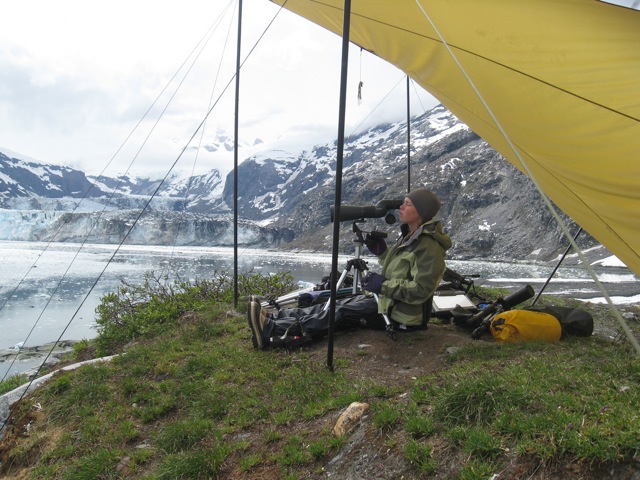
Colleen looks for seals in John Hopkins Inlet (photo: L. Carroll)

by Colleen Young, Vertebrate Ecology Lab

In my last post I told you about the findings of my thesis research on the effects of vessels on harbor seals (that cruise ships caused the most disturbance of all vessels), but then left you hanging about what the findings mean and why anyone should care.  So now that you’ve had a chance to think about it, what do you think?

Well, finding that cruise ships accounted for a greater incidence of flushing (when seals leave the ice and hit the water) was not what I expected, based on previous studies, which found that kayaks and canoes (non-motorized vessels) caused greater disturbance.  However, these previous studies were conducted at terrestrial haulout sites, where the water depth near the harbor seals is extremely shallow, making it easy for non-motorized vessels to get close to seals, and difficult for motorized vessels.
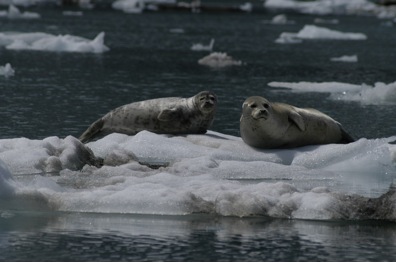
Harbor seal mom and pup resting on an iceberg in Johns Hopkins Inlet. (photo by C. Young)

In Johns Hopkins Inlet, however, seals haul out on floating icebergs in a deep fjord, so motorized vessels can get very close to seals, whereas kayaks stay more distant.  Therefore, the differences between reactions of seals to different vessel types may actually be a response to how close the vessels approach.  I tried teasing apart the effect of vessel distance on harbor seal behavior, but that proved less straightforward than I anticipated.  That’s because, like humans, harbor seals have individual personalities, meaning that they respond differently to approaching vessels, making their behaviors difficult to predict.

So harbor seals are disturbed by cruise ships and motorized vessels more than kayaks.  So what?  Well, harbor seals numbers in Johns Hopkins Inlet have been decreasing since 1992.  In contrast, cruise ship numbers in Glacier Bay National Park have increased, meaning the potential for disturbance is greater than ever before.  Harbor seals are top-level predators, so they exert great influence over marine ecosystems through the food chain.  Therefore, it is important to protect harbor seals, including reducing disturbance, in order to maintain a healthy ecosystem in Glacier Bay.
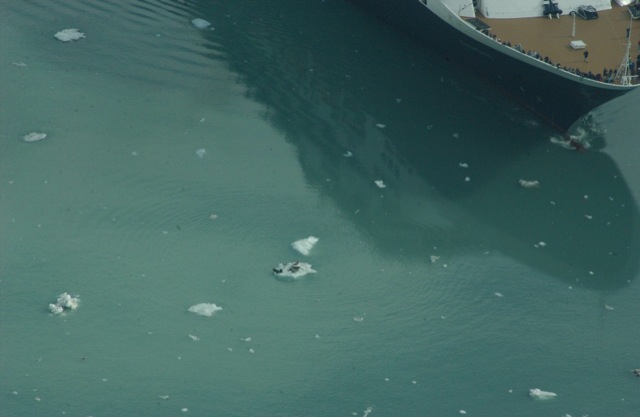
A sense of scale: a cruise ship approaches harbor seals (center). (photo: J. Womble, NPS)

I made some recommendations to the resource managers at Glacier Bay National Park about how they could reduce disturbance to harbor seals by cruise ships.  I recommended that they teach boaters about how to avoid disturbing harbor seals by keeping a good distance and not approaching seals head-on.  I also recommended that they limit the number of motorized vessels allowed to enter Johns Hopkins Inlet, and have disciplinary action for boaters who disturb seals.

I was able to voice my recommendations to the park superintendent and other important decision-making people at a special conference.  It felt really good to know that the people who have the authority to protect these harbor seals wanted to hear what I had to say and were interested in implementing many of my suggestions.  I hope to go back to Glacier Bay some day to see how the harbor seals are doing.
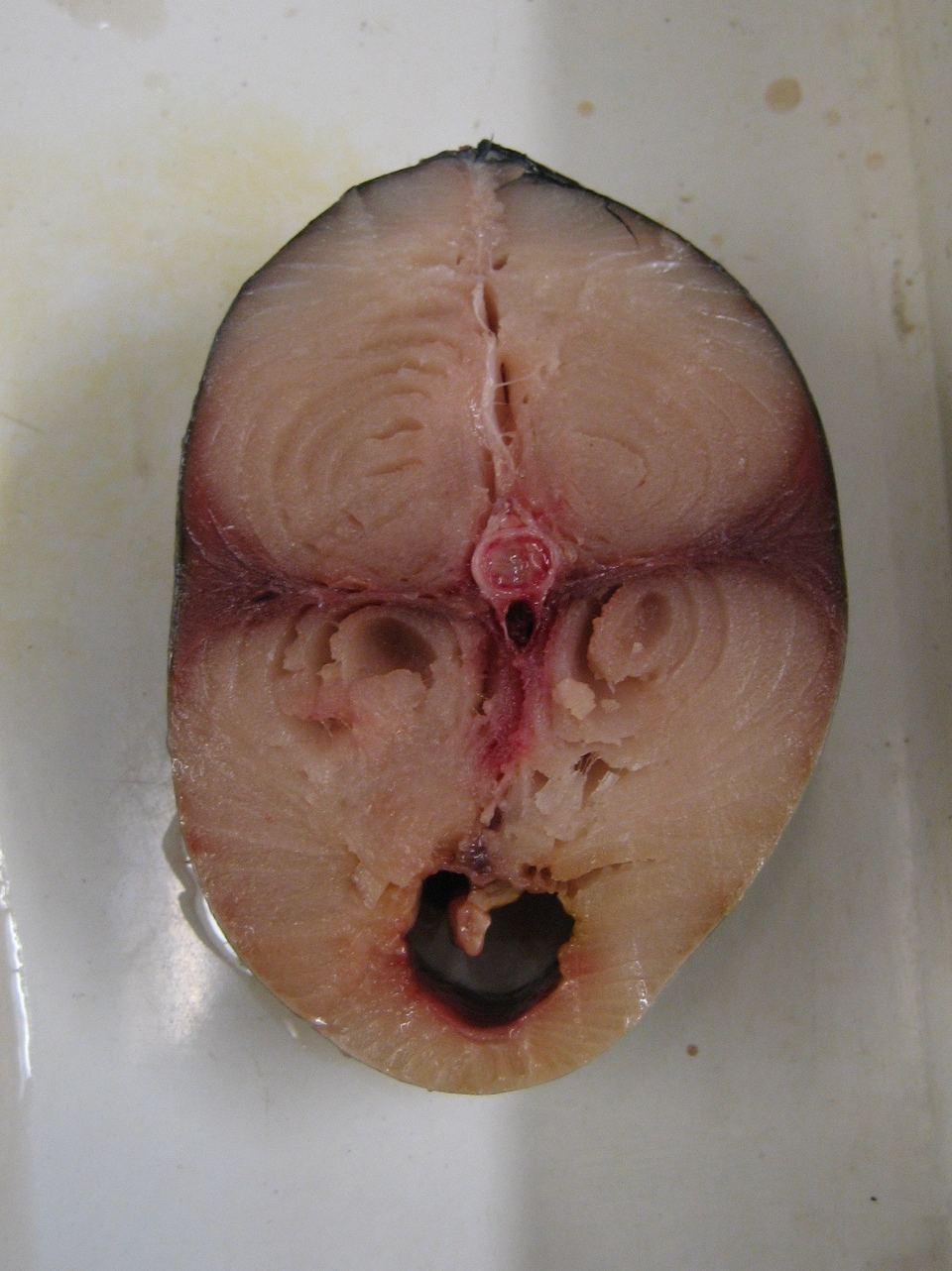
Slice o’ Tuna – the Other Red Meat

photo: E. Loury

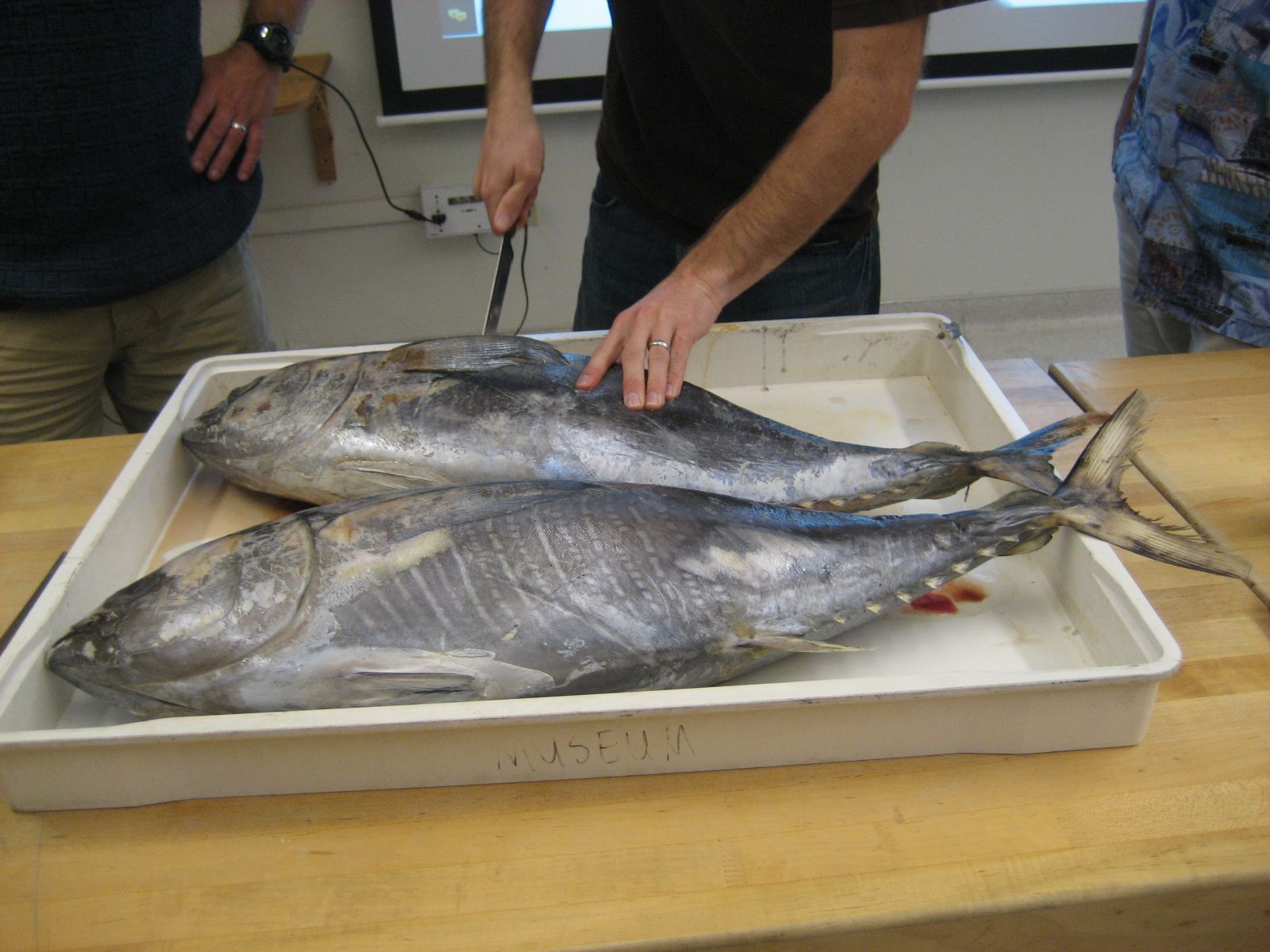
If you slice into a tuna like we did in Ichthyology class, here is what you’ll see: a layer of red muscle sandwiched between white muscle (which looks pink in this photo).   The oxygen-rich red muscle helps tunas power through the water.  Having red muscle located near the core of their body makes tunas unique from many other fishes, and allows them to keep their muscle at a higher temperature than the surrounding water.  Warmer muscle means faster contractions and increased power.  No wonder tunas are some hot-blooded fish!

We Got Off to a Rocky Start

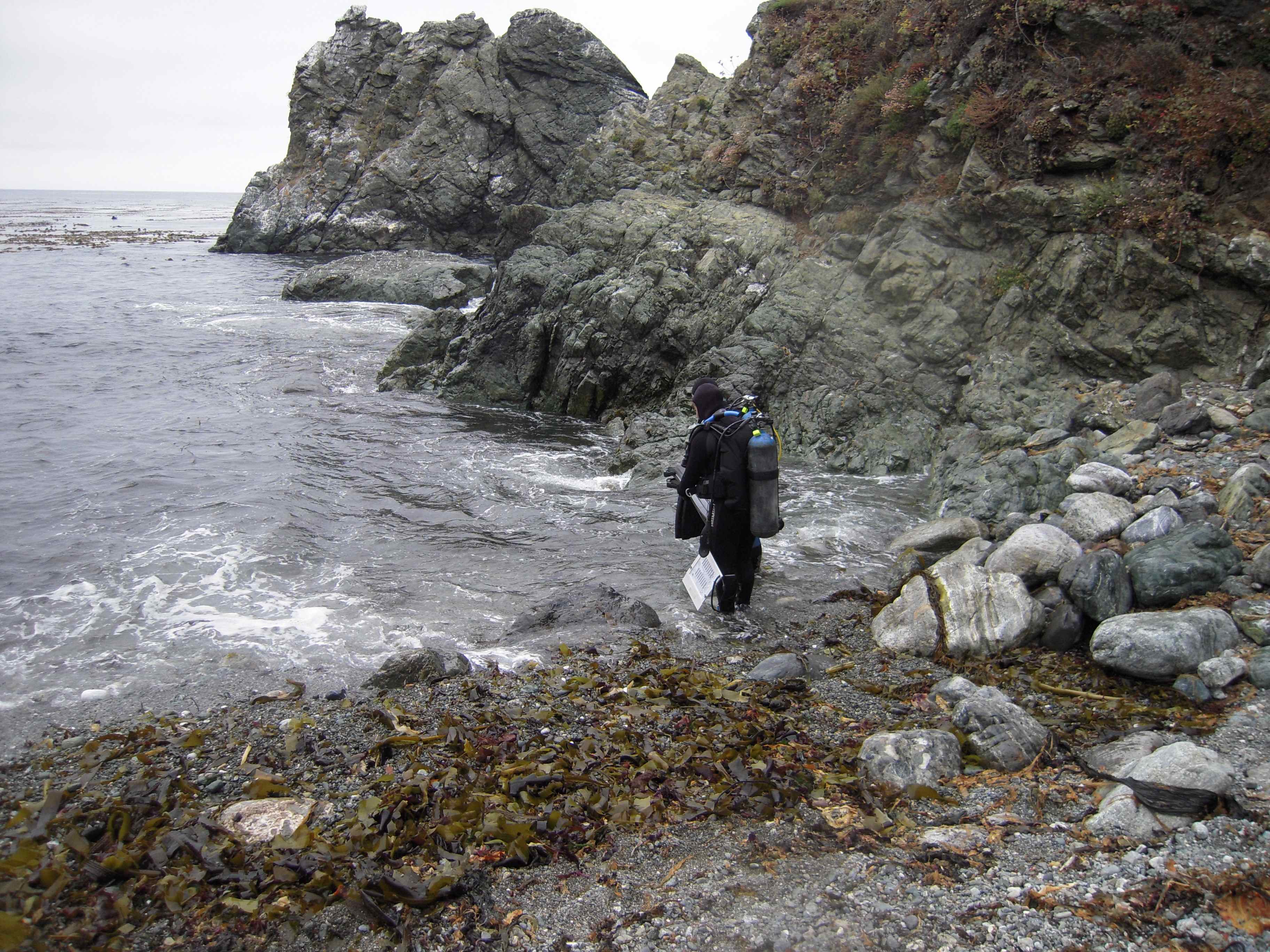
(photo: Z. Kaufman)

MLML scientific divers wait for a break between the sets of waves before wading into the water.  Diving from shore at Big Creek Reserve can be tricky, considering all of the big boulders between divers and open water.  With a little patience and sure footing, you can venture out for a gorgeous day under the sea.

Fishing for seabirds II

How DO marine ornithologists catch the birds they study?  Sometimes, it’s just like catching fish!

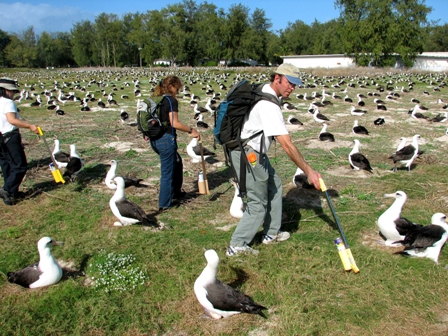
Of course, first you’ve got to find the birds.  The oceans are HUGE expanses.  They can be difficult to navigate, and birds can fly literally hundreds of miles in a single day!  Luckily for biologists, the most predictable place to find seabirds is actually on land, on a breeding colony during their reproductive season.  So, how does a biologist catch a seabird while it’s on a colony?  Amazingly, many seabirds exhibit no instinctual fear of humans while on their breeding colonies, and if they nest on flat ground then researchers can simply walk right up and touch them!

Albatross census. Photo: USFWS

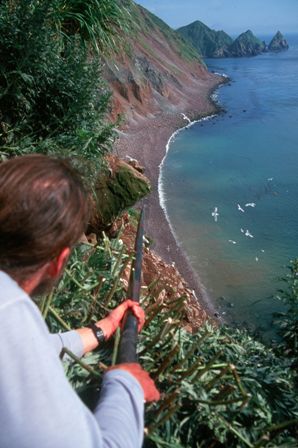
In many places where birds nest on cliffs they also exhibit little fear when humans lean over from the top, just a few feet above them.  This allows biologists to employ a modified “fishing” pole, with a slip-knot noose, to grab a bird (loosely!) by the neck, nudge it off its perch, and gently guide it through the air (as it flaps in a startled flurry!), back up to the cliff top where measurements, blood draws, and other work can be done.

M. Murphy, fising for kittiwakes! Photo: N. Jones
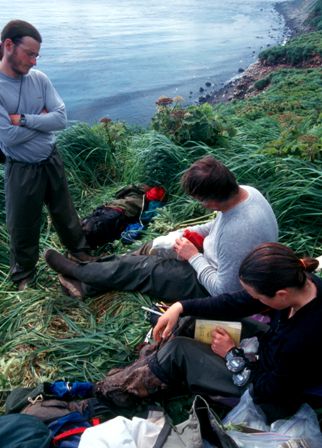
Photo: N. Jones

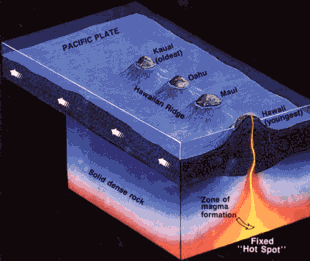
How can it be that these animals, which routinely fly thousands of miles in a year, would just sit there and allow themselves to be captured on their breeding grounds?  Wouldn’t this lack of caution put the breeding birds at great risk of predation?  Yes, but… many seabird colonies are located on relatively small and terribly remote islands, and in prehistoric times, as the birds evolved their breeding habits and reproductive strategies, there were NO land predators whatsoever!  This is because many of these remote islands emerged as the tops of ancient volcanoes, which oozed and spewed and built their way straight from the depths of the oceans, and so were never associated with any parent land mass.


USGS. http://pubs.usgs.gov/gip/dynamic/hotspots.html
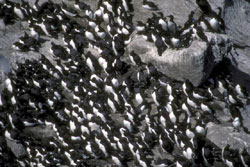
Murre colony. Photo: USFWS http://alaska.fws.gov/mbsp/mbm/seabirds/projects.htm

As such they remained for eons in isolation, free of any land predators.  Seabirds find these types of islands particularly suitable for breeding.  Without many foreign disturbances, they are left to partition the breeding habitat amongst themselves to a maximal extent.  Often, this means some VERY dense nesting aggregations!

Into the Dark Forest We Go

(photo: S. Jeffries)

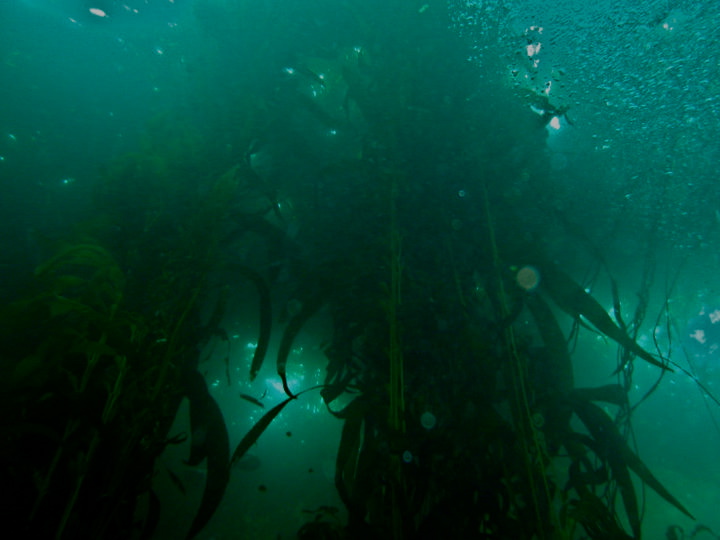
This isn’t a spooky scene from a movie, it’s a photo that undergrad MLML intern Sarah Jeffries took on a dive.  Sarah is looking up at two giant kelp plants, and you can see the bubbles that she just exhaled rising toward the surface.  This dive at Monastery Beach in Carmel Bay was a great way to enjoy the serene underwater landscape and remind Sarah why she loves marine science.

A Diver’s View of Big Creek Bridge

(photo: Z. Kaufman)

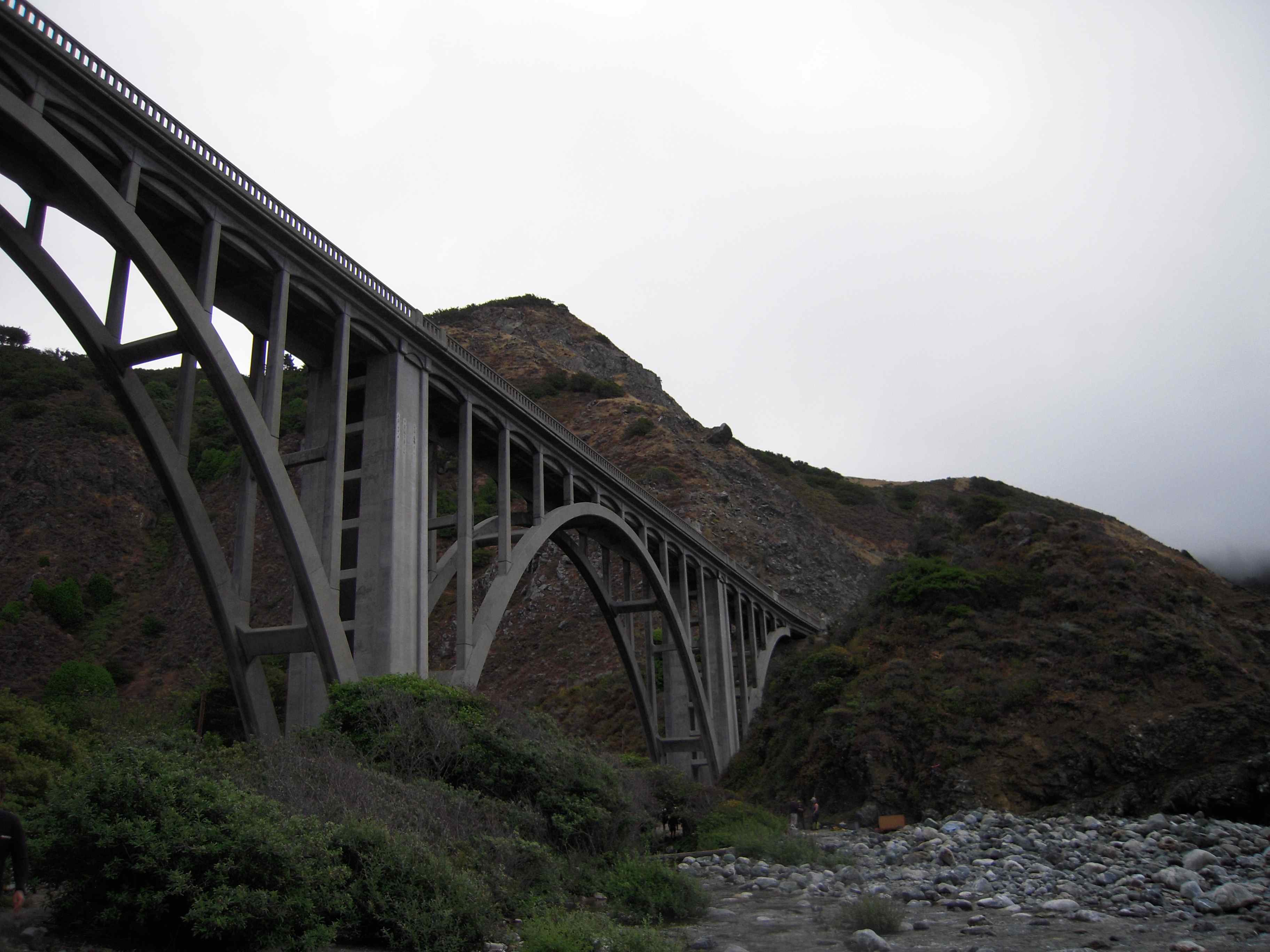
Here’s a last glance back toward Big Creek Bridge before heading into the water for a dive.  We MLML scientific divers love the chance to go down to University of California’s Big Creek Reserve for research and training.  Part of the MLML summer scientific diving course is taught here, and students get the chance to dive in pristine kelp forests that are home to a diverse and abundant group of inverts and fishes.  You can read about the adventures at Big Creek in the Big Creek Blog, written by reserve manager Mark Readdie.

Slicing Tuna – But Not for Sushi, if I Were You

photo: E. Loury

Though potentially a common sight in a sushi kitchen, these yellowfin tuna were collected for research, not eating.  The tuna arrived at an Ichthyology guest lecture in 2008 courtesy of fish physiologist Dr. Jeffery Graham from the Scripps Institute of Oceanography, and two of his grad students.  They are slicing in to display this warm-blooded fish’s unique musculature.  What does it look like? Stay tuned to find out!

Suiting Up to Keep it Clean

photo: E. Loury

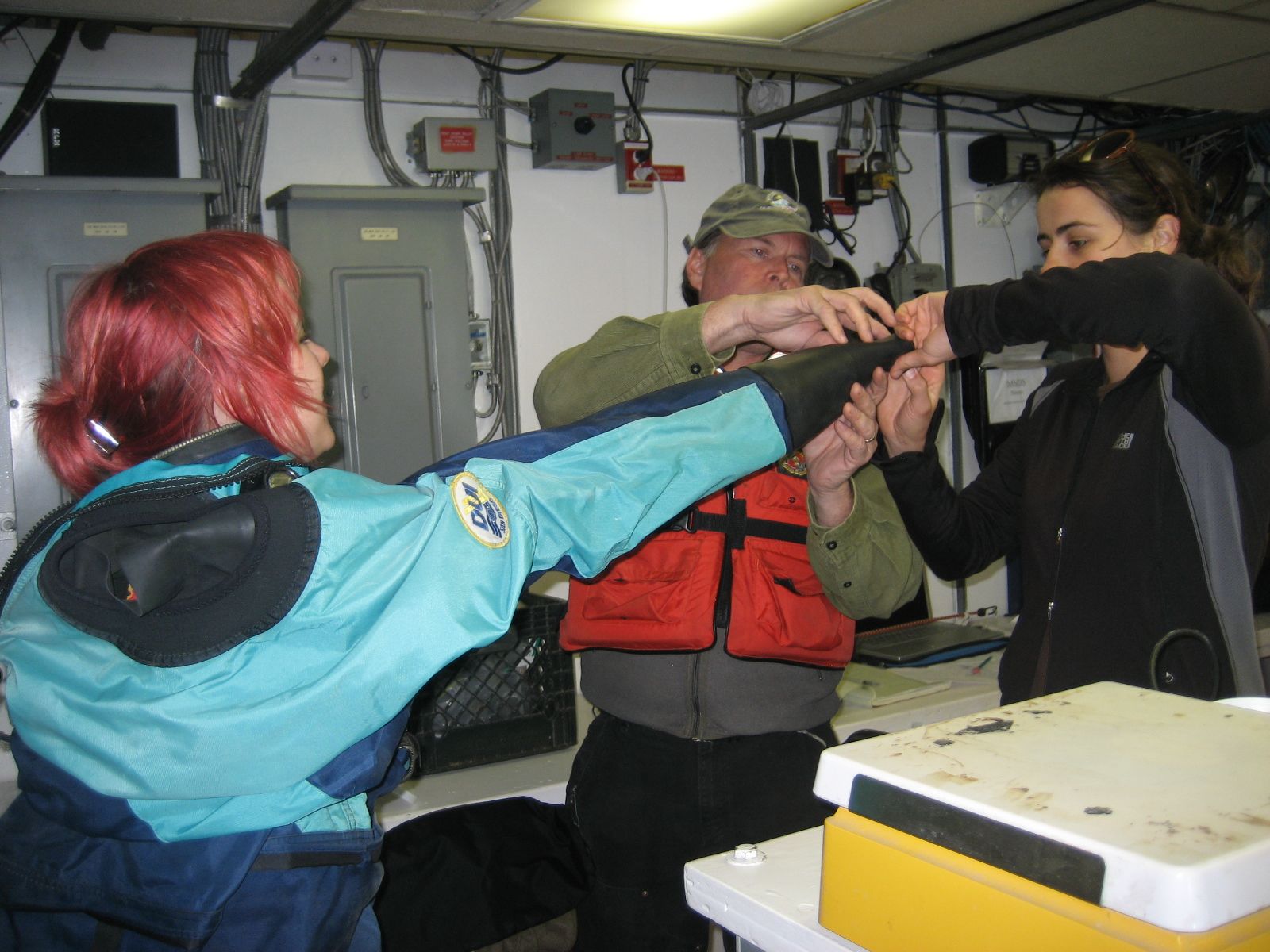
Trying to study trace metals that occur in seawater in such, well, trace amounts means getting serious about preventing contamination from any stray metal particles.  Kenneth Coale, MLML Director and Chemical Oceanography Professor (center), helps Ichthyology student Megan Winton don a clean suit to collect a water samples for a Chemical Oceanography class project.  Oh, and if you’re worried about contamination, you should probably get far away from that giant metal research vessel…

Have Your Skate and Eat it Too

photo: E. Loury

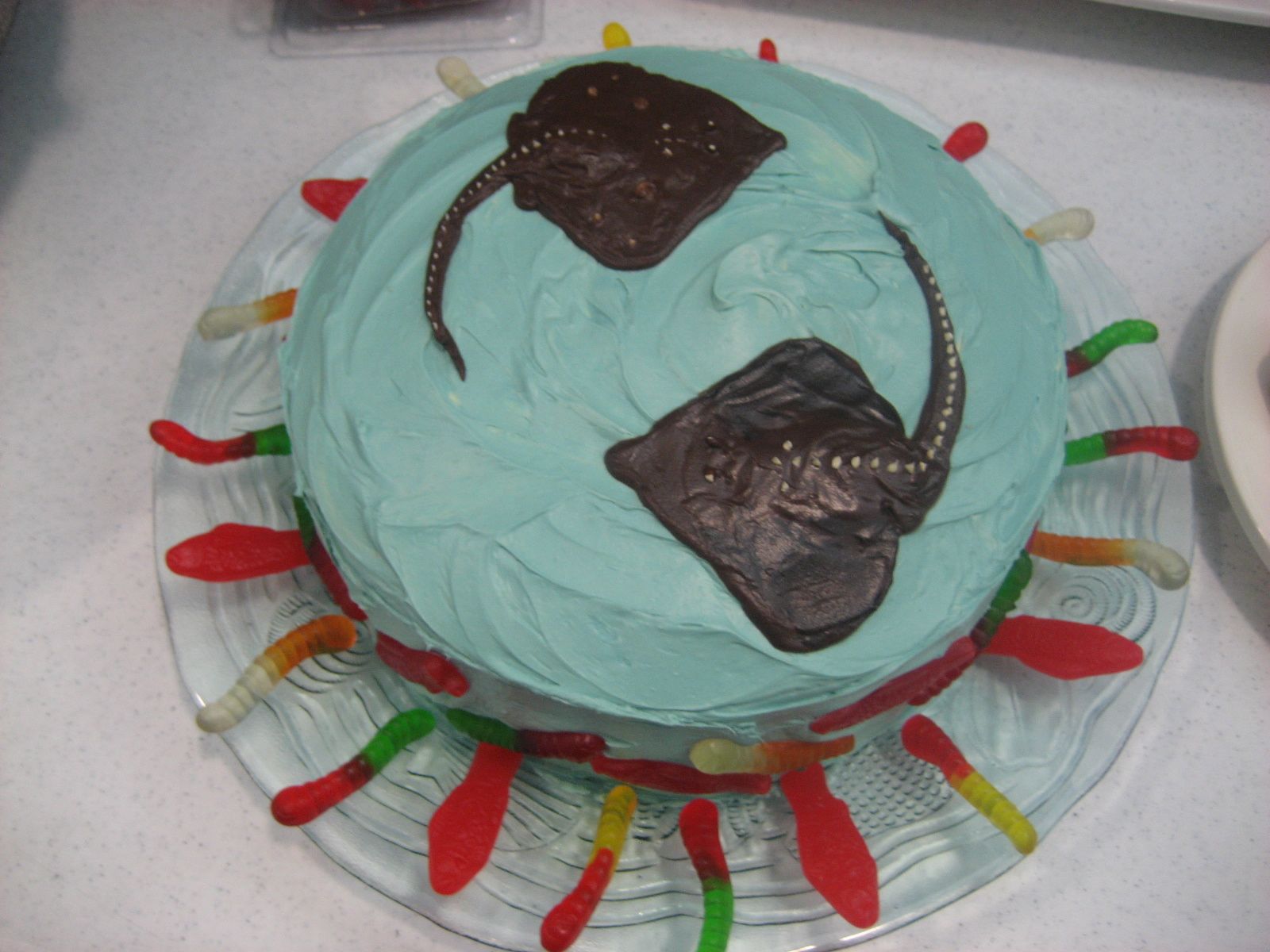
Here’s another incredible, edible, and ocean-themed creation by Ichthyology student and food artist extraordinaire, Diane Haas.  Baked in honor of Simon Brown’s recent thesis defense, the cake depicts Simon’s two study species – the Berring Skate (top) and the Aleutian Skate (bottom).  The differences between the two skates are small, but accurately rendered!   Since this was a thesis about diet, it’s only fitting that there should be some “prey items” for garnish. Check out some of Diane’s other masterpieces featuring sharks and rockfish!

Baby, You’re a Firework

photo: K. Demes

Happy 2011!  We’re celebrating the new year with a bang – or, you might say, a photo explosion.  If you’ve been trolling the Drop-In lately, you’ll see we’ve ramped up the number of photos we’re posting: glimpses of field research, class experiences awesome sea creatures, and more.   It’s all part of our ambitious new goal to bring you a steady stream of fresh photos, dropping you in alongside us in the great watery world that is marine science at Moss Landing Marine Labs.  Between this journal of images and our more detailed blog stories, there’s bound to be something happening at the Drop-In, so make sure to check back often!

Today’s photo of a fish-eating anemone from Monterey Bay (the very same featured in our Drop-In banner!) exemplifies a potential resolution for the new year.  Greet the world with arms or tentacles wide open, and you’ll be ready when good things come your way.  Like that tasty shrimp or little fish passing by…