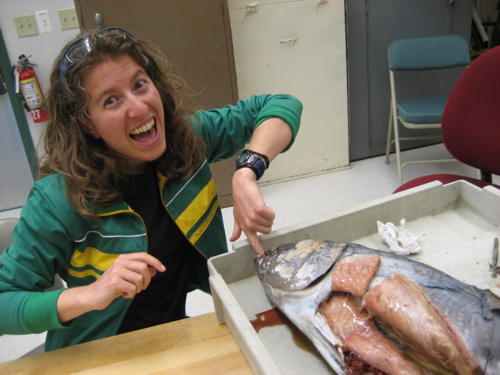
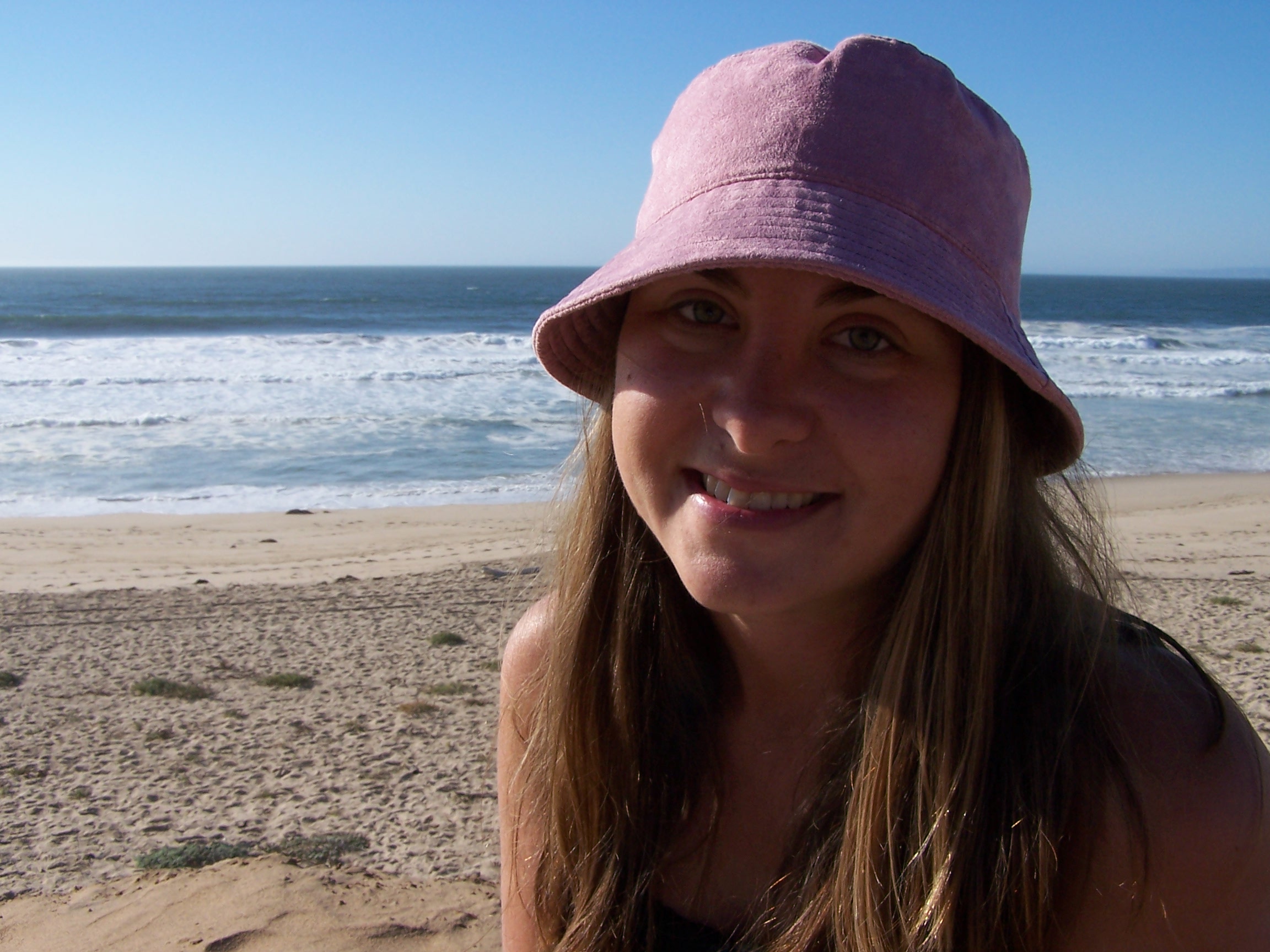
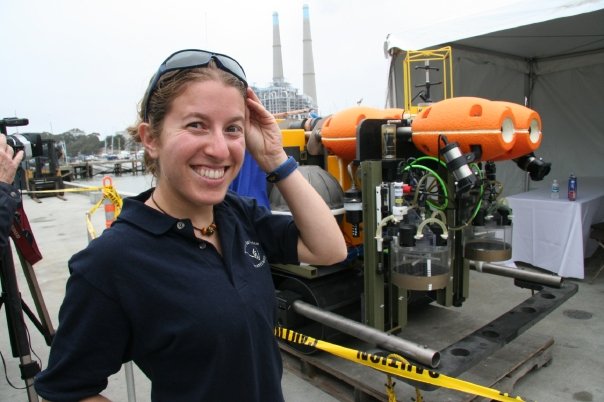
Ok, it’s been a crazy midterm week – so here’s a fun photo to look at! (Which is worth at least a thousand words of posting right?) I know, cop out, cop out…BUT! This is no random photo selection! It features our very own blogger Amanda Kahn, who (fact) is celebrating her birthday today (hooray!), and (also fact) had to spend it taking a 4 hour population biology midterm (doh!).
Think you can caption this photo? Give it your best shot!
Happy birthday, Amanda, and watch out for those dissected tuna – they’ll getcha!
Imagine waking up, stepping outside, and being surrounded by nothing but snow, ice – and lots of penguins. Such an opportunity is enough for even the most dedicated grad student to put a thesis on hold and hop a flight to Antarctica. For the next five months, Kristen Green of the Ichthyology Lab is switching gears from studying fish to their feathered counterparts: the penguins. What will this glamorous field work at the ends of the Earth entail?
Kristen writes:
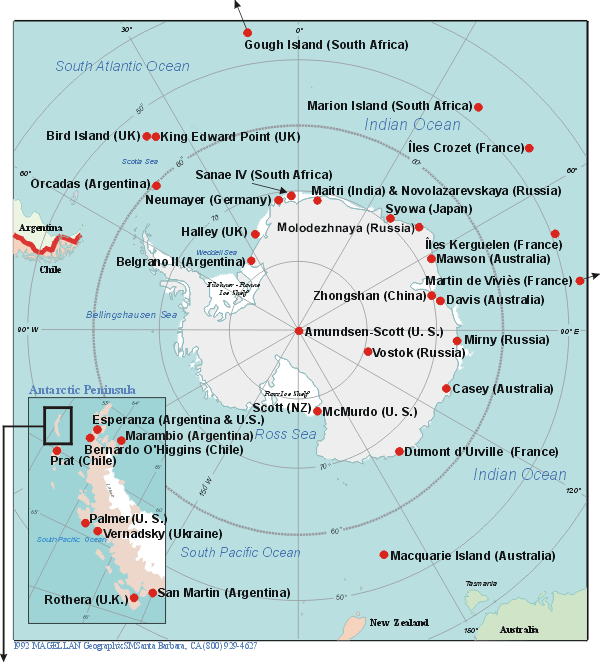
This arrow leads to King George Island (box at the end of the Antarctic Peninsula)
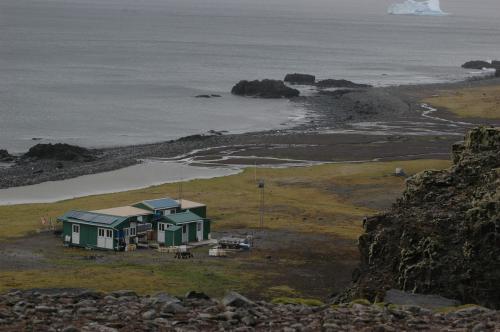
“It’s hard to write an email describing what you are going to be doing for the next five months, but I leave Saturday, October 11th to conduct research on penguins on a small field station in the Antarctic. I will be working with four other scientists on King George Island [at the tip of the Antarctic peninsula], at a field station known as “Copacabana.” Not the tropical resort you might have had in mind…instead, the temperatures might reach a balmy 5 degrees C (40 degrees F) in the height of summer. Minimum temperatures can reach -5 degrees C (22 degrees F). We will be there from mid-October to mid-March. This photo of the station is taken during the Antarctic summer, and as you can see, much of the snow has melted. But when we arrive, the island will still be covered in snow and ice.
Copacabana research station - a bit of a cruel joke in naming
Penguin research began at King George Island in 1976. It’s pretty amazing to be part of a research group that has been studying the ecology and demography (population characteristics) of the region’s penguin and flying bird populations for over 30 years. Briefly, the main two scientific objectives of the study are to: 1) quantify the reproductive success and survival of penguin populations in the area, and 2) to investigate these population dynamics in response to prey-predator relationships and environmental variability. Some of this involves simply stepping out the door to get to work, while other penguin colonies are as far as 12 miles away.
Our closest neighbor is the Polish Research Station, Arctowski, which we visit every week, for showers (yeah!), laundry, & socializing. Copa also receives visitors from other research ships passing through the bay, as well as cruise ships carrying tourists. We also coordinate with these ships to get re-supplied with food and other necessities.”
Wish Kristen luck and stay tuned for more of her chilly escapades!
It’s not unusual to feel “locked-in” at times during graduate school (as in, “What is this path I’ve committed myself to and where does it end?!”). But, according to the dry wit of one British ecologist, this is a natural product of the scientific method itself…
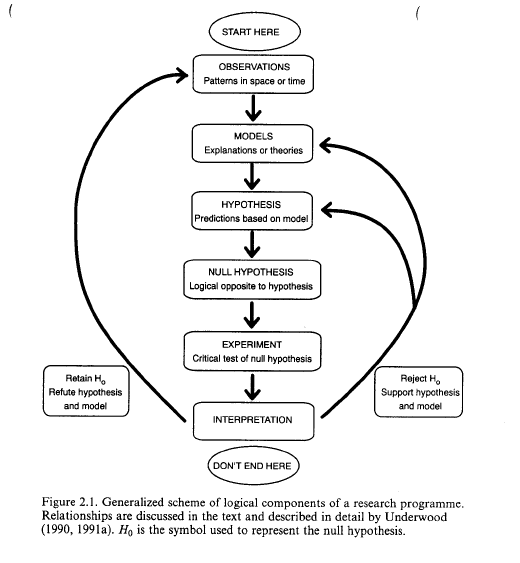
While doing a bit of class reading (can you tell midterms are around the corner?) from the book Experiments in Ecology by AJ Underwood (1997) I came across this little gem of a quote. Underwood stresses that the acceptance or a rejection of a hypothesis at the end of an experiment is hardly the end (as he subtly suggests in his figure: DON’T END HERE). More work remains to either create a new hypothesis or develop tests to refine the existing one. He concludes, “Thus, in Figure 2.1 there is no way out of the procedure once you have started it, until you die or change research fields.”
Click to see larger image: that endless hypothesis loop
That’s right. Until you die. Or change research fields… For some, the never ending flow of questions is the beauty of the system, or exactly the point. As Underwood continues, “This is comforting in terms of eventual longevity of employment” (assuming, of course, one can obtain funding to continue the process, but that’s another matter…).
For others, this smacks strongly of commitment, and has them edging towards the door. Grad school is the ultimate test-drive of a scientist’s life. Can you you see yourself pursuing this continuous loop and loving it? Do you have that insatiable curiosity to understand how the world works, to keep asking questions, to think of possible answers and find creative ways to test them? (and test them and test them and test them?) If so, congratulations, and welcome to the world of research!
And if not? Don’t fret – the life of a scientist these days is often more than just pure research, and research is just one of many avenues to pursue on the back of a science degree. Let me draw your attention to our great and growing collection of alumni career interviews, where actual factual graduates of Moss Landing Marine Labs graciously share where their science careers have lead. Explore, get ideas, and discover what people actually do with degrees in marine science!
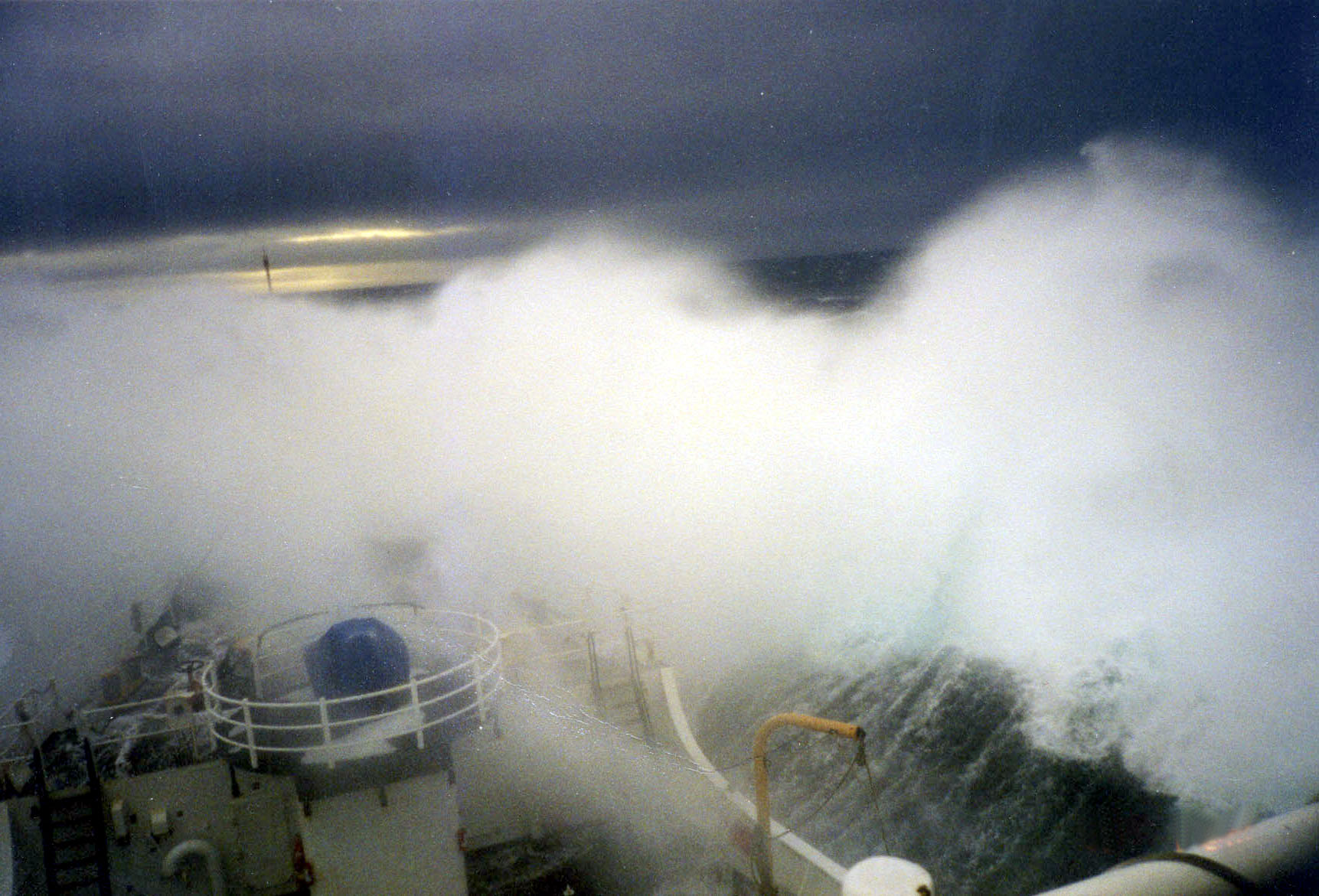
June 7, 2008: A short entry, because I’m seasick!The weather has definitely taken a turn for the worse!So much for the calm Bering Sea in summertime.We have a gale going, with winds to just over 40 knots, and seas of 15-20 feet.I went up on the bridge this morning to look and see the stormy weather.I was excited to experience this, because it’s definitely part of what makes this ocean what it is.I could barely keep my feet as the boat lurched from side to side.The spray from the waves was lashing across the windows, blown by the wind.That’s like 40 feet off the water!OOooppf.I couldn’t stay very long.I didn’t even take a picture, unfortunately.But, the US Coast Guard is nice enough to provide some stock footage on their website that I’ll borrow here to demonstrate what I saw:
Bering Sea storm (photo: J. Minchew, USCG)
Lucky for me, our scientific instructions (protocols) tell us not to survey in this weather because it’s too difficult to see birds anyway.I mean, c’mon – How many birds can you see in this photo?!
June 5, 2008: I am finally out counting seabirds!Fulmars flap, storm petrels flit, and murres paddle along the still ocean waters.Perhaps the Bering Sea is finally settling down for some summer sleep.At times the surface is so smooth I can see the silhouette of my own shape, dancing in reflection on its silky surface.The days are long, though the light is dimmed by the heavy, intermittent fog and constant overcast.It is difficult to judge distances in this lighting.Our world spans a continuum between black and white, but we see little color.Everything is some shade of gray; the sky, the horizon, the water.From our perch, 40 feet high up on the bridge of the boat, the whole experience is quite surreal.Sometimes the view seems unchanging, and it is difficult to tell if we’re even moving at all!
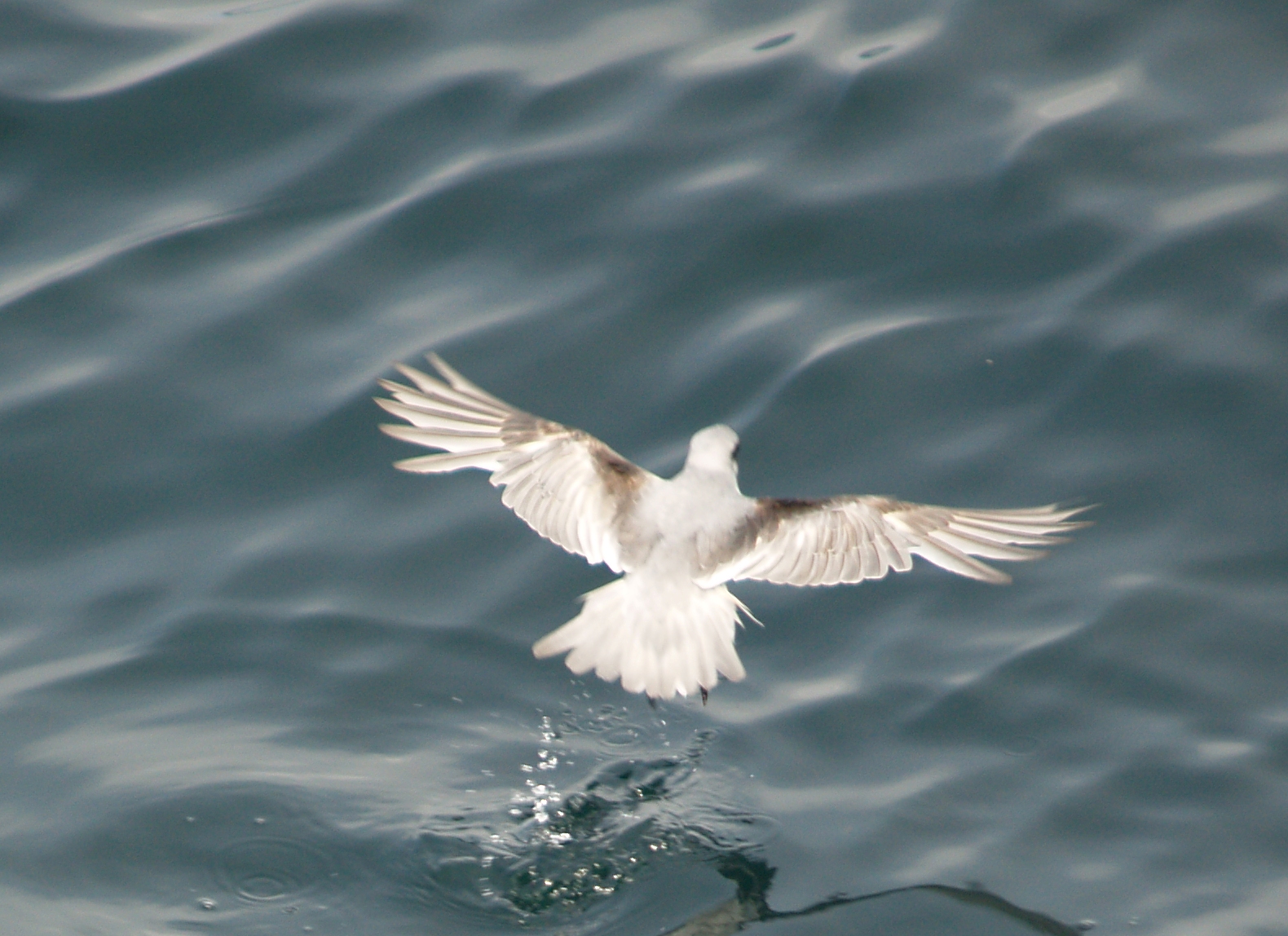
Forked-taiil Storm Petrel (photo: B. Parkinson)
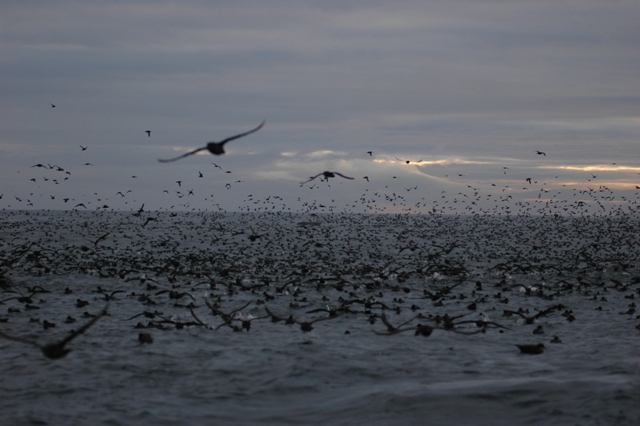
Luckily, there are birds to punctuate this monotonous tranquility!So far we’ve seen fulmars, kittiwakes, puffins, murres, storm petrels, and shearwaters.Fulmars and shearwaters are closely related, considered to be in the same taxonomic family.These birds travel great distances at sea – thousands of miles – to follow the seasons and stay near productive ocean hotspots.They race past me on strong steady wings, arcing and diving if it’s windy, brushing within inches of the wavelets and then climbing abruptly above the ship.When it’s calm they speed along with stiff, powerful wingbeats.
Shearwaters (photo: NOAA / NMML)
We see tremendous color variation in fulmars.Some are almost white, others a near uniform dark brown, and many more are some mix in between, splotched and peppered with contrasting feathers. Read more →
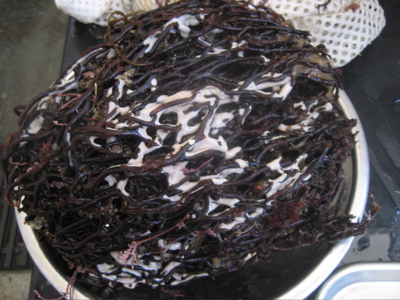
I got to play evil landlord the other day and evicted a bunch of little critters from their home (proving that even marine invertebrates are not immune to housing woes…). I was on the hunt for some specimens that might be prey items for the gopher rockfish, which I’m studying for my thesis. Someone suggested I seek out the creepy crawly snacks where they live – holed up in a kelp holdfast.
A whole mess of tenants was living inside!
A holdfast keeps a towering kelp plant anchored firmly to the sea floor. It may look like a giant root ball, but its many fingers don’t suck up nutrients and water like true roots do in land plants. They do, apparently, make a great high-density high rise for little crabs, brittle stars, and more.
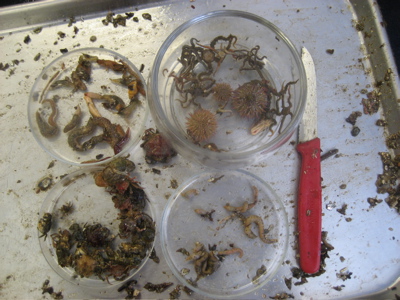
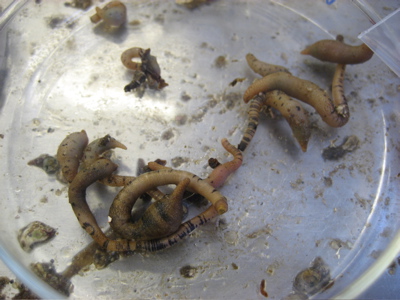
While hacking open the basketball-sized mass of slippery tubes, I expected to find maybe a dozen animals or so – but I tallied up some 85 residents! Crabs, brittle stars, polychaetes (worms), urchins, shrimp, you name it. I was so jazzed to dig up a handful of these little peanut worms (also called sipunculids). They have a long proboscis that they can actually turn inside out and tuck up inside themselves! And aren’t they just so fat and cute?
Peanut worms in a jam
What do you think makes a holdfast such a great home? Post a comment and let us know what you think!
That fall equinox may have passed, but here at Moss Landing, we’re getting ready to party like summer never ends! Mark your calendars for MLML’s 10th Endless Summer Celebration, the major fundraiser for the Friends of MLML, and the labs as a whole.
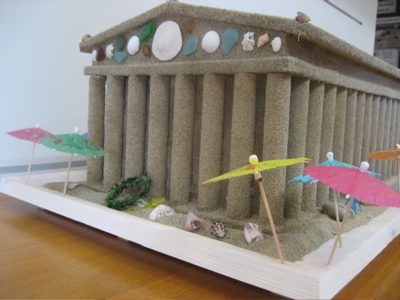
Join us for a night at the Acropolis - beachside!
Saturday, October 4th @ 5:30 PM
the Hilllside of MLML
This year we will even be celebrating Athens style because let’s face it, the – Greeks knew how to throw a party. So don your finery and join us for delicious food, live music, and live and silent auctions. The wine will flow, and yes, there may even be grad students in togas to wait on you hand and foot. Let the revelry begin!
Call (831) 771-4100 to RSVP. Tickets $60 for Friends Members, $70 for non-members
I recently witnessed some true beachside heroism while running (ok, ok, jogging) on my local sandy stretch. An older couple was out for their morning walk along the beach – and between them they were steadily filling two big bags, one for trash, the other for recycling. Had my heart not already been pounding from long-overdue exertion, the sight surely would have warmed it to the core.
Give your local beach some love on Sept. 20th, Coastal Cleanup Day!
You too can be a beach hero this Saturday, September 20th. It’s International Coastal Cleanup Day! Check out the Ocean Conservancy to find out more and also register for a cleanup near you. For those of us that study the ocean (or just love it), it’s a great way to say thank you to our coastlines and waterways, to keep them healthy and beautiful. Trash is an unbelievably big problem in the ocean (think the size of Texas big) and its critters (like the Laysan albatross). But you can help – check out this video about what the Coastal Cleanup Day is all about!
Obviously, you don’t need to wait for a special day to clean up your beach. I find it hard to jog pass by an empty Doritos bag or beer can on the sand without picking it up (yeah, I’m one of “those” people, but gosh darn it, I’m proud too!). While stooping for trash does turn a leisurely run into “red light green light,” it’s amazing how good it feels, in that Captain Planet sort of way.
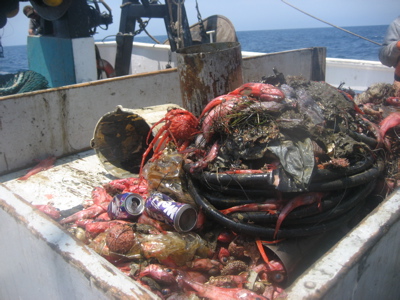
Deep sea trash from near San Diego. Just part of the bigger mess.
When I saw that tidy couple, I made my way over with a discarded plastic bottle in hand, and thanked them for their efforts. They bagged my bottle and said they were just tired of seeing others trash their favorite spot – so they decided to do something about it. Simple. I guess I could have asked for their names, but perhaps like all superheros they prefer to walk among us, unknown…. Read more →
You may not believe me when I say this, but not all marine science takes place underwater. That’s right… you don’t even have to get wet to study the seafloor! No, I haven’t been sucking the helium from my SpongeBob balloon, and I’m not off my rocker – I just got back from my first Geological Oceanography field trip.
Keep in mind that as an invertebrate biologist I’m hardly qualified to discuss geology on an intellectual level, but that’s never stopped me before! Please keep your arms and legs inside the blog at all times, because this could get rocky…
As sea levels have risen and subsided over the past 4.5 billion years of our planet’s existence, beachfront properties have changed their locations and altitudes dramatically. The earth’s crust has actually been swallowed up and spit back out through the mechanisms of plate tectonics and volcanic activity. So it just stands to reason that what was once found at the bottom of the ocean can now be found on the tops of mountains and vice versa. Oceanic sediments and fossils of ancient marine life even appear on top of the Alps!
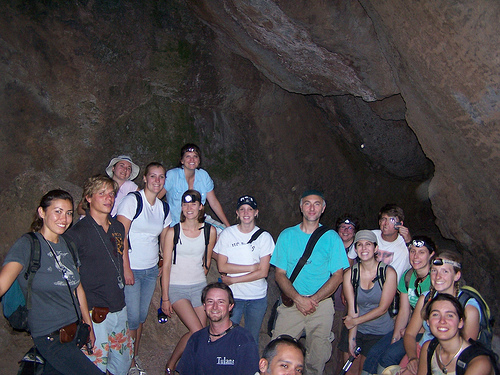
Dr. Ivano Aiello surrounded by his adoring Geological Oceanography students in a cave at Pinnacles National Monument
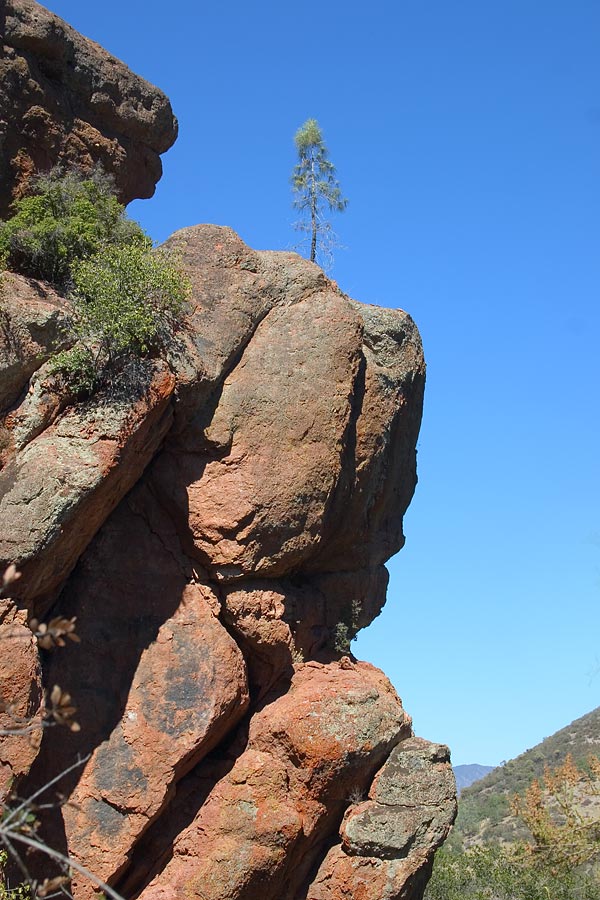
Fast forward to current geologic times (namely, last Friday), when the Geological Oceanography class here at MLML took a fun day-trip out to Pinnacles National Monument. We learned from our esteemed professor, Dr. Ivano Aiello of the Geological Oceanography department, that the rock pinnacles jutting out of the ground were once the sides of an ancient volcano. Most of the rock outcroppings we walked over and under that day had once been subducted along with seawater into the mantle of the earth before being spewed out by an explosive volcanic eruption.
Remnants of an ancient volcano at Pinnacles National Monument (Photo by Iryna Novosyolova; NPS)
In fact, right where we were standing marked the birthplace of modern plate tectonic theory (where scientists realized the plates of the earth must be shifting and moving). It turns out that some brilliant geologist noticed that the pinnacles at this location exactly matched an outcropping near Los Angeles. Part of the same volcano in two different places! Did these rocks hitch a ride to vacation in the Monterey Bay area? No, it appears that the volcano was sitting right on top of a transform fault, and part of it has been slowly migrating north for the past 23 million years until it wound up here. And it won’t be sticking around, it seems. According to the USGS, the west side of the fault zone creeps north at a rate of several centimeters per year!
Don’t touch that dial! Stay tuned for more geology field trip ramblings as the class camps out in beautiful Point Reyes and takes a cruise to collect sediment cores in the Monterey Canyon…
by Amanda Kahn, Invertebrate Zoology and Molecular Ecology Lab
I’d like to introduce you to my favorite organism! I’m studying these critters for my thesis project, and I think they are one of the weirdest critters in the ocean. Let me explain why they’re so cool, first of all:
This organism lives in all places where there is water: bays, harbors, freshwater lakes, coastal environments, and the deep ocean. It eats microscopic particles out of the water, yet can grow so large, a person could fit inside of it! To find its microscopic food, it sifts through microscopic particles one by one, to find the edible bits with up to 95% efficiency! As if that’s not cool enough, this organism is the star of a popular cartoon, is present in many people’s homes, and has a delicious dessert named after it. Wow! Can you figure out what I’m talking about? Read more →