
Vote for your favorite holiday marine creature!

The authors of The Drop-In are locked in the vice-grip of final tests, projects, papers, you name it, along with the rest of the MLML community.  But the holiday break is approaching as quickly as our wandering attention spans.  For a welcome distraction and a bit of good cheer, we invite you to vote for the best holiday-themed marine creature!

[polldaddy poll=1191250]

Of course, you want to be an informed voter, so meet the contenders:

1. Christmas tree worm (Spirobranchus giganteus)
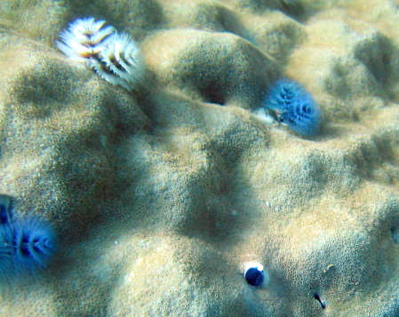
E. Loury)
Christmas tree worms (photo: E. Loury)

The name says it all, really.  This colorful polychaete (worm) spends its life bored into a coral, and extends its twin spiral plumes to filter-feed on passing plankton .  Like Old Navy sweaters, they come in a variety of colors, from orange and yellow to blue and white.  But if you pass a shadow over them, they may retract faster than your camera’s shutter (like the lower right of the photo)!

2. Firefly squid (Watasenia scintillans)
Firefly Squid
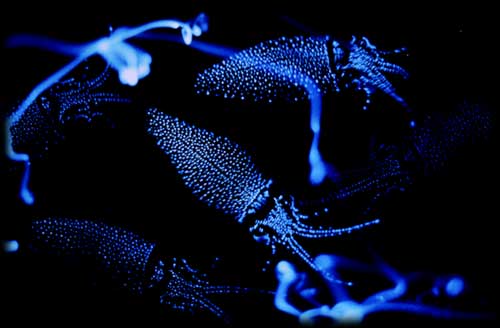
Firefly Squid (photo: gocarter.com)

Also called the the Sparkling Enope Squid, this three-inch marvel lives in the Western Pacific and packs a bioluminescent punch that rivals the light decorations of your most zealous neighbors. Their spectacular seasonal display is a tourist attraction and a natural monument in Japan!

3. Comb Jellies (Phylum Ctenophora)

[youtube=http://www.youtube.com/watch?v=G7WT81ukHZE]

Ok, the other contestants may cry foul for nominating an entire phylum, but there are  too many cool comb jellies out there to choose just one.  And a photo doesn’t do them justice either, because they are the equivalent of those “running” Christmas lights.  Watch this video from the Vancouver Aquarium (if you can handle the cheesy sci-fi music…) to see the twinkly action!  Comb jellies are also called ctenophores, and unlike true jellies (Phylum Cnidaria), they don’t have stinging cells, just lots of little hairs that defract light in really cool ways!

4. Bamboo coral (Isidella sp.)
live_bamboo_600
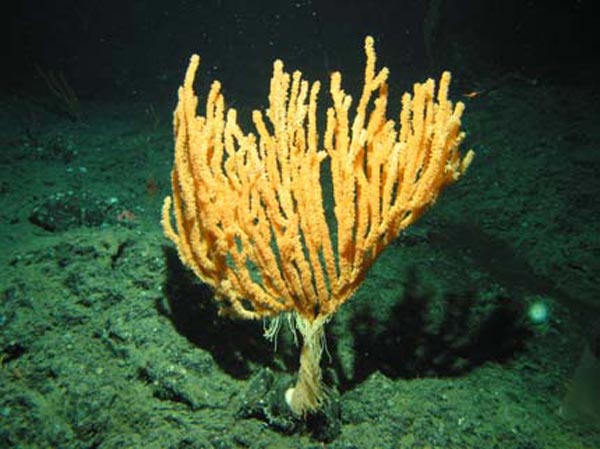
A bamboo coral (photo: NOAA)

Bamboo corals may have more than 8 branches, but their candelabra shape made them a prime candidate to represent Hanukkah. (They also belong to the octocorals, because each of their little polyps has 8 tentacles!)  This particularly beautiful representative was discovered by a team including Peter Etnoyer of the Deep Sea news!  They found the deep-sea coral living on seamounts 700-2700 m deep in the Gulf of Alaska.  Learn menorah about this cool new species at the Deep Sea News, including a video of its discovery!

5. Ornamented wrasse (Halichoeres ornatissiumus)
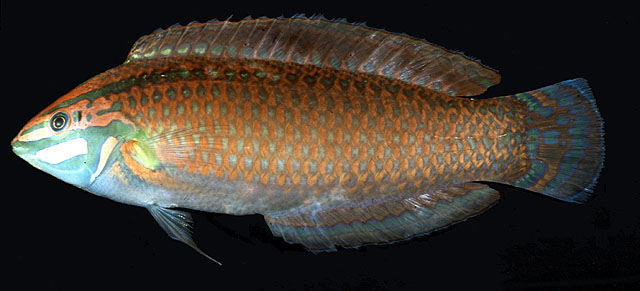
JE Randall, fishbase.org)
Ornamented Wrasse (photo: JE Randall, fishbase.org)

It’s red, it’s green, it looks like it should be dangling from your tree, it’s sometimes called the Christmas wrasse, and it’s even found at the Christmas Islands.  This little tropical darling clearly has a lot going for it, besides being the only vertebrate of the bunch!

Cast your vote today using our poll!  Did we grossly omit any tinsel-worthy candidates?  Post a comment to share your write-in vote!
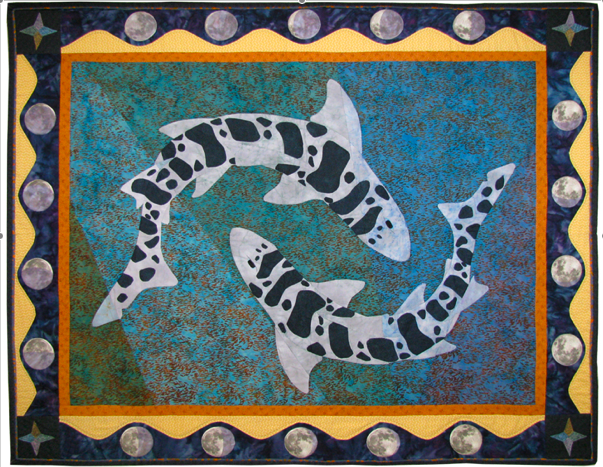
Buy a ticket, win a shark quilt! (and support grad students!)

Feeling cold?  Feel like giving?  Feeling lucky?

Lunar Influence, by the Moss Landing Marine Labs Quilt Guild

If you answered yes to any or all of the above, then hurry and buy your tickets for the MLML Quilt Guild opportunity drawing!

Tickets are currently on sale for the chance to win “Lunar Influence,” a 44″ X 55″ art quilt that makes a beautiful wall hanging or lap throw!  The stunning design features leopard sharks, sand dunes, and phases of the moon, inspired by an illustration by Jane Schuytema.

Tickets are only $2 each or 3 for $5.  All proceeds will go to the Friends of MLML Scholarship fund, and a one-time scholarship in memory of Signe Lundstrum.   An opportunity drawing will take place on Friday, December 19th to determine the lucky winner! You do not have to be present to win. Postcards of the design are also available for $1.

Call (831) 771-4400 to buy your tickets by December 19th!

Signe Lundstrum
Signe Lundstrum

Signe Lundstrum was a much-loved member of the Moss Landing Marine Labs community who worked as an SEM and histology technician from 1972 to 1989.  She battled cancer from August 2000, and lost in 2005.  Signe found that the lab produced a special desire to give back more than one receives,  a practice continued by the graduate student scholarship created in her memory.

Can I become a marine scientist even if I get seasick?

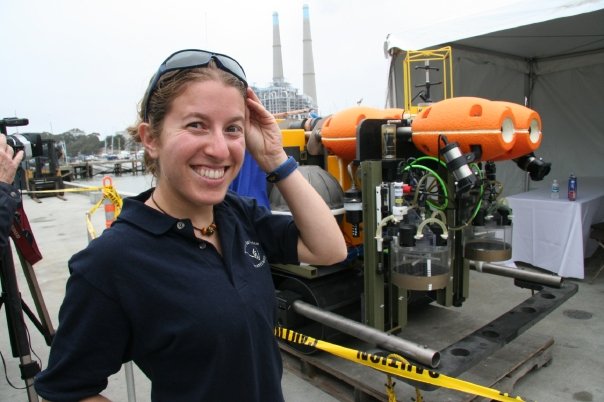
Amanda Kahn
Amanda Kahn

by Amanda Kahn, Invertebrate Zoology and Molecular Ecology Lab

I went out to sea yesterday and it was INCREDIBLE!  We saw animals we’d never seen before, explored an underwater canyon that is deeper than the Grand Canyon, and spent a beautiful day out on calm seas aboard the R/V Point Lobos.  As I was miles away from solid ground, I pondered the irony of my choice of career – you see, I get seasick.  Horribly seasick.  I was the only person running out to the side of the boat every half hour to, uh, fertilize the ocean.  I’ve tried taking Dramamine, eating saltine crackers and drinking ginger ale, pressure point bands, even wearing a paper bag against my stomach (which kind of works, actually…), but nothing fully gets rid of that queasy feeling.  So how can I tolerate going out and being sick all day?  Basically, I am really excited about learning about things that live under the ocean.  So interested, in fact, that I don’t mind the seasickness so much!  I wanted to write about this because people who get seasick should know that it is still possible to have a successful, happy career in marine science.

First of all, some tips to help eliminate or reduce seasickness:

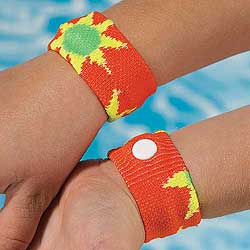
Pressure point bands can help alleviate seasickness in some people.
  • Medications such as Dramamine, Bonine, and Marezine are helpful.  They are most effective if you take one pill the night before going out on a boat, then another about one hour before the boat is underway.
  • Pressure point bands work for some people.  These look like bracelets with a little knob that presses on a pressure point on the inside of your wrist.  If you start feeling sick, you can press the knobs into the pressure point.
  • Ginger, whether in the form of fresh, dried, candied, or ginger ale, helps ease upset stomachs (although I personally think candied ginger tastes terrible!).
  • Carbonated beverages (especially ginger ale) are also helpful for upset stomachs.
  • Surprisingly, keeping some food in your stomach can be really helpful.  I don’t start feeling really sick until my stomach is completely empty.
  • Scopalamine is a prescription drug that you can ask for.  It comes in a little patch that you wear behind your ear.  It releases medication into your body slowly over time.  Some people get a little loopy on this, but it is supposed to be one of the best medications.
  • A brown paper bag (huh?).  A friend of mine just told me about this one, and basically, you just put a paper bag under your clothes, in contact with your stomach.

These solutions would not all be necessary if so many people didn’t end up with the same problem that I have.  Seasickness is common!  Everyone figures out the best way to deal with it (for example, my favorite is to take Bonine, wear pressure point bands, drink ginger ale, and keep some food in my stomach).  The other scientist on yesterday’s cruise wore a Scopalamine patch.  If you tend to get seasick, you’re not alone!  And you can still pursue marine science.  In my next post, I’ll tell you about some of the amazing things we saw on our cruise, and you’ll see why seasickness is minor compared to the amazing coolness that is marine science and oceanography.  *Sigh*

[youtube=http://www.youtube.com/watch?v=Gjzkf1xiQ-8]

You can already check out some of the cool things people do at sea with this video! Also, share your favorite seasickness remedies by leaving a comment!

Gloomy forecast for Atlantic cod, MLML alum writes

Cassandra Brooks
Cassandra Brooks

Since graduating from MLML last spring, former ichthyology student Cassandra Brooks has gone on to explore science through the written word at the UC Santa Cruz Science Communication Program.  In addition to writing many feature stories for the Santa Cruz Sentinel, Cassandra recently had her work published in ScienceNOW, the online compliment of the esteemed Science magazine.

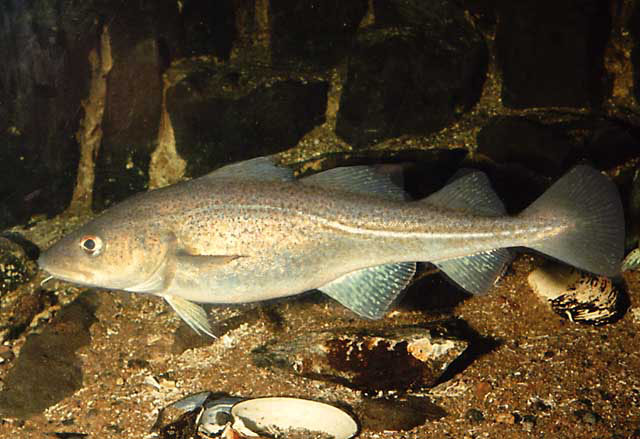
While this is great news for Cassandra, the story itself is a grim prognosis for her subject, the Atlantic cod (Gadus morhua).

Cassandra writes:

“Atlantic cod is a symbol of boom-and-bust commercial fishing. After 50 years of heavy harvesting in the late 20th century, the Canadian cod fishery collapsed in the early 1990s. Total bans ensued, and fisheries managers expected to see a recovery. However, after 15 years of little to no fishing, local populations show no sign of rebounding. In fact, some will continue to spiral downward, according to projections reported in this month’s issue of the Canadian Journal of Fisheries and Aquatic Sciences.” Read the rest of her story here.

Another testament to the challneges (and the importance) of fisheries science needed to inform management…

Atlantic cod, the "waiting for the comeback" kids (photo by K. Nilsson, fishbase.org)

Eight-Legged Bundles of Joy

From the octopus baby album. (photo by Shaara Ainsley)
One for the octopus baby album. (photo by Shaara Ainsley)

by Erin Loury, Ichthyology Lab

It’s a girl!  It’s a boy!  It’s 200 of each!

The MLML aquarium room was asqueal with coos and baby talk last week – and that was just from the fawning grad students.  The brooding efforts of a resident female octopus had paid off, and dozens of little eggs had become  dozens of oh-so-squishable baby octopuses.  Shaara Ainsley snapped this shot of the photogenic little tykes when they were a few days old.

Sadly, the babies didn’t survive too much longer after their photo-op, despite valiant efforts by student Erin Jensen to get them to eat.  It’s a marvel to think how something so seemingly vulnerable, drifting around in the plankton, stands a chance of ever becoming an adult in the ocean.

Here’s a rather low-quality video (sorry!) of the babies doing their bouncy thing (and Mom having none of it):

[youtube=http://www.youtube.com/watch?v=_LmXdGRzrqM]

Now even if you don’t want to admit it, I know you’re dying to ask – where do baby octopuses come from?  Well, you see, when two octopuses really… actually it’s probably better that you learn more about octopus dating and mating by checking out this awesome UC Berkeley research, which includes work by Christine Huffard, now a post-doc at our neighbor, MBARI.

And if that puts you in the mood for more off-the-wall octo shenanigans, check out this crazy video of an octopus taking down a shark at The Other 95%, and the sideshow-worthy, 96-armed octopus at The Pink Tentacle!

Beating chilly weather with a chili cook-off

by Erin Loury, Ichthyology Lab

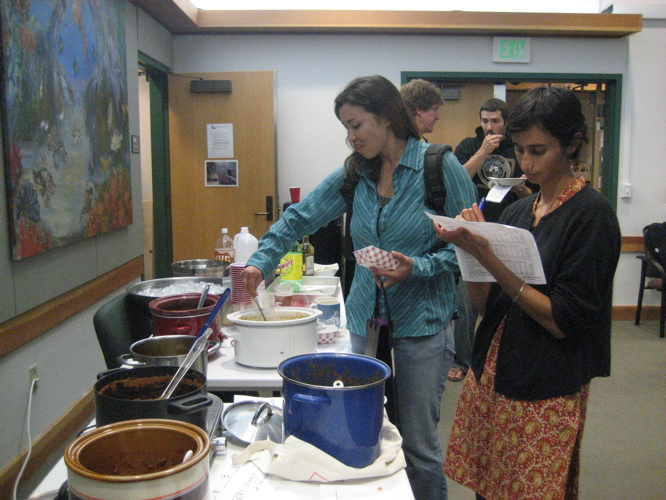
Nothing brings grad students together quite like the promise of free food and friendly competition.  The MLML community turned out in fine form on Friday for the first ever MLML Chili Cook-off, the brain-child of Ichthyology student Shaara Ainsley.    Hungry students, faculty, and staff alike poured out of the woodwork in a celebration of sampling that had nothing to do with statistics or experimental design.

Jahnava Drueya spoons out a sample while Sonya ticks off her ballot
Jahnava Duryea spoons out a sample while Sonya Sankaran ticks off her ballot
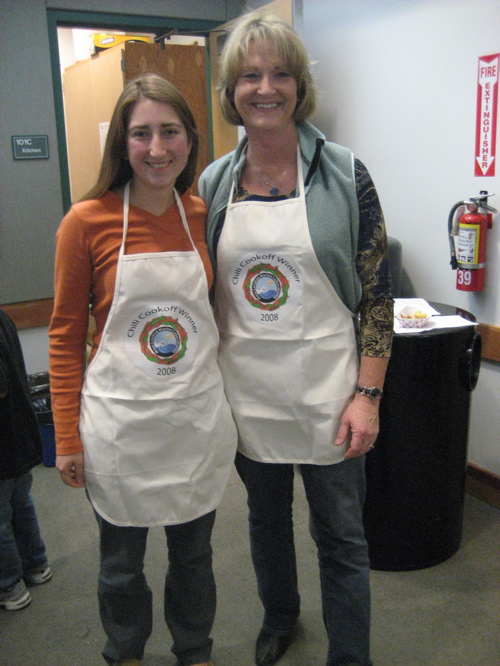
Rosemary Romero, best vegetarian chili, and Dr. Shannon Bros-Seemann, best meat chili, model their prizes!

Nearly a dozen contestants entered their hearty concoctions, ranging from super-meaty to vegan.  The crowd of appreciative “judges” ranked the chilies based on the judging criteria of the Chili Appreciation Society International: aroma, red color, consistency, taste, and aftertaste.  Once the ballots were cast and tallied, it appeared that the color-blind community eschewed tradition to embrace an outsider: a delicious white chili submitted by Dr. Shannon Bros-Seemann emerged victorious, despite the fact that it didn’t look like the other chilis in the cookbooks, and its unconvential composition, which included chicken.

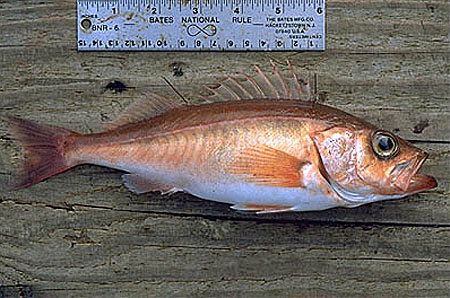
Chilipepper rockfish (Sebastes goodei), from Fishbase.org
Chilipepper rockfish, photo by Milton Love (fishbase.org)

The only thing that could have made the evening even better (and marine) would have been a cameo by the chilipepper rockfish, Sebastes goodei.  Well, I guess there’s always next year…

Get the skinny on SCINI, the under-ice robot

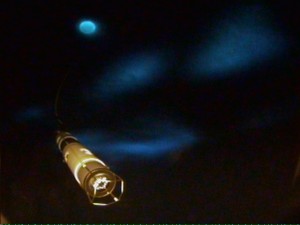
scini-image
An image of the ROV SCINI as it dives under the ice
Kyle Reynolds
Kyle Reynolds

by Kyle Reynolds, Benthic Ecology Lab

Under the ice of Antarctica, there is a virtually untapped, pristine world just waiting to be explored. For the past several years, Dr. Stacy Kim has made it her goal to explore this world by diving under the ice to document the benthic communities and their changes through time. Her biggest limitation in this research endeavor (up until last year) has been the depth she is restricted to as a human diver. Since divers are limited to depths of about 100ft or less, there is a vast territory that remains inaccessible. Not to mention the hardships involved with drilling holes in the ice for divers, and keeping them from refreezing for any amount of time.

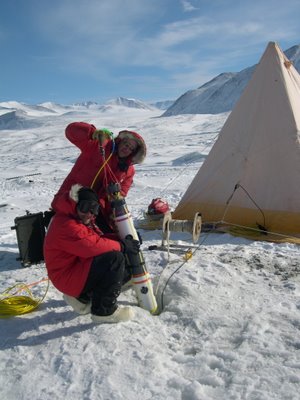
Bob Zook and Stacy Kim lower SCINI into a hole in the ice
Lowering SCINI under the ice for a dive mission

When Stacy’s husband Bob Zook, a self-proclaimed “Gizmologist”, set his mind to helping Stacy overcome the limitations of her research, SCINI was born. SCINI is the name of the diving robot Bob, Stacy, and a small team of hand-picked engineers designed themselves (from scratch!). The name stands for ‘Submersible Capable of under-Ice Navigation and Imaging’. (Click here to read more about SCINI and see daily logs from the team in Antarctica)

Now in their second year with SCINI, they are reaching new heights (or should I say, depths). Just this Monday they shattered their previous depth record and were able to get SCINI all the way to the seafloor 206 meters (680 ft) below, where they viewed communities of sponges and seastars no one has ever laid eyes on before! Needless to say, this new technology promises to be invaluable for a myriad of uses, and its significance has not gone unnoticed. Just yesterday, our very own Dr. Stacy Kim was interviewed by the Today Show (click to watch) to speak about the impacts of global warming in Antarctica and about the merits of SCINI!


Bivalve questions make me happy as a clam!

Amanda Kahn
Amanda Kahn

by Amanda Kahn, Invertebrate Zoology and Molecular Ecology Lab

In our Ask a Grad Student page, Leeanna asked a bunch of really good questions, and all revolve around bivalves.  Now, maybe you think you don’t know bivalves well enough to have them over for dinner, but I expect that many of you actually have had them FOR dinner!  Bivalves include clams, mussels, oysters, scallops, and other generally clam-shaped animals with two shells.  Class Bivalvia is within Phylum Mollusca, and its closest neighbors on the evolutionary tree are Classes Monoplacophora (extinct, snail-like animals), Polyplacophora (chitons), Gastropoda (snails and slugs), Scaphopoda (tusk shells), and Cephalopoda (octopuses and squids).  Too much information?  Too much information.  Sorry.  On to the questions!

Q: How do bivalves pump out water?

A: On each side of the foot inside of the bivalve (let’s say, for example, a clam), there are two big hollows, called mantle cavities.  On one end of the bivalve’s shell, there is an inhalant and exhalant siphon, which the clam uses to pump water in and out of the mantle cavities.

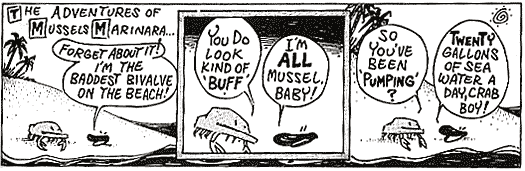
There's some heavy-duty pumping going on...water pumping, that is!
There is some heavy-duty pumping going on...water pumping, that is! From Mutts comic strip by Patrick McDonnell

Q: How do bivalves eat their food?
Read more

How to Feed Sharks – and Get Paid!

Juan Manuel (Manny) Ezcurra has a job many would give their right pectoral fin for – he works with elasmobranchs (read: sharks!) at the Monterey Bay Aquarium!

How did his master’s at Moss Landing Marine Labs prepare him for this splashy job?  Read his interview on our Alumni Career Interviews page to find out!

Manny acknowledges that the getting a job at an aquarium can be tough (lots of competition for few resources) – but it helps if you can find a specialized niche.  For Manny, that niche is diet.  He helps decide what type of food, and how much of it, to feed the sharks on display – which is important to keep them from eating their tank-mates!

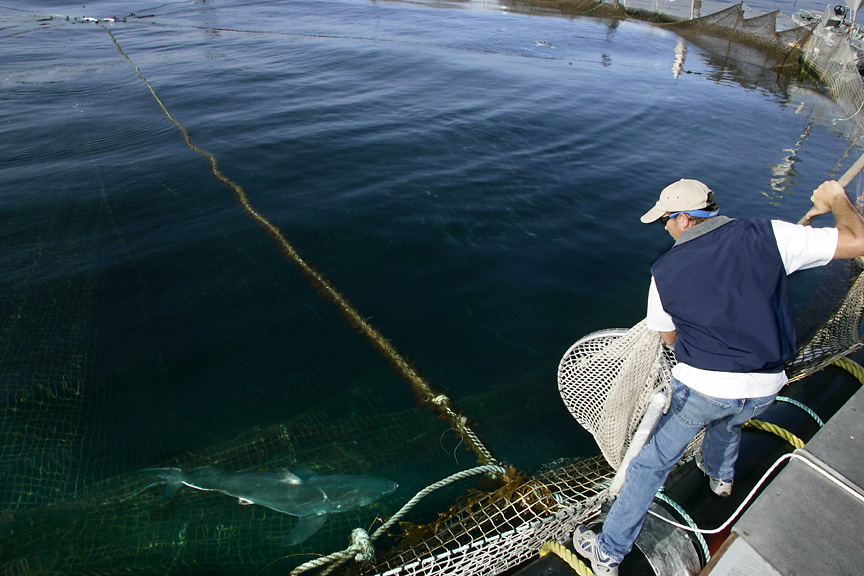
Manny helps capture a young white shark in a holding pen in southern California to transport it to the Monterey Bay Aquarium.

Manny shares:  “At times you need to take opportunities that aren’t quite what you had in mind: the first job I had at the Monterey Bay Aquarium was dressing up as marine creatures for the outreach education programs.  But I was able to get a commercial license to drive to the schools in our Aquarivan, and the driving lessons still help me today while I’m driving on the freeways with a tank of water weighing over 3,000 lbs. in the back of our trucks after a collection trip.”  Read more of his interveiw by clicking here!