Come hear them describe the historical ecology of the the Central Coast, the State Wetland Monitoring Project, wetland restoration and planning, and the California Rapid Assessment Method for Wetlands (affectionately known as CRAM). Rather appropriate, with finals just around the corner…
Advancing the coordination of wetland science and management on the Central Coast
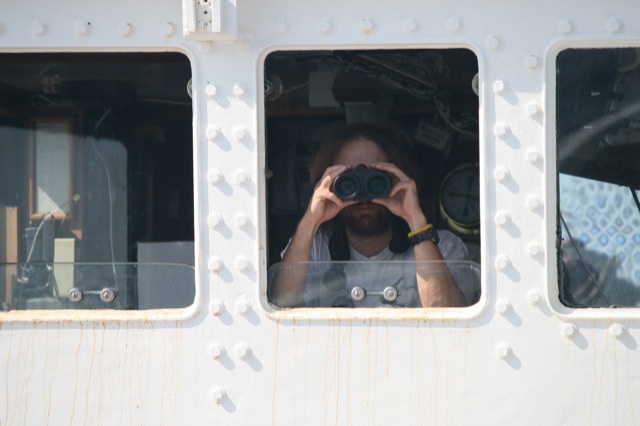
(photo by L. Whitman, submitted by and B. Hoover and N. Jones)
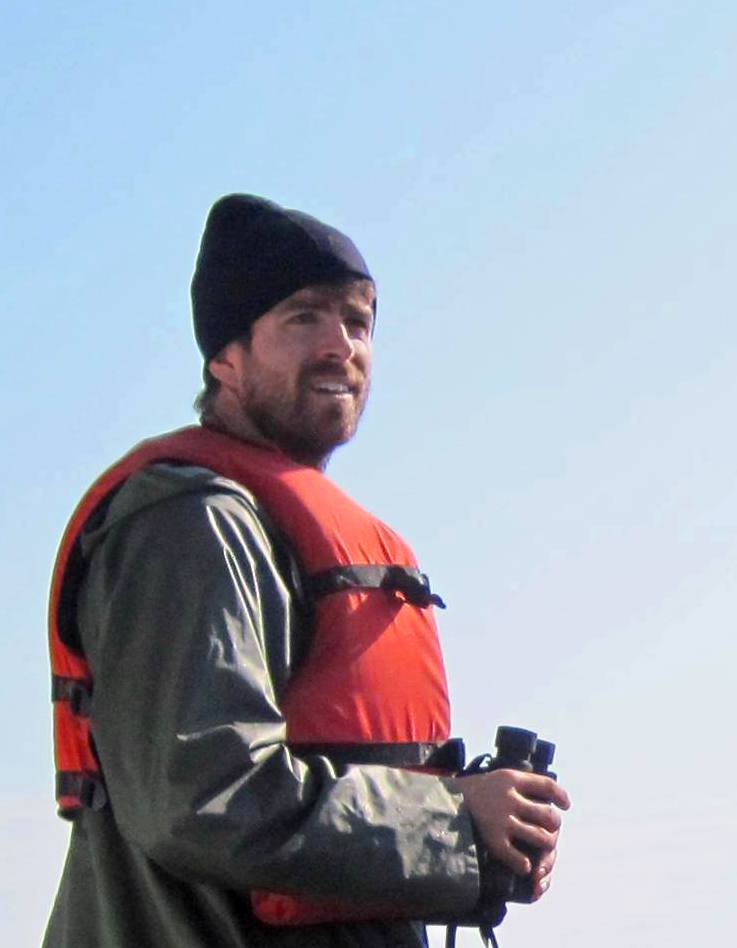
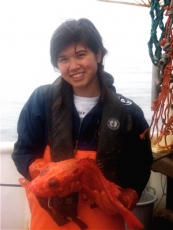
Counting birds is harder than its sounds when your place of observation is the ocean, not a bird feeder. This week’s photo features Brian Hoover of the Vertebrate Ecology Lab up in Alaska looking for a clue – to what drives seabird distribution, that is. Brian and Nate Jones, a Drop-In regular, spent several weeks on the Bering Sea this summer recording where and when they spotted seabirds, as well as gathering data on bird prey and oceanography patterns.
If you have a good caption for this illustrious researcher hard at work, submit it as a comment. We’ll post our favorite!
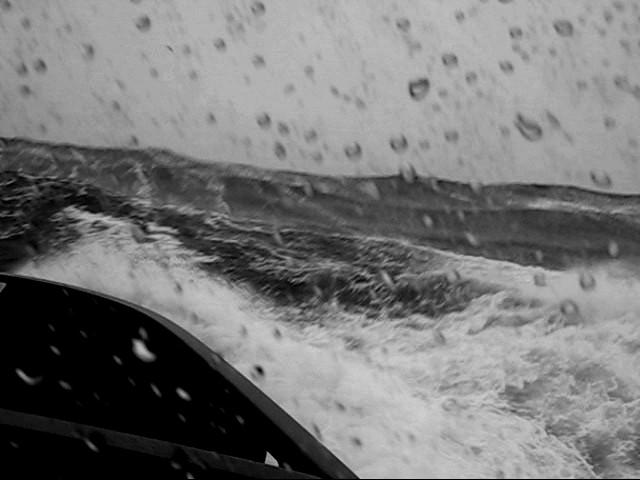
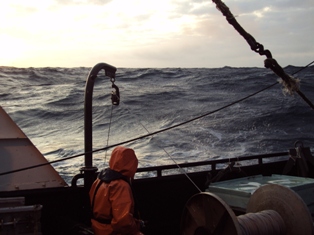
(still in the Bering Sea) … Of course the bad weather I’ve been writing about was nothing compared to what happens on the Bering during the months of February or March, and the Gold Rush fishes regularly during that time of year, so I had complete faith in the seaworthiness of the ship and the judgment and skill of the crew. I took comfort in that thought, and stumbled down to my bunk for what became a grueling 72 hours of bumps, rolls, and queasy stomachs. During this stormy time the crew exchanged watches at the helm, keeping the ship pointed into the fury.
Bumpy Bering Sea
We all hoped for the best, but by the time the seas had calmed to (a more manageable?) 8-10’, the hungry ocean had damaged and ripped off much of our scientific equipment, snapping several ¼” steel bolts and ripping welds clean apart!
The Gold Rush itself weathered this storm in fine shape (wish we could say the same of our scientific equipment!), and there were no major injuries to anyone on board. It really was quite a minor event in the context of the Bering Sea; just another blowy, bumpy day or two out on the water.
Another day at "the office" for a marine scientist
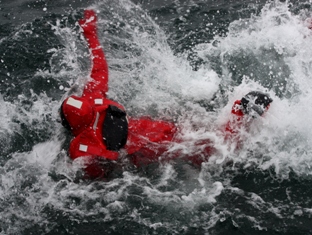
But, it impressed me and I couldn’t help contemplating darker scenarios – what happens when there is a true emergency? What if someone had been swept overboard, or, worse yet, what if the ship itself had been damaged or taken on water and started to go down? Such things do happen, although not as frequently now as they have in the past (coast guard regulations and improvements in technology and crew training have contributed to much increased safety).
In my next post I’ll put up some images from training exercises that are routinely undertaken to help prepare crew and passengers (scientists) for emergencies at sea…
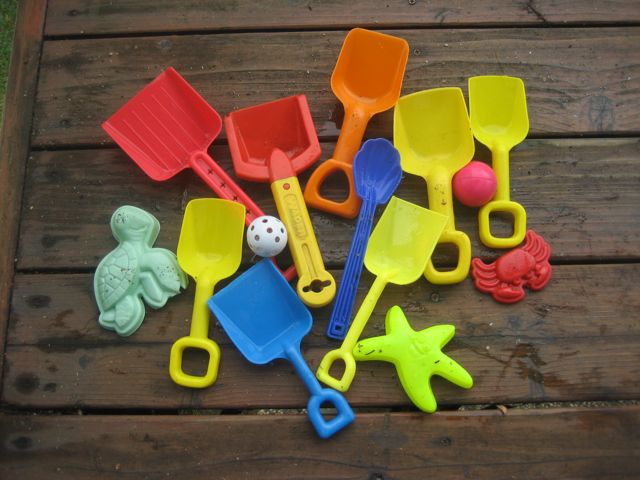
Do you remember that big storm that soaked the central coast in mid October? What I remember most is not how scary the driving was in that first big rain of the season, or the sound of the downpour on my roof – what stands out for me is the pile of shovels the storm left in its wake.
Yes, shovels. When the weather cleared, I paid a visit to my local beach to observe the fall-out. The sand was strewn with kelp, and fair amount of trash. But what floored me were the nine, count’em nine plastic shovels pictured above that I picked up in a half-mile stretch of beach. Not to mention passing a few other beach walkers with colorful shovels in their hands too!
So you’re thinking, what’s the big deal? A bunch of kids left their shovels on the beach. Consider this: even if those shovels were buried in the deepest of sand moats, a good storm can unearth them and sweep them out to sea. Add a few spin-and-tumble cycles in the surf zone, and suddenly a happy, harmless shovel is reduced to a plastic pile of marine debris.
And marine debris is a Big Deal, especially of the plastic variety:
You can be a beach hero by conducting your own Coastal Cleanup Day at your local beach after a storm. And remember to pack out those toys you pack in when visiting the beach with kids in tow. Just think of all the lonely pails out there.
Each week we’ll try to introduce you to some nifty resource for learning about science and the ocean, whether fundamental or just plain fun. At MLML, our multi-talented students are puppetry and singing pros. Apparently theatre arts and science are not as uncommon a pairing as you might think – enjoy the singing and puppetry exploits of students at UC Berkeley:
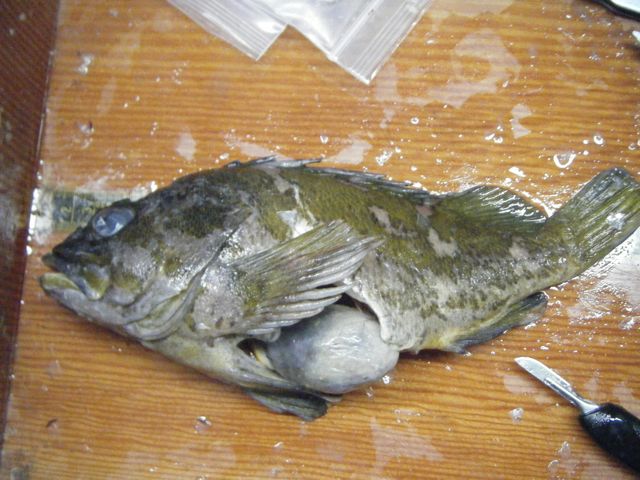
On this, the national day of overeating, I thought I would kick off our new featured photo segment with an example of a stuffed gullet from the animal world. For my thesis studying what gopher rockfish eat, I’ve cut open a lot of fish (somewhere in the ballpark of 700, and finally as of this week there are no more fish in my freezer! Woohoo!). Every now and again I’ll see something surprising or out of the ordinary – but none so much as this one.
To give you some perspective, most gopher rockfish stomachs that are empty or have a bit a food are the size of my thumb. The one pictured above was closer to the size of my fist. I’ll put it this way – their stomach lining is some kind of fantastic elastic. What floors me is that this little porker was caught with hook and line, meaning after all that eating, it still went for some bait. But I guess when that pie comes around at the end of tonight, I’ll probably be able to relate.
Just what kind of food does a gopher rockfish pack in at such staggering volumes? Stay tuned to find out!
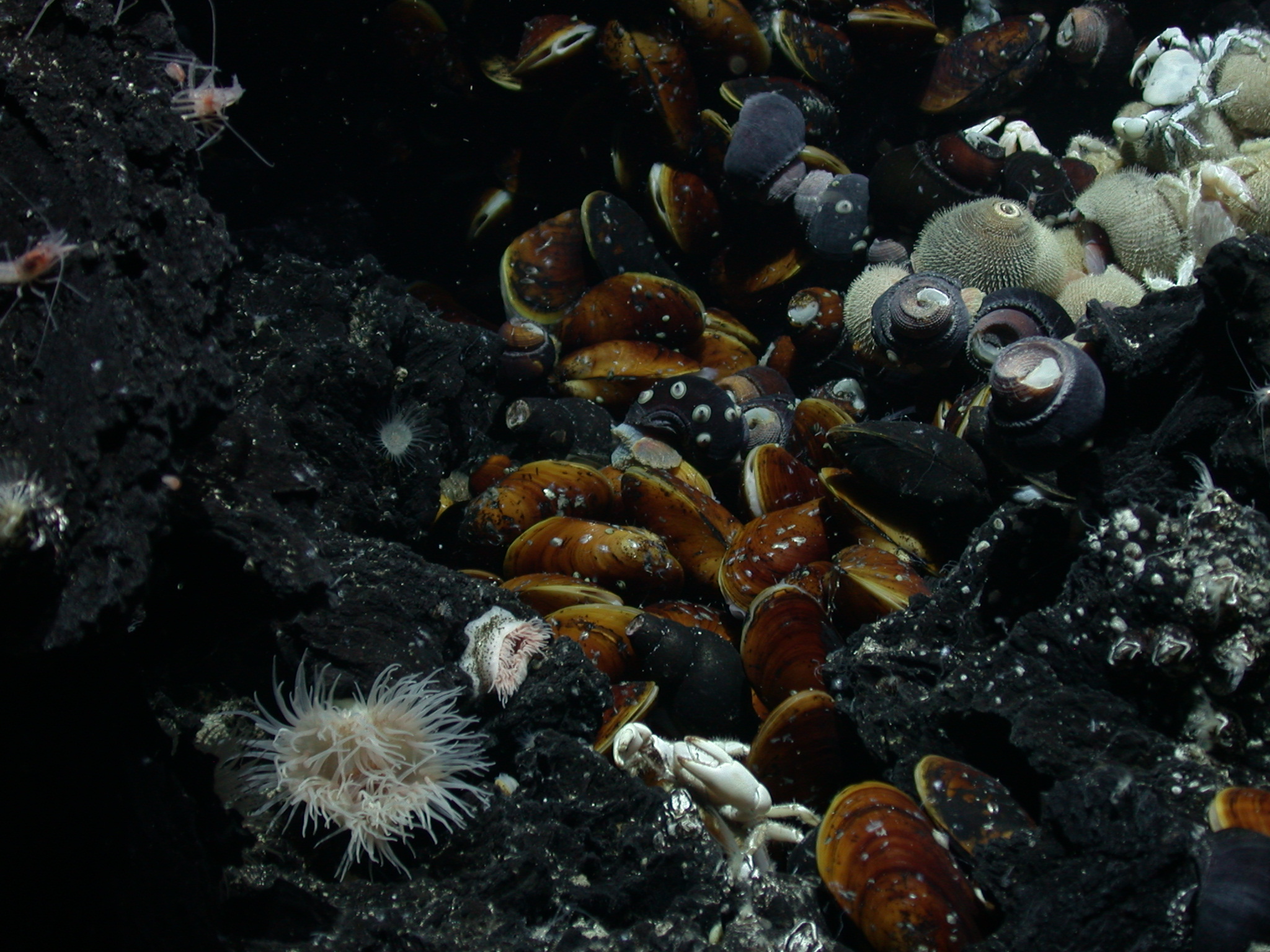
Snails living on and around hydrothermal chimneys in complete darkness provide excellent material for startling scientific discoveries (Photo taken by ROV Jason II, Dr. Charles Fisher, Chief Scientist) Kyle Reynolds
Can you imagine being pregnant in your foot? That’s just one of the fascinating things I discovered about the snail species I studied for my thesis. I studied animals at hydrothermal vents (seafloor volcanoes) and the adaptations they’ve made that help them cope with their harsh environments. Specifically, I looked at two species of snails that live about 1.5 miles deep in the southwestern Pacific at a hydrothermal vent system near Tonga and Fiji.
These snails get as big as softballs when full-grown and have evolved many ways to deal with life in a chemically toxic volcanic world. My thesis focused mainly on reproductive adaptations, and I was able to find many of those. Not only have they wrapped their larvae in protective coatings, they also house them for a short time in a pouch in their foot! Like I said – pregnant in your foot!
Hangin' at the vent: These black snails and a variety of neighbors make a living in a harsh environment (Photo taken by ROV Jason II, Dr. Charles Fisher, Chief Scientist)
This research was challenging on many levels. First, since I was studying something so far away from California and so deep in the ocean, I had only one chance to get the samples I needed and there was no guarantee they would be reproductively mature. With the expense of the research vessel, the submersible robot needed to collect samples at that depth, and the many crew members needed to run everything, these types of expeditions are much too costly to repeat. So I had one shot to get it right!
Also, I was studying animals that had very little previous research done on them (in fact, no one had ever studied their reproductive systems before) so I had very little guidance and often had no clue what I was doing! It took many visits with experts in many fields before I was able to piece the clues together and see the true picture of the bizarre mechanisms these animals were using to give their babies the best chance at survival.
For me, it was the challenge of this research that was most rewarding in the end. There is nothing like being the first person in the world to discover something! That’s what science is all about. More details to come on all of the crazy adaptations we found in these alien snails…
All you science educators out there, get your browsers ready! The National Institutes of Health have unleashed a learning tool so powerful, it actually speaks:
If a talking glossary could take over the world, maybe it wouldn’t be such a bad thing – at least we’d have one gene-savvy populace.
What sets this site apart from your workaday genetic glossaries is the use of audio snippets from medical and science-y people. And no, they don’t just reiterate the definition that you can read yourself like some kind of brain-numbing driver’s ed – they are actually pretty engaging! Hearing Dr. Francis Collins, the NIH director, discuss genetic discrimination makes me feel like I’m eavesdropping on a cocktail party of the white-coated elite (probably the closest I will ever get to doing so…).
Some of the words also come with an illustration or nifty 3D animation (type in “gene” to see an example). And if you click the button that says “Test your gene knowledge,” you can choose a quiz containing genetic terms you may hear in the classroom or in the news.
Best of all, in this ichthyologist’s humble opinion, is the link to the aquatic world. The one entry listed under “Z”? Zebrafish.
This site is the newest addition to our Teacher’s Corner page, prompting the creation of a “genetics” subheading. Check it out!
Long hours in a tiny, dark windowless room looking through a microscope – yes, this is very much a part of a marine biologist’s job description. Not really the fun and exciting part, but this type of data collection is very, very important. For my thesis and additional projects, I spent well over 100 hours (probably closer to 200!) in the microscope room. In order to estimate the age of a skate, you need to examine its vertebrae and count the number of bands. In order to get a ‘good’ estimate of the growth of a fish over time, you must examine many vertebrae from fish at all different sizes.
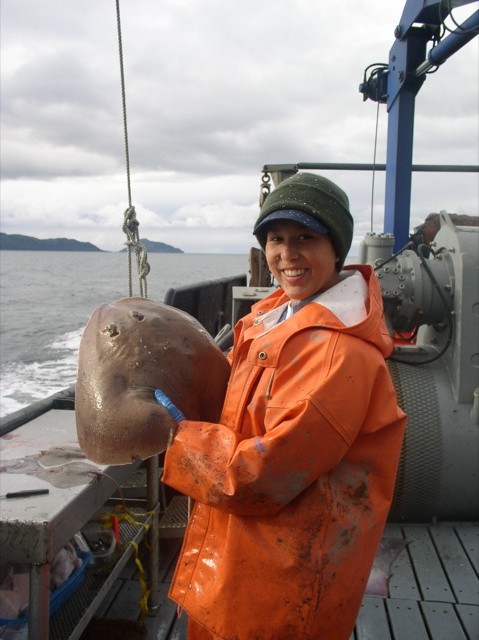
Shaara holds her thesis species, the Bering skate
The microscope is necessary, since the largest vertebrae are about the size of the eraser on top of a pencil, and the smallest vertebrae can be as small as 1/10 of an inch in diameter! The biggest challenge I have experienced was trying to locate a little white vertebra that I accidentally dropped on the white linoleum lab floor. For the record – the vertebra was located!
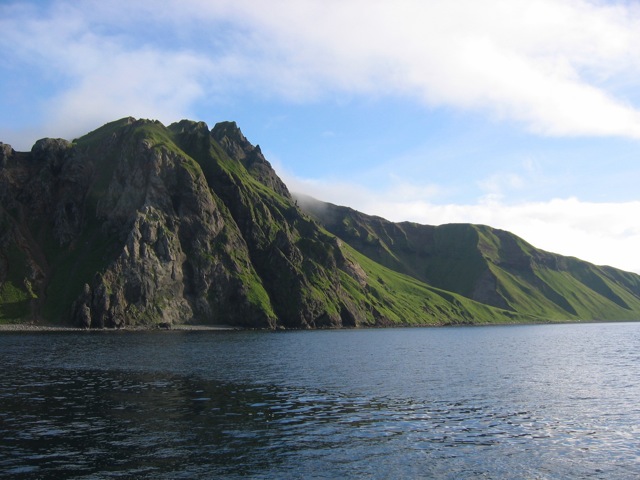
However, studying skates can have its perks – the most interesting aspect of my work was spending time on the Alaska Department of Fish and Game boat the RV Resolution. I really enjoyed spending each day sorting through fish and seeing what we found on the bottom of the sea. It was an opportunity to meet interesting people who have spent their lives working on boats. The views of the Alaskan coast were astounding. I was completely spoiled by the breathtaking scenery and photos just can’t do it justice. While the days were long, and the work was not easy, I would do it all again if I could. We also had access to a whole variety of candy and ice cream, so I think that helped us stay on track and work hard…
The beautiful Alaskan coastline (if you squint, it even looks like somewhere warm!) - not a bad place to be out fishing. (photo: S. Ainsley)
Count them bands - looking at a vertabra from a skate's backbone gives clues about its age
Congrats to Shaara Ainsley of the ichthyology lab who recently defended her thesis and joined the ranks of many other recent MLML grads! Here Shaara shares a bit about her research, and addresses that all-important question: what does it mean to “age” a skate? (aka a flat shark…)
For my thesis, I studied the life history characteristics of a skate from Alaska, Bathyraja interrupta, commonly known as the Bering skate. Knowing the life history of a species of fish is important because fisheries managers use the information to determine whether a fish is vulnerable to overexploitation, or can be fished at a certain level to maintain a healthy population.
So what are “life history parameters,” and how do we study them? From a fisheries management perspective, it is important to know how long the fish lives, how big the fish can get, how many offspring the fish can have, and how often it can reproduce. Estimating the age of an individual fish is at the heart of a life history study. In fisheries biology lingo, this is called “ageing” a fish. Ageing (spelled with the “e”) does not mean that we make the fish older, nor does it mean that we set it aside for a few years like a fine wine! It means that we are looking at structures in the body of a fish that can give us clues about how long the fish has been alive.
Size matters - getting the samples of the smallest/youngest individuals is important for an age-and-growth study
Just like trees, fishes deposit rings or “bands” in their bones. Specifically in boney fishes, such as a rockfish, you can look at the ear bone (or “otolith”) and count the bands to estimate the age. In sharks, skates and rays, which are cartilaginous and do not have boney structures, we can count the bands deposited on their vertebrae. There are many additional aspects of a fish’s life history that are important to management, however the majority of my research has focused on the age and growth of skates. Through my research, I have estimated that the Bering skate can live to at least 22 years old, which is an average life span compared with other skate species.
What is the hardest part about studying how old these skates get? Stay tuned to find out!


 It’s time for another steaming cup of science and discussion at the MLML Science Cafe!