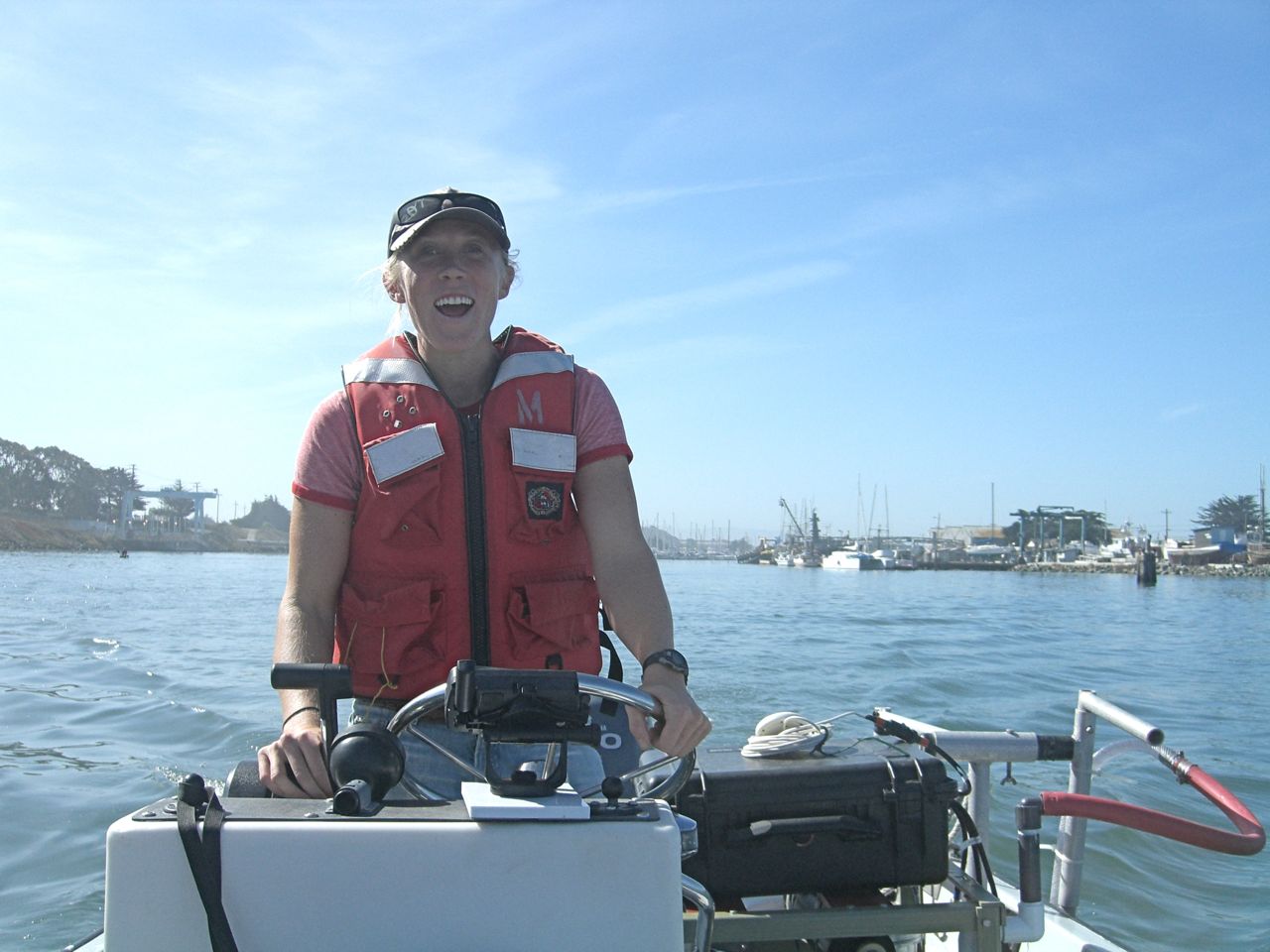
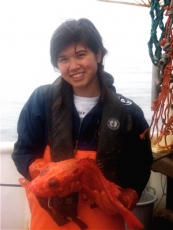
Tanya Novak of the Physical Oceanography Lab collects data outside of Elkhorn Slough (photo: S. Buckley)
What do you do if you want to measure the properties of water in realtime? Take out your portable Underway Data Aquisition System (UDAS), of course! This week’s photo comes from Physical Ocenography student Tanya Novak. Tanya drove the boat pictured above in a back-and-forth transect in Monterey Bay with her UDAS in tow, trying to characterize the water that flows from the mouth of Elkhorn Slough.
That UDAS contains a whole suite of impressive-sounding instruments: a thermosalinigraph, to take automated measurements of temperature and salinity, a transmissometer, which measures the fraction of light transmitted through the water (to determine water clarity), a fluorometer which measures fluorescence (the light emitted from chlorophyll in phytoplankton), and an ISUS, or In-Situ Ultraviolet Spectromter, which measures the amount of nitrate in the water.
What do you get when you put all those measurements together? Click here to see the plume Tanya traced (and the information she collected) on the MLML public data portal. Thanks for the photo, Tanya!
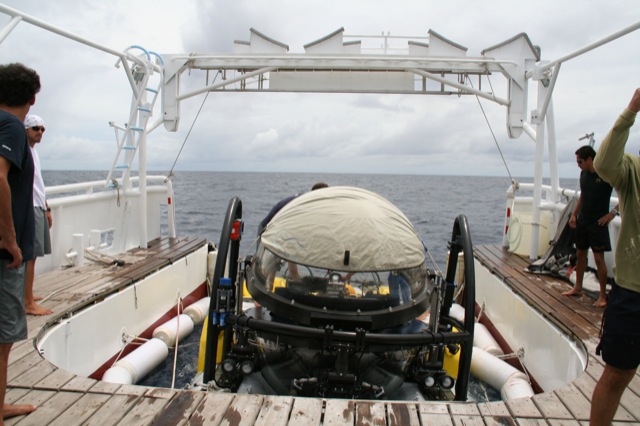
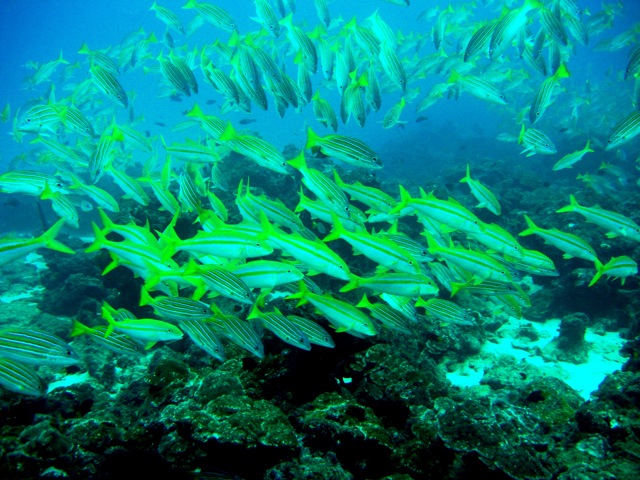
The dome of the DeepSee Sub provides a panoramic underwater viewKristen Green
by Kristen Green, Ichthyology Lab
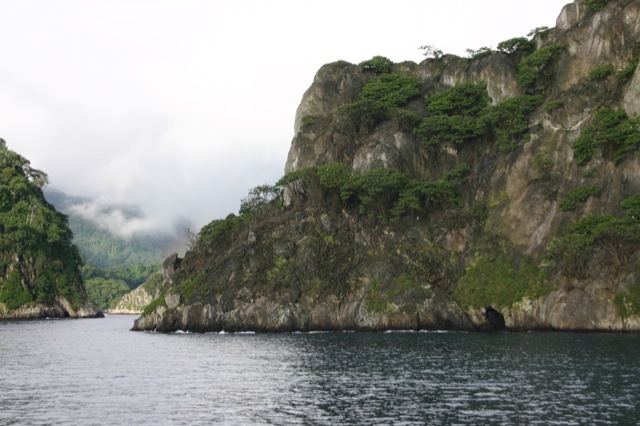
September 2009: For the next three weeks, I am traveling to Cocos Island and the Las Gemelas Seamounts, which are located approximately 520 kilometers southwest of Costa Rica. Cocos Island is renowned for its marine biodiversity, and the island has been established as both a UNESCO World Heritage Site, and as a National Park in Costa Rica.
I will be working with scientists from the US National Geographic Society, University of Costa Rica, Ocean Research & Conservation Association, and the Monterey Bay Aquarium Research Institute to explore deep water habitats via manned submersible around Cocos Island and the nearby Las Gemelas Seamounts.
Manned submersibles are like miniature submarines; they allow scientists travel to ocean depths that would otherwise be inaccessible. We will be using the DeepSee submersible, which has room for a pilot and two passengers, and can travel to a maximum depth of 1,500 feet. We will use the submersible to record video images of the seafloor habitat, fishes, and invertebrates, as well as to collect invertebrate specimens from the seafloor.
What lies beneath the waters of Cocos Island, Costa Rica?
In addition to the submersible dive operations, there will be several other research projects conducted during the research cruise. One team of scientists will be using SCUBA to identify and count fishes in shallower waters (less than 80 feet) around Cocos Island. Another team of scientists plan to catch sharks and implant them with sonic tags. These sonic tags transmit signals to receivers, which are like underwater listening devices. These receivers will be stationed all around the island. When a shark with a tag swims in the vicinity of a receiver, signals from the transmitter will be detected by the receiver. The transmitter signals include information about the animal’s depth and location. These data will help scientists understand where and when the tagged sharks move around the island.
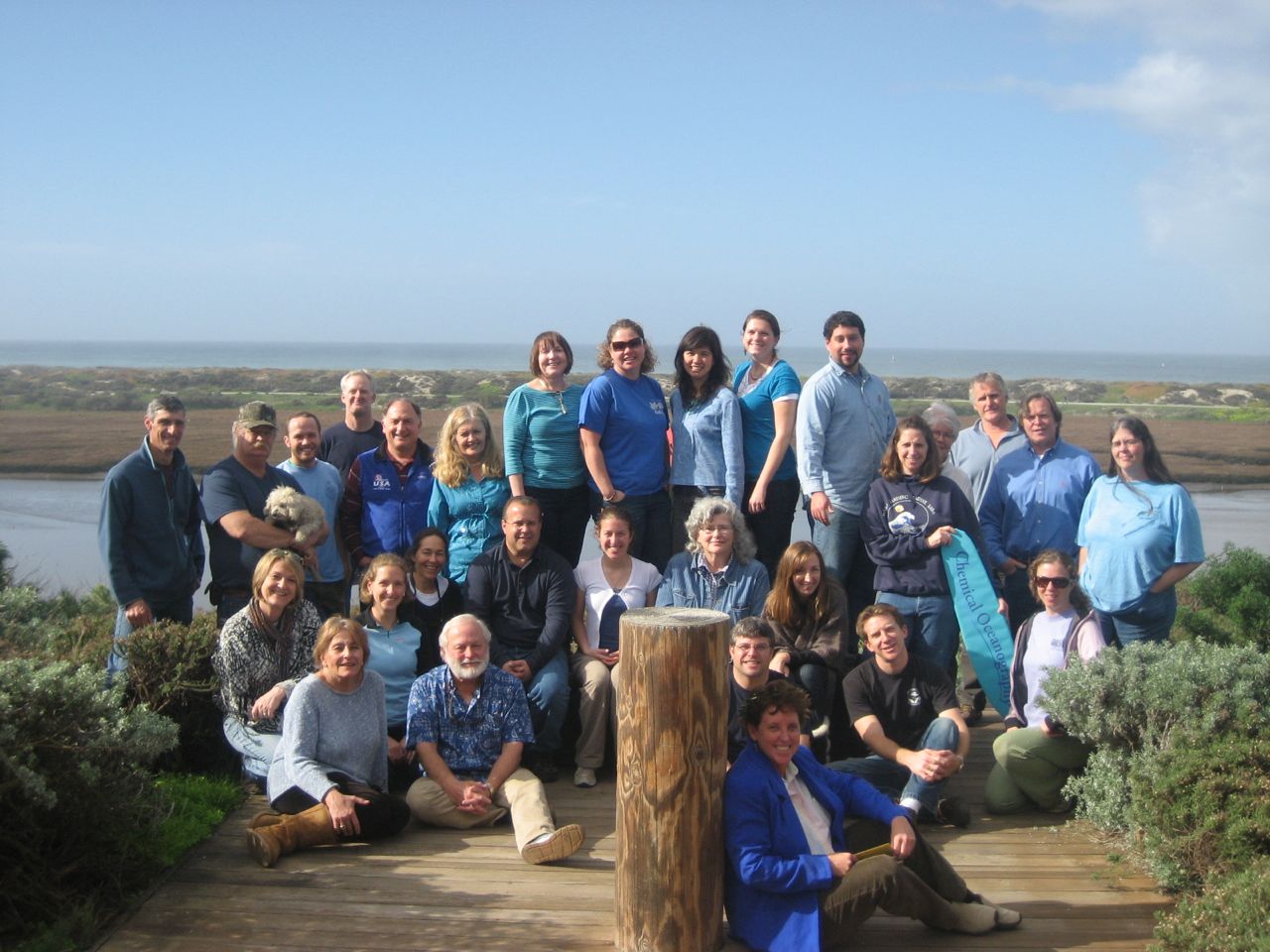
Moss Landing Marine Labs students, faculty and staff turned out in every hue of true blue on January 13th! Wear Blue for the Oceans Day is part of an effort to create a national ocean policy for the ocean, coastal and Great Lakes ecosystems. Find out more at http://wearblueforoceans.org/ with the characters from Sherman’s Lagoon, and share how you wear blue for the oceans! (Can you find our MLML photo?)
We must constantly extend our gaze out from the familiar, into a void of unknowns – where to start? – which courses? – what research is relevant, yet approachable? – how will we find funding? – is our study design robust? – are the data sound? – which condiments in the student fridge have gone bad over winter break?
Seemingly heavy questions.
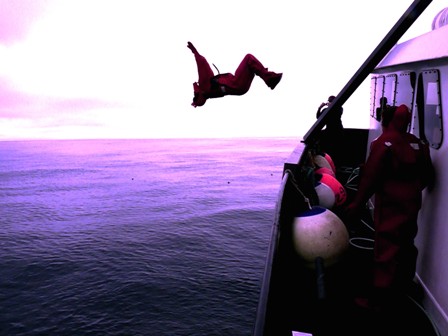
But we must remember that all endeavors start with an, idea, a hunch, a dream (or, an ultimatum?). The best we can do is take stock of our knowledge, double-check our equipment, and jump into things. We wouldn’t have made it this far in school if we weren’t fully capable… and more than a little crazy!
With only a few hours left in 2009, it’s time for a whirlwind year in review! Click through to take in some of the great Moss Landing Marine Lab adventures we posted this year at the Drop-In:
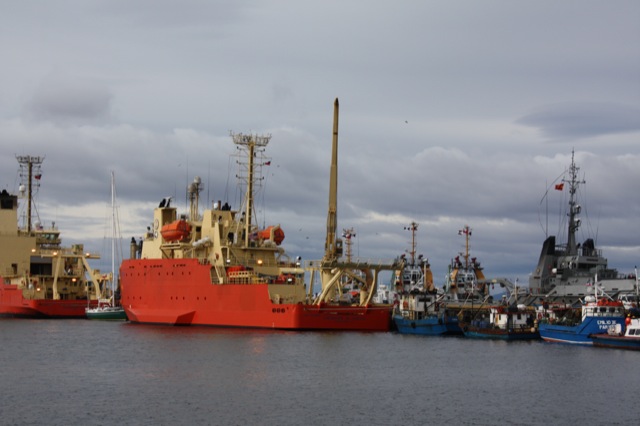
Great big ships are the Antarctic ticket home (photo: K. Green)
by Kristen Green, Ichthyology Lab
March 2009: Yesterday’s dawn revealed the greasy, orange Russian research vessel looming on the horizon. A few short hours later, the small green field station with white shutters where I’ve lived in for the past 5 months grew smaller as we sped across the bay in zodiacs towards our floating ride home.
The events of the past three weeks are a blur of inventorying, packing, and cleaning. Everything was counted down to the last pencil, and then placed in bags to inhibit moisture and mold over the winter. The satellite antennas, wind generators, everything that connected us to the outside world and generated our power supply was disassembled.
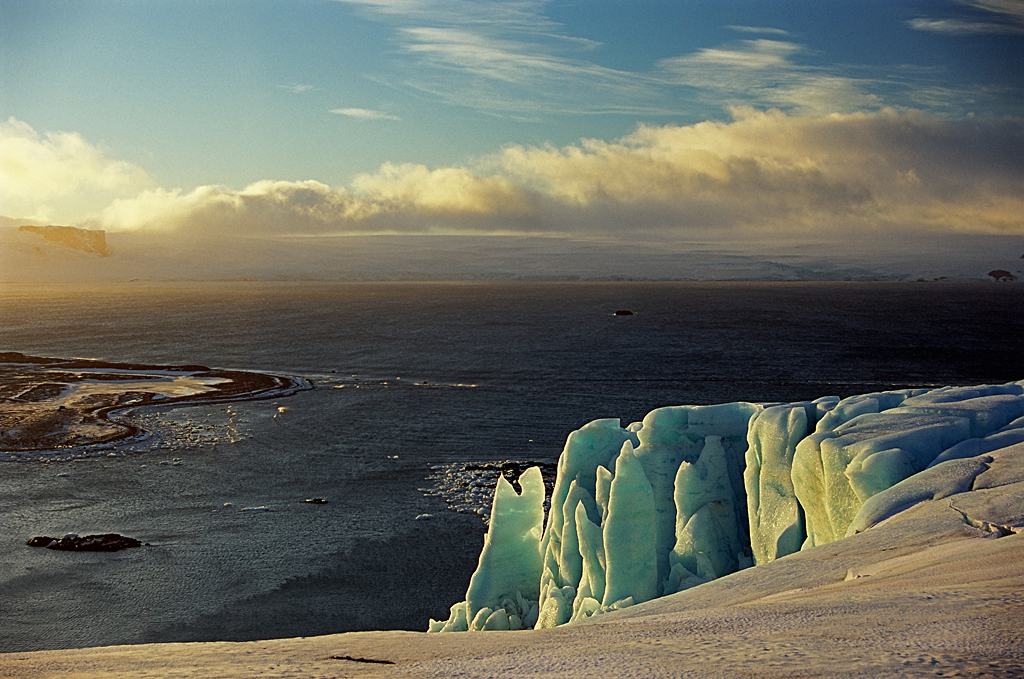
I felt ready to go, but wanted to climb to the top of Jardine, the 700 ft peak above Escurra Inlet. The weather had been unimpressive all week, but the morning of the extra day was miraculously clear and sunlit. We made the three hour trip from Copacabana, exploring some new routes over the glacier. Jardine is an eroding basalt monument, the remnants of a 25 million year old volcanic plug. From the top, all of Admiralty Bay was visible in stunning panorama. The scenery was crystalline, the light was just right. From this perspective, I could see a good portion of the area we worked in over the past 5 months. I tried hard to imprint this last, perfect view of the island.
photo (K. Green)
Now, sitting on the Russian ship, I feel drained. I just took the first consistently hot shower I’ve had in 5 months. Watching the rust-tinged water drain away, I felt like I was being wasteful. I’m too clean, the ship is too hot. I’ve spent months of my life on boats, but now I feel claustrophobic. The dull roar of the engine never ceases, the fluorescent lights flicker in tunnels of blue hallways.
Already I miss my life on King George Island. I wish I could sum up my experiences in the last five months with the perfect conclusion, like that last day on Jardine. Maybe the filter of time and distance will provide the necessary perspective, but for now, nothing I could write would be eloquent enough.
Kristen and her fellow team members signing off from Antarctica
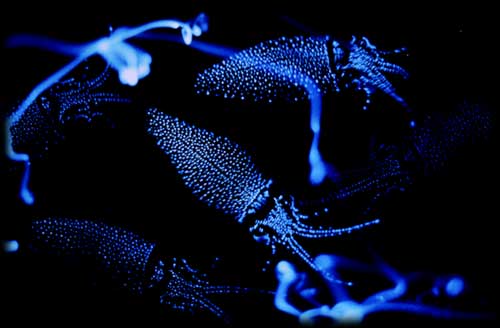
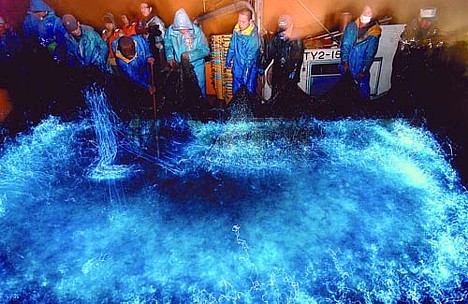
Happy Holidays from The Drop-In! Our gift to you is a Creature Feature of one our most popular celebrities. “Firefly squid” and “bioluminescent squid” are some of the most frequent search terms that lead people to drop in on us. And seeing how these decorated dazzlers are the winners of our “Vote for Your Favorite Holiday Marine Creature” poll, we figured their victory justifies some more attention.
Known to the science world as Watasenia scintillans and to the Japanese as “hotaru-ika,” these sparkling cephalopods grow to a mere three inches long. Their tiny bodies are packed with photophores, which they can flash in a variety of alternating patterns. These squid are believed to be the only cephalopods that have color vision, possessing three visual pigments instead of one like other squid.
Toursits and fishermen alike soak up some squid light in Toyama Bay, Japan (photo: pinktentacle.com)
Firefly squid live throughout the Western Pacific Ocean at depths from 600 to 1,200 feet. They gather to spawn from March to May, and can be found by the millions (or even billions!) in Toyama Bay, Japan. The adults die soon after releasing their eggs and sperm, completing a brief, one-year life cycle. That is, if they are not first scooped up by fishermen to be served as a Japanese delicacy.
We have past copies of Science looking for an educational home
Are you an educator that could benefit from copies of Science magazine in your classroom? Many MLML graduate students currently receive free subscriptions of Science as part of the AAAS/Science Program for Excellence in Science. It’s a great way for us to keep tabs on the latest developments, but the volume of weekly installments can become unwieldy after a few months. We would love to pay the knowledge forward in support of education! Please leave us a comment below if you are interested, and we will contact you to pass on copies of this esteemed publication.
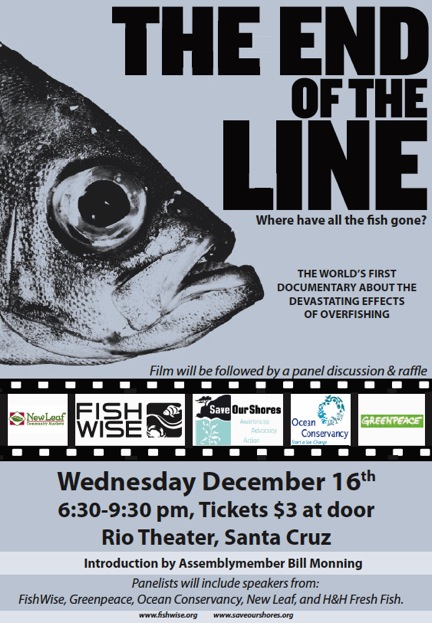
Hi, this is Mariah, an ichythyology student here at MLML. I want to let you know that a local non-governmental organization (NGO) I work for, FishWise, is hosting a screening of The End of the Line, an amazing documentary about the global overfishing of our oceans.
This documentary is excellent, as it is based in science – you will hear from leading scientists such as Daniel Pauly and Ray Hilborn in the film. This film also reminds us of the global nature of overfishing the oceans, as what we do here in California affects the rest of the world, and vice versa.
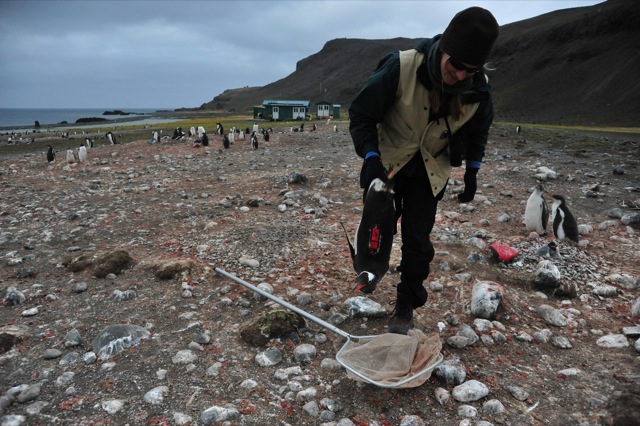
Kristen goes for the catch to get a satellite tag from a Gentoo penguin in a successful roundup (photo by P. Angiel)Kristen Green
by Kristen Green, Ichthyology Lab
Before leaving my Antarctic camp last spring, we still had biological work to do which was a welcome break from the monotony of packing. The first was a last ditch effort to retrieve the last missing transmitter on a Chinstrap penguin. The satellite data indicated the bird was still coming to shore; sometime between 10 pm and 1 am, and somewhere in a three mile stretch of coastline between Demay and Patelnia. Dave planned to search at Patelnia and then walk back to Demay at midnight. My job was to search the colonies at Demay.
By 11 pm, I was starting to feel my headlamp wasn’t quite sufficient in illuminating the distance I would have liked from fur seals. Surrounded by low guttural warning growls as I picked my way to the penguin colonies, I hailed Dave on the radio and was relieved to hear that he was on his way back. He too, was tired of waiting in the cold, navigating through minefields of territorial fur seals. We returned empty handed, morale sinking further as we tried to decipher Polish cooking instructions on the food stored at the tiny, unheated Polish refugio where we planned to stay the night. Later in the week the next satellite download revealed the transmitter had stopped transmitting signals all together, but at least we tried.
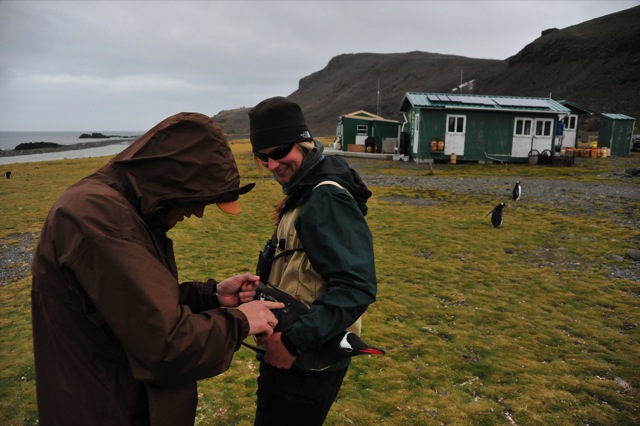
Had Kristen and Dave caught their rogue penguin, they would have proceeded to do something like this... (photo by P. Angiel)
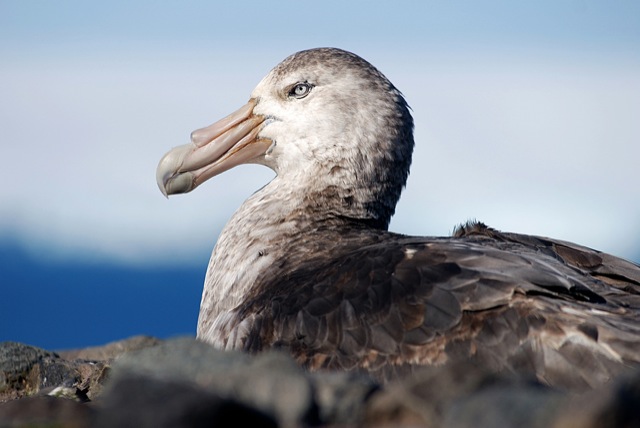
Our final biological task was to count and band giant petrel chicks. Of the birds we work with, giant petrels are the most sensitive to disturbance. The chicks need to be old enough to fend for themselves since the parents will fly off immediately when we approach the colony. These are the largest birds we handle; the adults are about 25 lbs; the chicks are like big fuzzy 15 lb dough balls.
Despite their size, the giant petrels are primarily scavengers, and their defense mechanism is to project an oily vomit onto potential attackers. The best way to avoid this is to approach within 10 ft of a nest, and then sprint the last few feet to the nest, grabbing the chick quickly and holding the beak so it can breathe, but not regurgitate on the lucky person doing the banding. Giant petrels are known for their strong site fidelity, often returning to the same colony and the same nest each year. The bands help us to estimate this site fidelity, as well as measure over winter survival. This year’s chicks will fledge in about a month, and then live on the open ocean for the next 5 years before returning to the island to breed.
A giant (non-vomitting) petrel looks on (photo: P. Angiel)
The bird work was done, but the chaos of packing continued. Sitting in the hut the night before we were scheduled to leave, surrounded by plastic bags with a laundry list of things to still accomplish, we found out via radio call that the ship was going to be delayed a full day. They needed better weather to offload researchers at another island field camp about 12 hours away. The gift of this extra day was a blessing, not only in needed time to finish closing camp, but also for me in being able to say goodbye to the island.
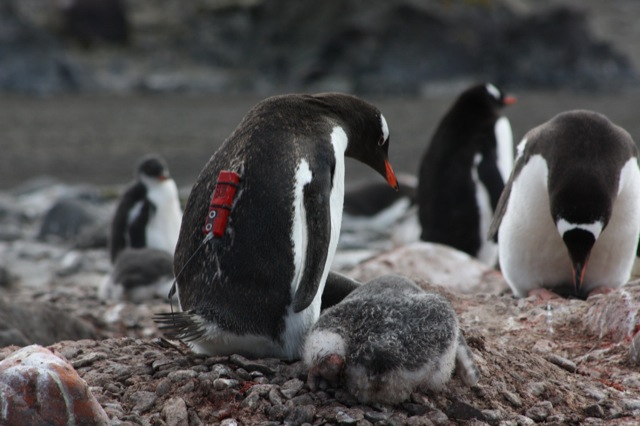
A tagged Gentoo penguin shows off its fashionable new satellite backpack (photo: K. Green)