Hi everyone, another post from your sustainable seafood enthusiast! If you don’t already know I work at FishWise, a non-profit sustainable seafood consultancy, in Santa Cruz CA while finishing up my thesis.
FishWise has just launched a new public enewsletter. You can go here (http://www.fishwise.org/contact-us) to sign up for the newsletter, and once a month we will email you top sustainable seafood news along with a species spotlight on a sustainable fish, recipes, and policy initiatives that you can support.
The FishWise blog now features a photo of the week!
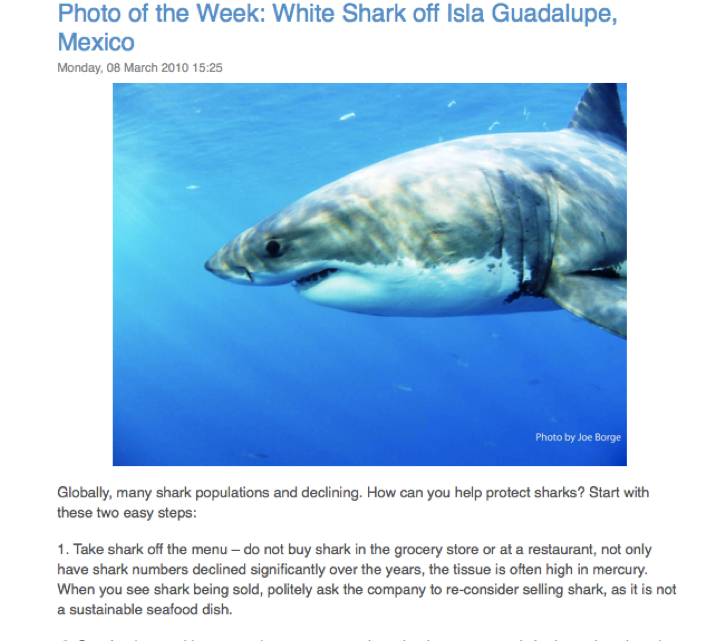
Also our blog also just started a photo of the week! Every Wednesday we will post a fantastic underwater photo and tell you how it applies to sustainable seafood. Check out this week’s white shark. http://www.fishwise.org/blog
If you have any questions about careers in sustainable seafood or questions about what makes seafood sustainable please post it here as a comment!
Sometimes corals need a lift - restoring a reef in Fiji.
If all of Mariah’s posts about diving in Fiji has you itching to visit a tropical coral reef, now is your chance! Join us for a science cafe on Wednesday, March 31st to learn about the need to restore coral reefs in Fiji, and what actions are currently underway.
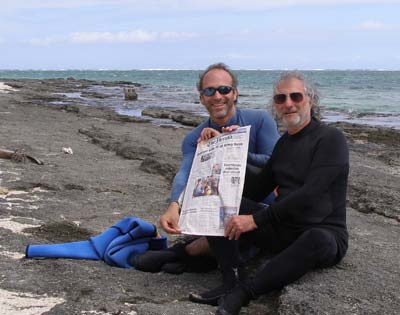
Our speakers include Dan Presser, the owner of FourWinds Travel, who has explored jungles from Borneo to Argentina to Africa. Recently, Dan began working on coral reef restoration in Fiji with Victor Bonito. Victor Bonito is a coral reef ecologist (M.S. Biology from the United States who has studied and explored reefs worldwide. Victor’s company, Reef Explorer Fiji Ltd., is based in the Fiji Islands with the mission to conserve Fiji’s natural and cultural resources through research and education.
Hope to see you at the Science Cafe!
Join us for:
Sasalu Tawamudu – an Integrated Community-Based Approach for Fijian Coral Reef Conservation
After an interval of time at the surface during my Fijian shark dive, suddenly, it’s time for the real thing – visitng the spot where the tiger shark (Galeocerdo cuvier) shows up. We drop down and lie on the seafloor this time, though we aren’t as deep. I get a spot on the end next to a divemaster and begin to watch another feeding. Bull sharks are coming in again, and then all of a sudden the water feels electric. We can all see something in the shadows, and we are all hoping and yet nervous that it is the tiger shark. The divemaster next to me nudges me and points.
Here goes nothing.
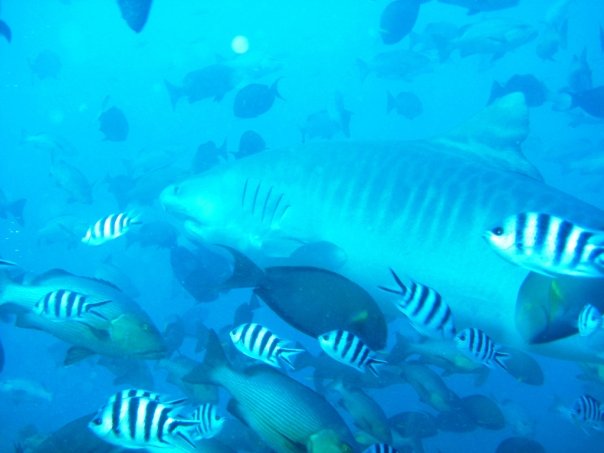
The tiger shark shows its stripes (photo: M. Boyle)
I clear my mask and its size comes into view, 4 or 5 meters in length. It is almost too big to seem real. Then it makes its appearance, swooping over our heads and checking us out. Apparently it likes our bubbles the divemasters have determined. The shark, a female named Scarface we learn later, cruises around and opens her giant mouth for fish, a mouth I’m sure I could have fit into very easily, scuba gear and all. The shark was never aggressive, although you could tell she owned the place, even the bulls waited for her.
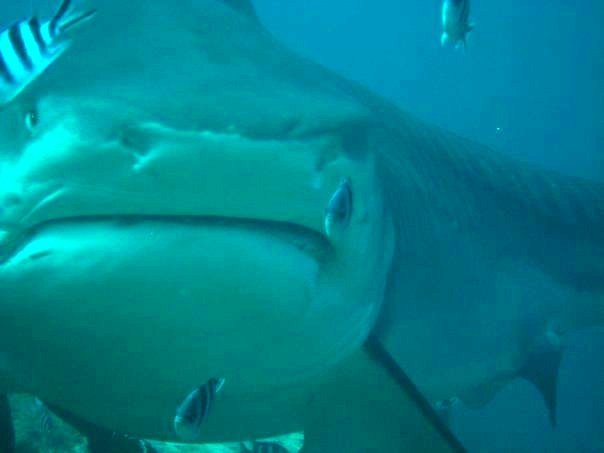
On one of her last rounds she took a fish and came really close to the wall, coming within a meter of me, mouth first. On this dive I had my camera with me, and I snapped photos later that would scare me because they were so close, but at the time I felt nothing but calm and at peace with these animals. Like we knew our visit was just temporary and the sharks were happy with the small price of some fish.
Ready for my close up! The shark swims right by after feeding. (photo: M. Boyle)
We surfaced, cheering out loud from the adrenaline and then hop up into the boat fast since the tiger is still beneath us somewhere, and we know we are still in her realm. On the way back the Divemaster tells us a story that went something like this: “One day the tiger shark, Scarface, showed up and she was agitated, angry, I could tell. She circled and circled above me and finally showed me the problem. There was a large metal hook in her mouth, right through the skin. She kept circling and so I knew what I needed to do. Scarface knows me, I’ve dove with her so many times, so I swam to her and put my hand on her mouth and stopped her, and I pulled out the hook.” The Divemaster goes to the front of the boat and pulls out a huge fishing hook, he keeps it in a box onboard as proof.
When deciding to go shark diving I had a lot of reservations, not only about the safety but about the fact that if I participated I was making a conscious decision to feed the sharks, to disrupt their natural patterns. In the end I’m glad I did the dive. I understand now more the power and beauty of these sharks. The divemasters say the sharks don’t come around every day, the tigers go missing for weeks at times, so they are still in their natural behavior, they still leave to mate and feed.
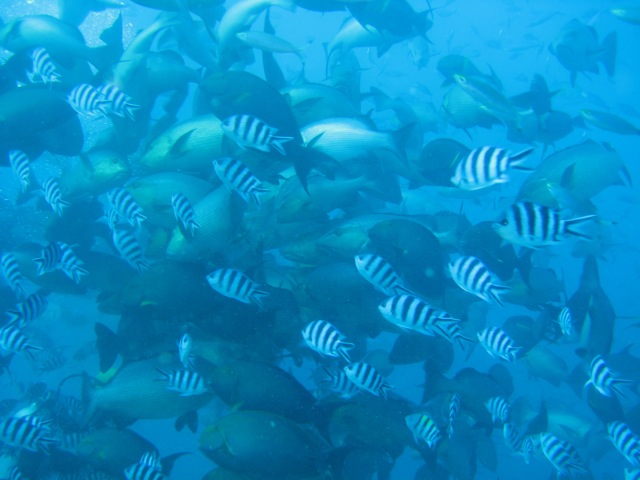
A human-induced feeding frenzy - how much should we be part of the mix? (photo: M. Boyle)
This opportunity has also provided the divemasters, all Fijians who believe they are protected from the sharks, the chance to intimately get to know these sharks and give us insight into their patterns. These divers can tell when a shark is pregnant; they know each shark by name. They have also started a tagging program for the bull sharks, to gain insight into their movement. While I didn’t feel the need to repeat the dive in Fiji, I think going once is a great experience. I don’t have a list of sharks to see and won’t be chasing them on a bunch of shark dives, but as our desire to see the world first hand and preserve the animals in it increases, we all need to decide where we stand on feeding or tracking or swimming with all animals. For me, seeing these animals once was enough to appreciate them more, I’ll never forget that dive – but from now on I will leave them to cruise the oceans on their own.
I’m sitting on the dive boat bouncing around as we speed off to our dive site. Normally I wouldn’t be this nervous, I’ve logged plenty of dives – honestly I’m surprised I don’t have gills after my childhood spent in the ocean. But today is different. Today we are in Fiji (during my trip as part of Tribewanted), heading towards Beqa (pronounced benga) Passage and the Shark Reef Preserve.
This reef is owned by two villages who allow for operators to bring divers in, while charging $10 FJD per person for all that participate with the money going back to the villages. The outfitter I’m with, Beqa Adventure Divers, has trained 12 Reef Wardens from the local community to patrol the reef and keep an eye out for illegal fishing, the biggest threat to this protected area.
The boats motor cuts out and we start our dive briefing.
“Safety is our number one concern” the Divemaster says. He reminds us to watch our air and the sharks. “No one has ever been hurt here in five years, since we started.” We are given black neoprene gloves to wear as our white hands and palms can be mistaken for fish.
What did I get myself into? I keep thinking at how strange this feels, how in California white sharks have been known to nibble on things looking like seals, which is exactly how the crew was telling us to dress. When in Fiji…
After more prep we finally descend as a group, with divemasters all around us in a circle. They drop down a huge garbage can of fish.
This could get ugly, I think.
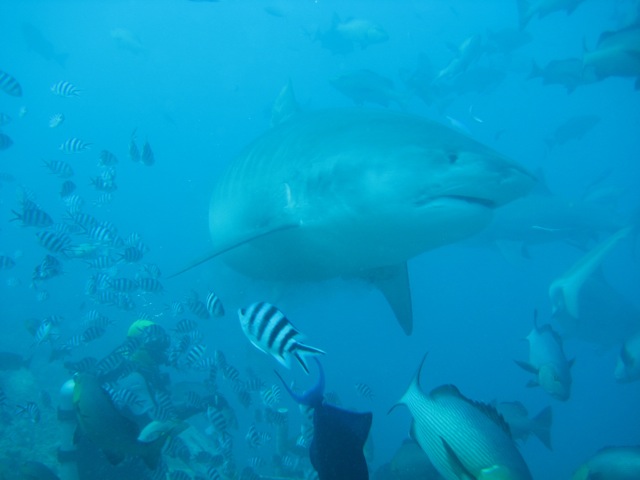
Duh-duh, duh-duh - the sharks emerge (photo: M. Boyle)
I squeeze myself behind the coral wall and between some other dives, sitting on the floor.
I contemplate peeing in my wetsuit, for warmth of course, though I have a feeling that is a convenient excuse.
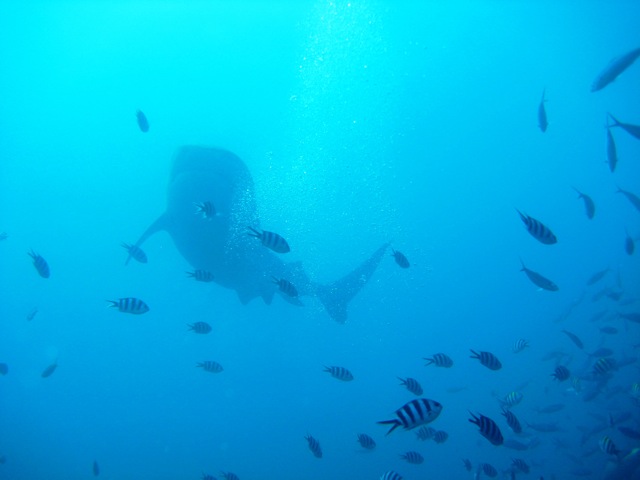
This is a deep dive, we have to be careful about watching our computers so we don’t run out of air or stay at depth too long. Then the show begins. The garbage can is opened and fish swarm the feeder. All of a sudden circling us in the blue haze are big shadows, big beefy shadows. The sharks come closer, bull sharks (Carcharhinus leucas), one of the sharks on the list not to mess with. They are all just under 3m long and stocky sharks, thick like a white shark. The sharks start to move in, swooping in effortlessly and gracefully for a piece of fish.
This is awesome.
I’m smiling so much I get seawater in my mouth. Then I feel it.
Ouch, something bit me…
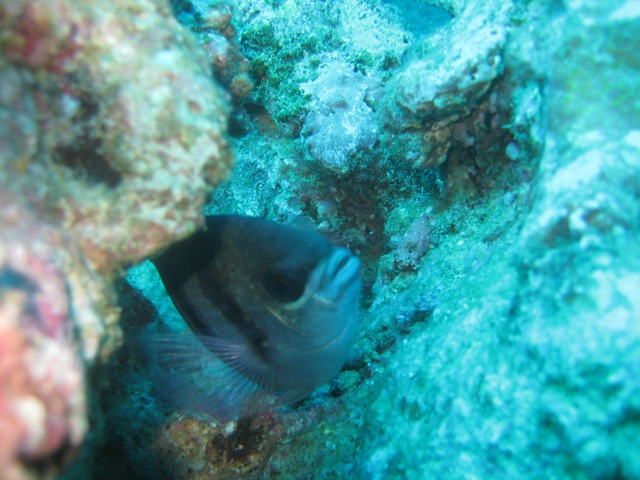
Help! This little guy hid in the rocks like me when the sharks came around (photo: M. Boyle)
Not of a bull shark, but a tiny damselfish in the rocks. I’m sitting next to his territory and he is letting me know. Luckily the gloves don’t let him break the skin but it hurts, and he won’t stop attacking my knuckles. I cross my arms to bury my knuckles, and then he goes for the knees. I laugh, I’m here watching bull sharks be fed and am getting pecked by a tiny damselfish. We can’t stay at this depth long, and leave as a group to the shallow reef top where we watch all types of reef sharks feed, and feed up close. Then get so excited and in such a frenzy that they brush against you and even bump into you, close encounters all around.
“Woohoooo, that was awesome” a fellow diver yells when we surface. High fives are exchanged, because we saw such awesome sharks, and because we all still have all of our hands. I’m stoked. All of us have the biggest smiles on our faces. The smile you get when you know you’ve cheated something and witnessed an unprecedented event.
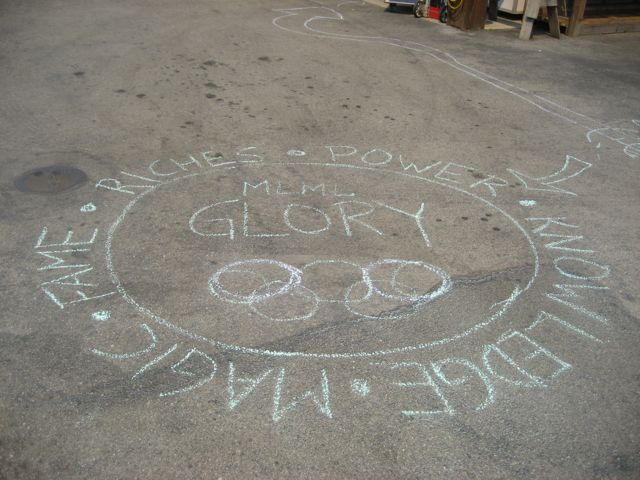
The benefits of an MLML Olympic win are obvious (photo: E Loury)Erin Loury
by Erin Loury, Ichthyology Lab
So long, Vancouver. It’s been a good two weeks, steeped in Olympic excitement (especially when we could get the student lounge TV to work). And this year I got that much closer to actually understanding curling. But before we go back about our daily business, free of snow and ice sporting distractions, here are a few more parting shots to honor MLML’s proud Olympians and glorious events:
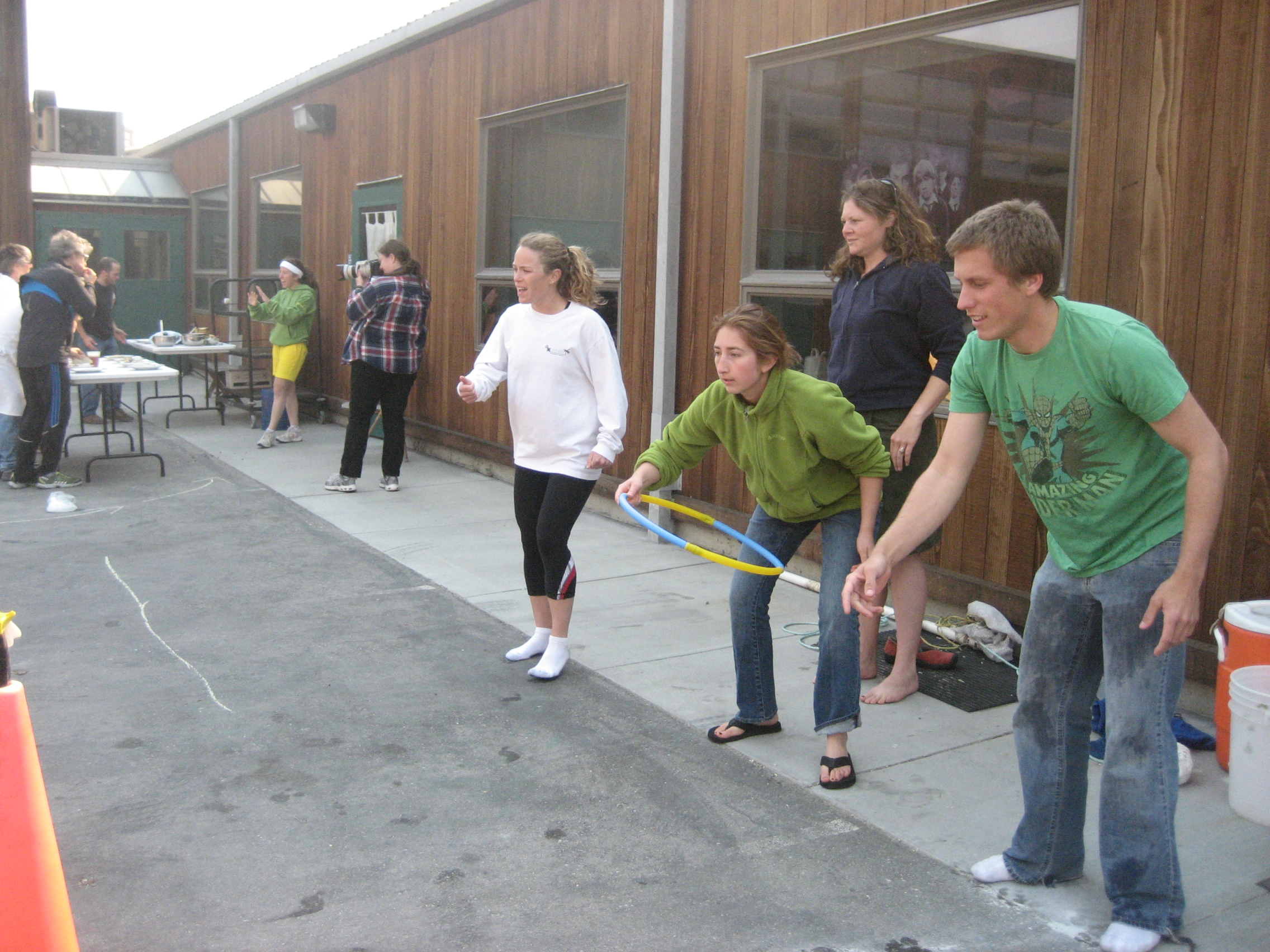
The quadrat toss: simulating real sampling equipment (photo: E. Loury)
Did you know that hula hoops have their own proud place in science? We actually use them in the field as quadrats (sampling areas) because their round shape has the smallest perimeter to area ratio, and minimizes the possibility of pesky “edge effects.” But they are also great to test your skill at the ring toss!
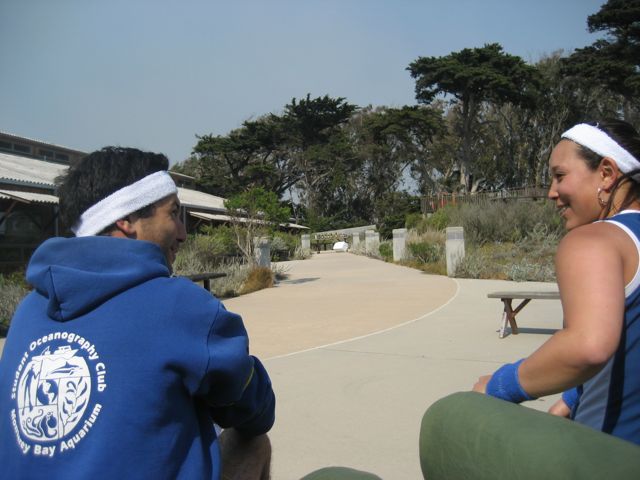
Do you have any idea which beers those are? Olympic challengers ponder their options (photo E. Loury)
This game of skill is after any grad student’s heart: long-distance beer identification. That white dot in the distance is a cooler, next to a table of bottles. While seated on the couch, contestants had to identify each beer by its label, and the city of origin. Though most could only offer best guesses, a few players swept this field…
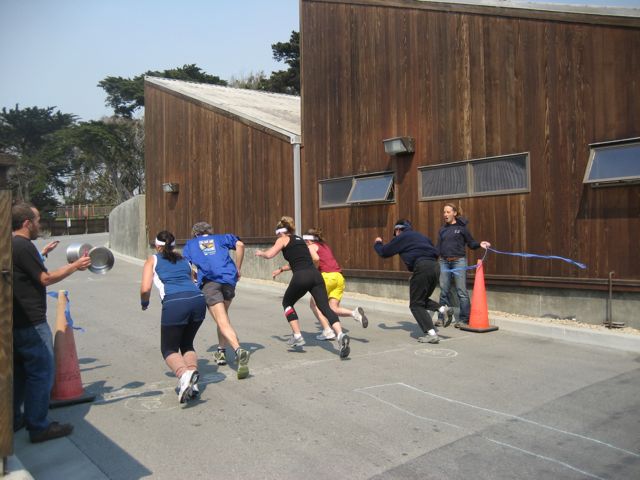
And they're off! Charging forward to the next lab Olympics! (photo: E. Loury)'
Lest we be categorized as wimpy scientists, we do throw in the odd event of stamina (not counting the Wii “virtual athlete” competition). A few hardy contestants make off on the 2-mile foot race, setting the pace for the next year of Olympic games.
The MLML Lab Olympics trophy – a coveted accolade for any marine scientist's resume! (photo: E. Loury)
by Erin Loury, Ichthyology Lab (and former MLML Olympic champ…)
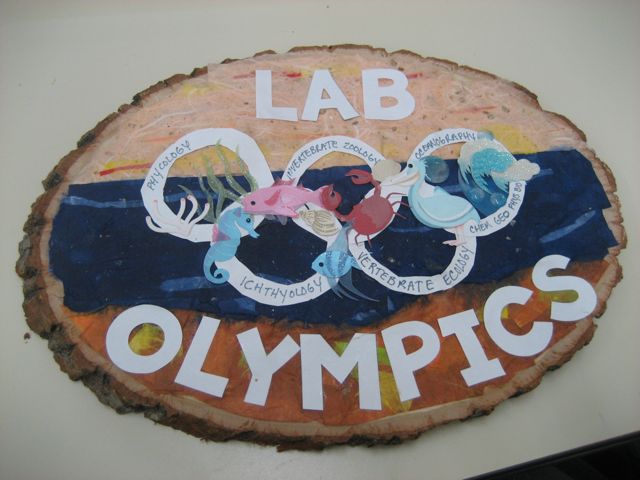
With the Winter Olympics well underway in Vancouver, I thought it was time to focus some attention on the lesser-known games of glory in the marine science world – that is, the legendary Lab Olympics at MLML. Once a year, the student body gathers together in a battle of skill, speed, and smarts to decide which lab is deserving of MLML gold. Here’s a look at some of the daring events:
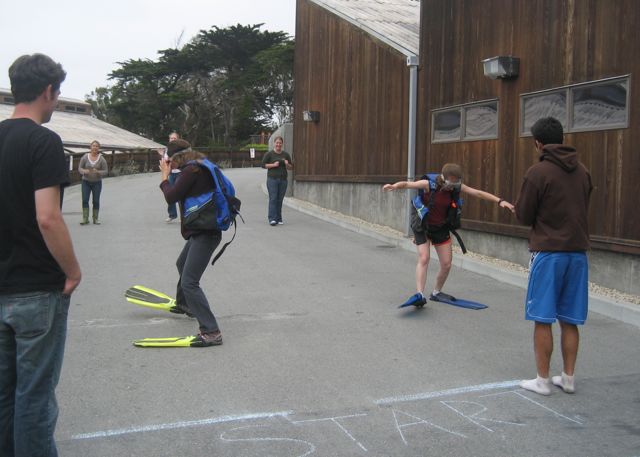
Science gear in action is a popular theme for variations on the quick-change relay:
The scuba gear relay - strip the gear of your teammate, put it on yourself, and waddle your way to victory! (photo: E. Loury)
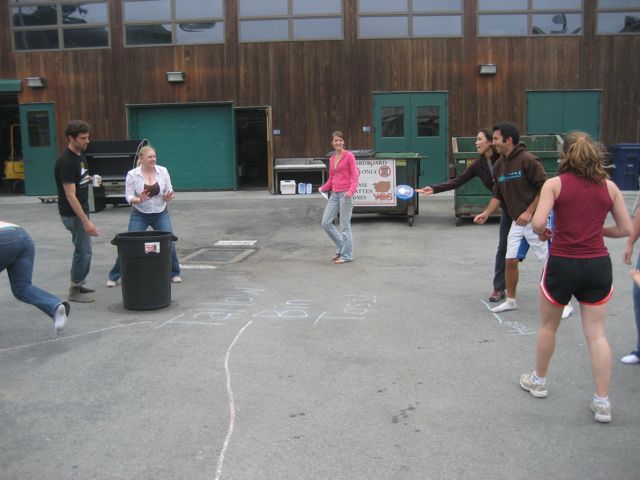
Combining frisbee and accuracy with a science flair is the true essence of grad school:
The tallow bin toss: bag that (picture of a) dead skate or sea lion carcass in the tallow bin to snag the gold! (photo: E. Loury)
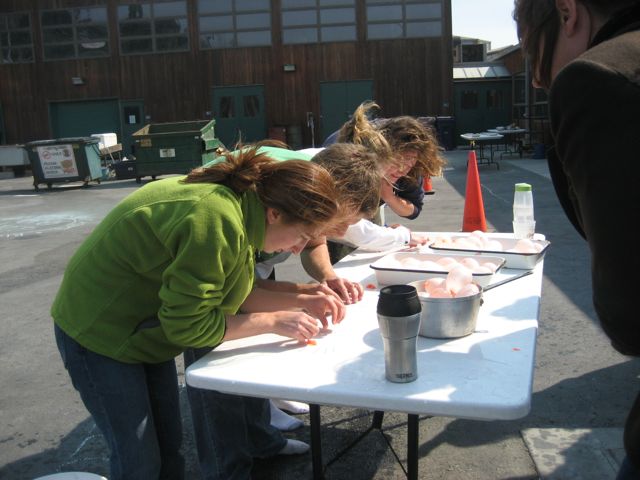
And any true marine lab event would require some brain power as well:
The unscrambler: break water balloons and rearrange the words inside to spell a win! (photo: E. Loury)
For all our years of training, we have yet to take our competition to the regional level. Any labs out there willing to challenge?
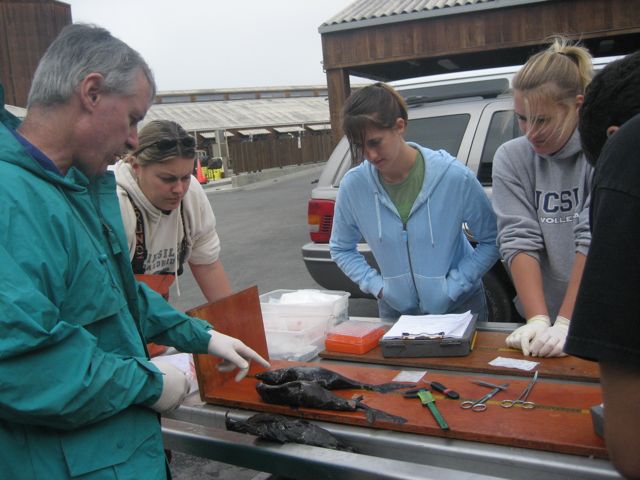
These photos come to you straight from the fish gut detective files – and are a diet scientist’s (sadly nerdy) dream come true. Most of the time, we peer under microscopes to poke and prod at mashed, chewed, digested bits, trying to figure out what animal they once resembled.
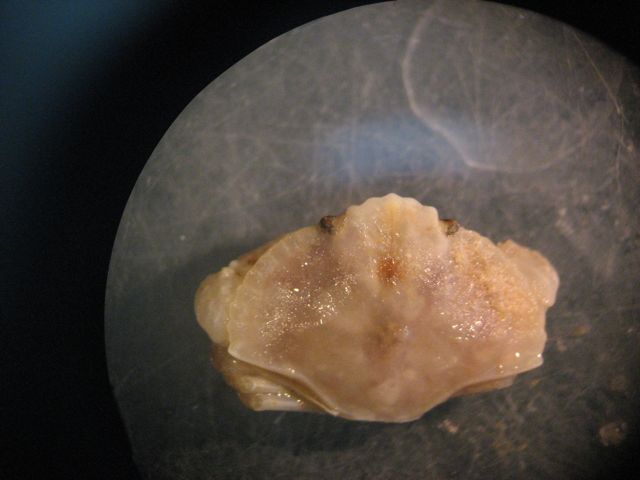
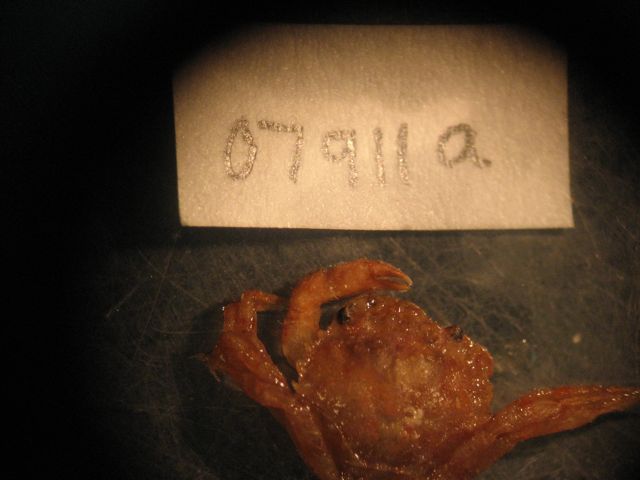
Rare are those those idyllic occasions when, behold! A perfect little specimen appears in your gopher rockfish stomach, as intact as if it had crawled out from under a rock…AND you just so happen to find an identification key from 1921 for tiny crab specimens under 2 cm. That is what we in the gut world would consider a “good day.”
The crab snack above was pretty easy to identify. Cancer productus, the red (yes, red) rock crab is distinctive in its crazy juvenile color patterns, including bright white. My real triumph as also identifying this widdle guy (Cancer jordani, the hairy rock crab, should you care to know)…
Dime sized - wave hello to baby Cancer jordani, aka gopher rockfish lunch (photo: E. Loury).
The running joke of the diet world is that people who poke at guts become more familiar with the prey species than their predator of study. Hence, despite being in the ichthyology lab, I will be one crackerjack invertebrate identifier when this is all through, since gopher rockfish love to chow down on all things spineless. At least, I’ll have the market on identifying 1-inch Cancer crabs cornered!
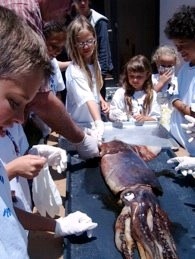
Kids get squiddy at the Pacific Grove Museum of Natural History (photo: A. Booth)
by Erin Loury, Ichthyology Lab
Unwrapping a jumbo-squid-sized mail delivery was but a dream for marine scientist hopefuls of yesteryear. Now, thanks to our pals at Stanford’s Hopkins Marine Station, your students can have that experience in your own classroom!
The Squid-4-kids program, run by graduate students out of the Monterey-based Hopkins Marine Station, can provide your students a one-of-a-kind learning experience to poke, prod, and dissect a giant of the deep. The squid and lesson plans come free, you just pay for shipping. All Humboldt squid are collected in conjunction with ongoing research or by sport fishermen who donate their excess catch.
And while you’re at it, check out the awesome squid research these Hopkins students are doing! This great podcast and photo slideshow on searching for squid with the Hopkins crew was put together by Cassandra Brooks, an MLML alum working for the National Park Service. And Hopkins student Danna Staaf is not just a squid researcher but also a squid blogger extraordinaire. Give her a visit and get your dose of Squid-A-Day!
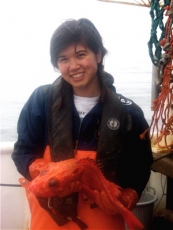
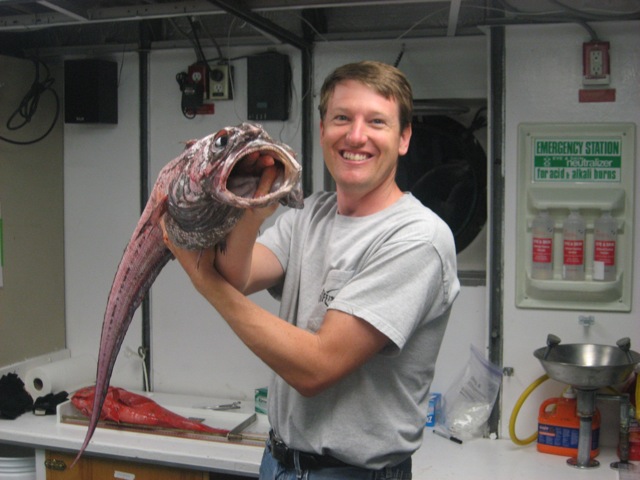
No, this isn’t an elaborate fish puppet you’re looking at – it’s a Giant Grenadier caught in the depths of Monterey Bay on a research cruise. If it looks a little worse for wear (that pink color is from all its scales falling off), it’s because the fish was pulled up from a depth of around 1,000 feet. Like most deepsea fishes, the different species of grenadier tend to grow slowly, reproduce late in life, and can live to be quite old (several decades) – all of which makes them susceptible to overfishing.
Yes, believe it or not, fishing is a real issue for these squishy critters. Grenadier now makes an appearance on the West Coast version of Monterey Bay Aquarium’s new 2010 Seafood Watch pocket guides. And they’re in the red – that’s the “Avoid” section. In addition to a slow-growing life history, the fishery for grenadier is virtually unregulated, and often the result of destructive deepsea trawling. This is all good news you can use – I recently saw grenadier on a menu for the first time. Now I know to steer clear.
Curtailing demand for this fish probably wouldn’t be a problem if people only knew what it looked like – besides, how appetizing is something also called a “rattail”?
Hot off the presses! The MLML Wave Newsletter is here! Ever wonder what it’s like to study sharks and their relatives? This issue takes an in-depth look at MLML’s Pacific Shark Research Center, including the description of new species. You can also read a tribute to Ichthyology Professor Greg Cailliet’s retirement, as well as updates from all the labs. Click to download your copy of the 2010 Wave Newsletter, or visit our Friends of MLML website. Enjoy!