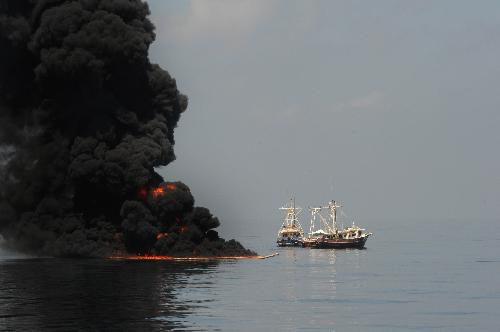
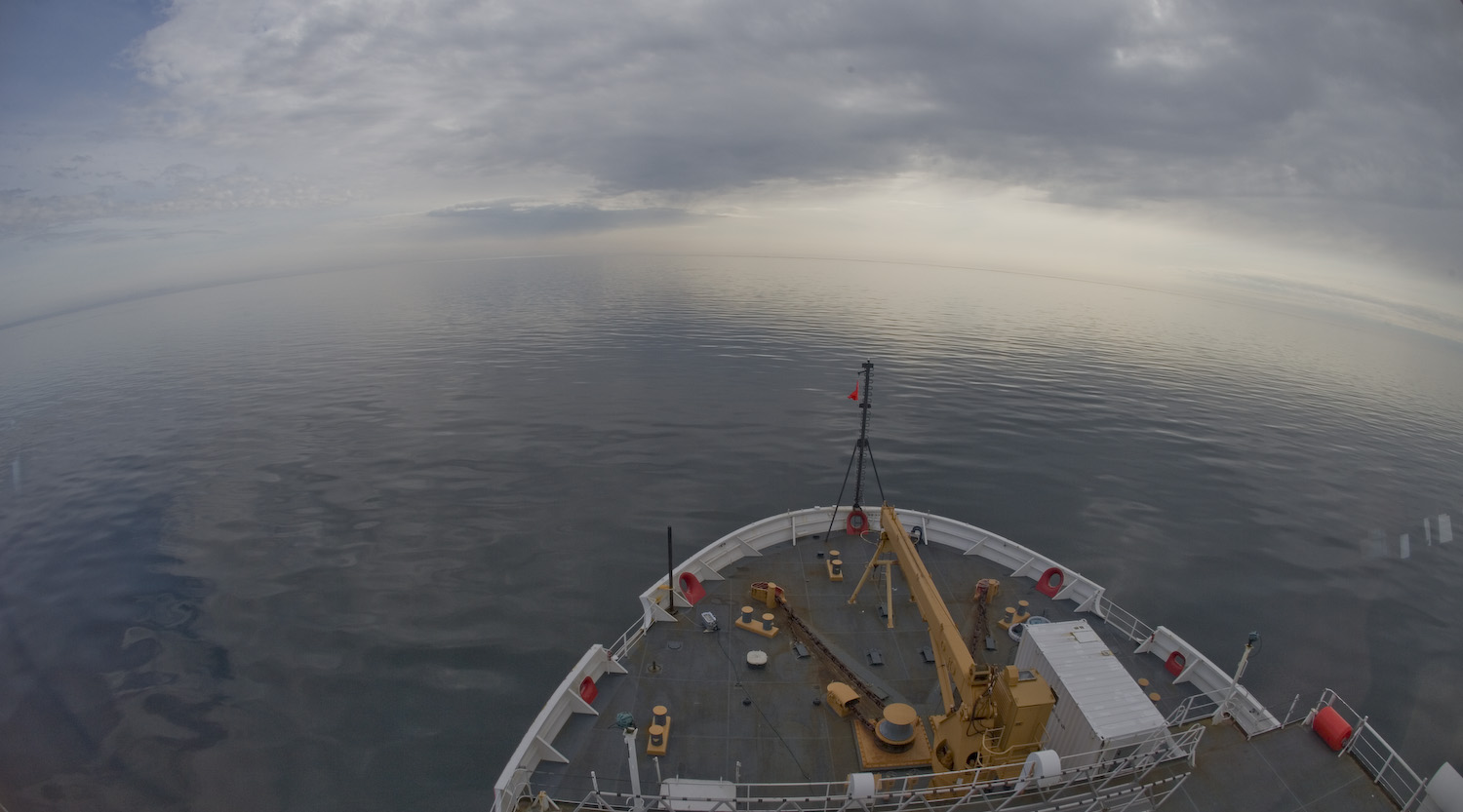
What more timely topic for discussion than clean energy in the ocean? Above, fishing boats drag oil booms as the U.S. Coast Guard trains for controled burns of the Gulf of Mexico oil spill. (photo: U.S. Navy, Jeffery Tilghman Williams/Marine Photobank)Erin Loury
This week I’ll be trading my MLML t-shirts for a business suit when I head off to Washington, D.C. for Capitol Hill Ocean Week. Sponsored by the National Marine Sanctuaries Foundation, the week is held around World Ocean Day (coming up on June 8th!) and brings together legislators, agencies, academics and nonprofits to discuss ocean and coastal issues. This year, the topic couldn’t be more timely: “Clean Energy and a Healthy Ocean: Navigating the Future.” I hope that the major topic of discussion will be the oil spill and environmental disaster currently unfolding in the Gulf Coast.
Thanks to a scholarship from the Center for Ocean Solution’s MARINE program, I will get to immerse myself in the mix of ocean science, policy, and science communication during a whirlwind few days. I’ll be posting along with other staff from the Center for Ocean Solutions on their new Open Ocean blog. In addition to attending some of the scheduled panels, I’ll be traveling around the city to meet with a variety of science communicators and conservation scientists from the Smithsonian Institution, the World Wildlife Fund, and the International Union for Conservation of Nature, to name a few.
Send me your thoughts and I’ll pack them along with me to DC!
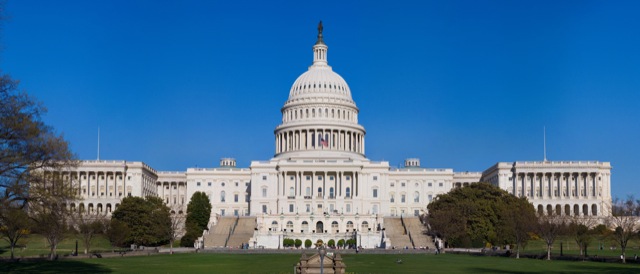
I'll be searching for role of science and science communication during the discussions of Capitol Hill Ocean Week (photo: Noclip, Wikipedia)
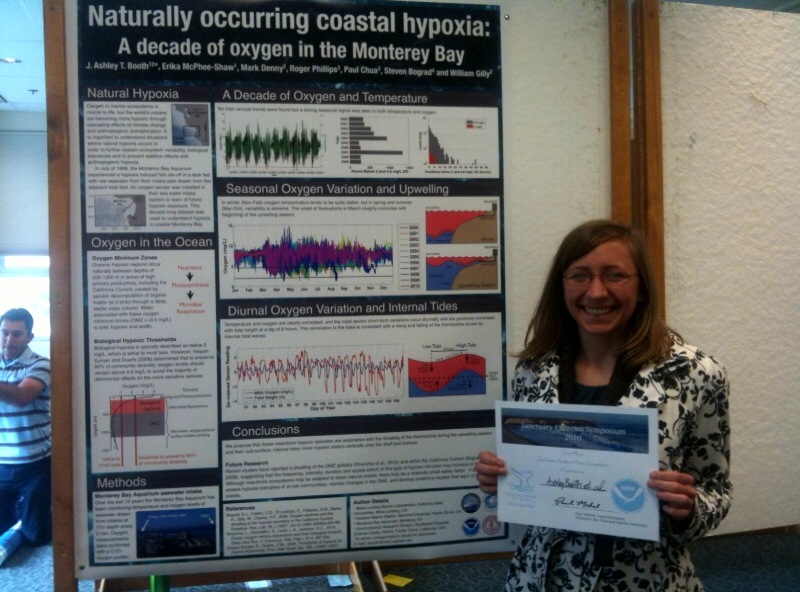
Ashley Booth shows off her winning poster at the Sanctuary Currents Symposium. Congratulations!
by Erin Loury
Breathing is a pretty key function in life, and most living things need oxygen to survive. This fact is just as true in the ocean as it is on land, meaning that areas of low oxygen water can severely stress marine organisms. Scientists and managers are particularly interested in low oxygen, or hypoxic, zones in coastal areas because they can be human-created: agricultural runoff can dump an excess of nutrients into the water, triggering a huge phytoplankton bloom. Not all of the phytoplankton get eaten, so these algae die and sink to the sea floor, where bacteria decompose them. These bacteria working on overdrive use up the oxygen in the water, creating a hypoxic zone.
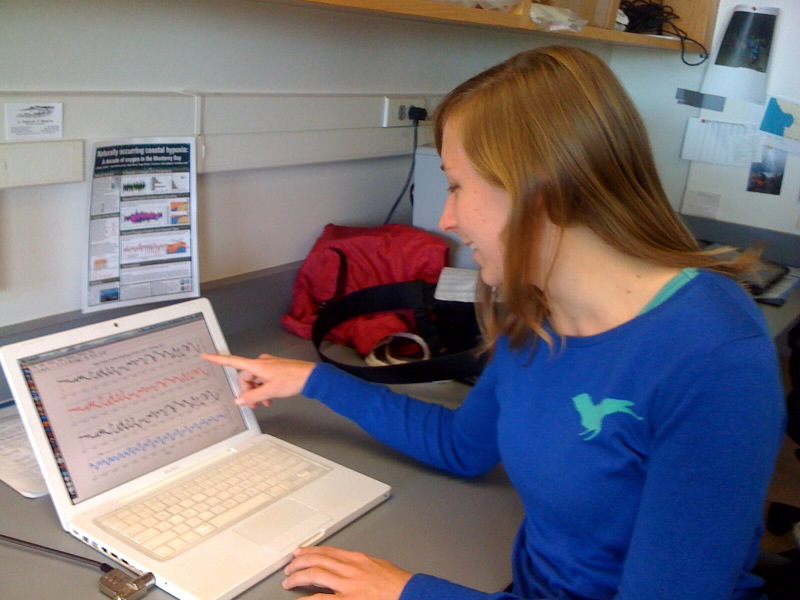
But some areas of the ocean are just naturally low in oxygen. Much of this low oxygen water is very deep, but is occasionally carried to shallower, coastal areas through the process of upwelling (when surface water is blown offshore by wind and deep water rises up to the surface). Physical Oceanography student Ashley Booth is studying oxygen data from monitoring stations in a kelp forest near the Monterey Bay Aquarium to determine how often low-oxygen water from the Monterey Submarine Canyon flows into this important nearshore habitat. The goal of Ashley’s work is to look for patterns and determine what “natural” low oxygen concentrations look like – using this baseline, managers can then determine the impact the agricultural runoff has in further depleting marine oxygen levels.
The seasonal ice is breaking up, and it’s time once again for oceanographers to motor out into the Bering Sea to check the vital signs of the rich sub-arctic. This summer Brian Hoover and I (from Dr. Harvey’s Vertebrate Ecology Lab) will spend many weeks observing seabirds and marine mammals while on scientific research vessels that ply the waters of the Bering, Chukchi, and Arctic. We are participating in a large, coordinated research effort led by scientists from across the country and funded through the North Pacific Research Board’s BEST-BSIERP science plan.
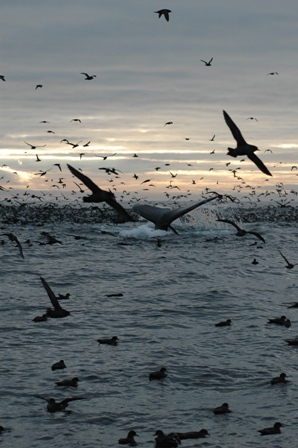
Humpbacks and shearwaters feeding on the north side of an Aleutian pass (photo: NMML)
This plan applies research to every aspect of the marine environment – from the flow of currents and micro-nutrients, through the growth and transport of plankton, and on across an interconnected food web to include fish, seabirds, seals, walrus, whales, and even humans and our species’ relationship to the oceans.
Brian and I focus on marine birds and mammals for our studies. While on these ships we will be counting and describing the animals we encounter, entering information as we observe the activity from the wheelhouse, high above the water. This is a good location from which to appreciate the dynamism of these productive regions. In the following four months we will be posting more pictures and stories about our studies, brining you along with us as we push through ice, buck storm swells, and glide through the glassy bliss of calm seas between. Can’t wait!
Moss Landing Marine Labs alumna Cassadra Brooks has taken her research on the Antarctic toothfish to a new level, hoping to effectively convey relevant science to the public and fisheries managers. Now a science communicator for The Last Ocean project, Cassandra recently interviewed MLML Professor Emeritus Greg Cailliet about the aspects of deep-sea fishes, including their old ages and slow growth and reproduction, that make them vulnerable to overfishing.
Dr. Cailliet is our local goldmine of ichthyology (that’s fish knowledge!). Get the scoop straight from the expert’s mouth!
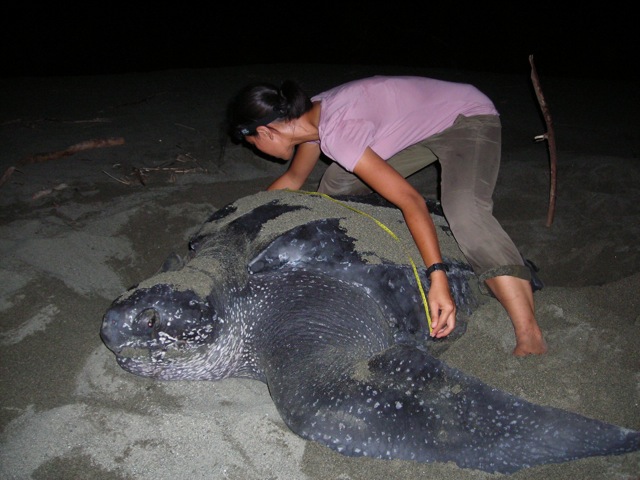
What an armful - Deasy measures a nesting leatherback turtle in Indonesia.Deasy Lontoh
by Deasy Lontoh, Vertebrate Ecology Lab
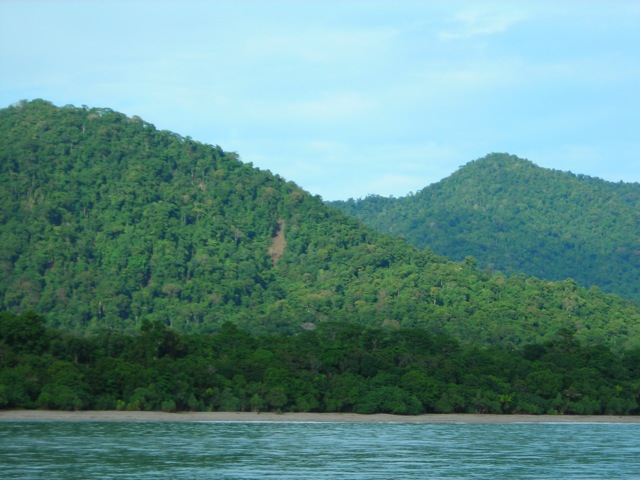
In July 2009, I went to see the leatherback turtles in Papua. After a five-hour flight from Jakarta to Sorong, West Papua, and a six-hour boat ride east, I finally arrived at Jamursba Medi beach. It is the home of leatherback turtles and Birds of Paradise. Jamursba Medi consists of three beaches, and together they span approximately 18 km. The Tamrauw Mountains covered in pristine lowland rainforest give the beaches a lush emerald backdrop.
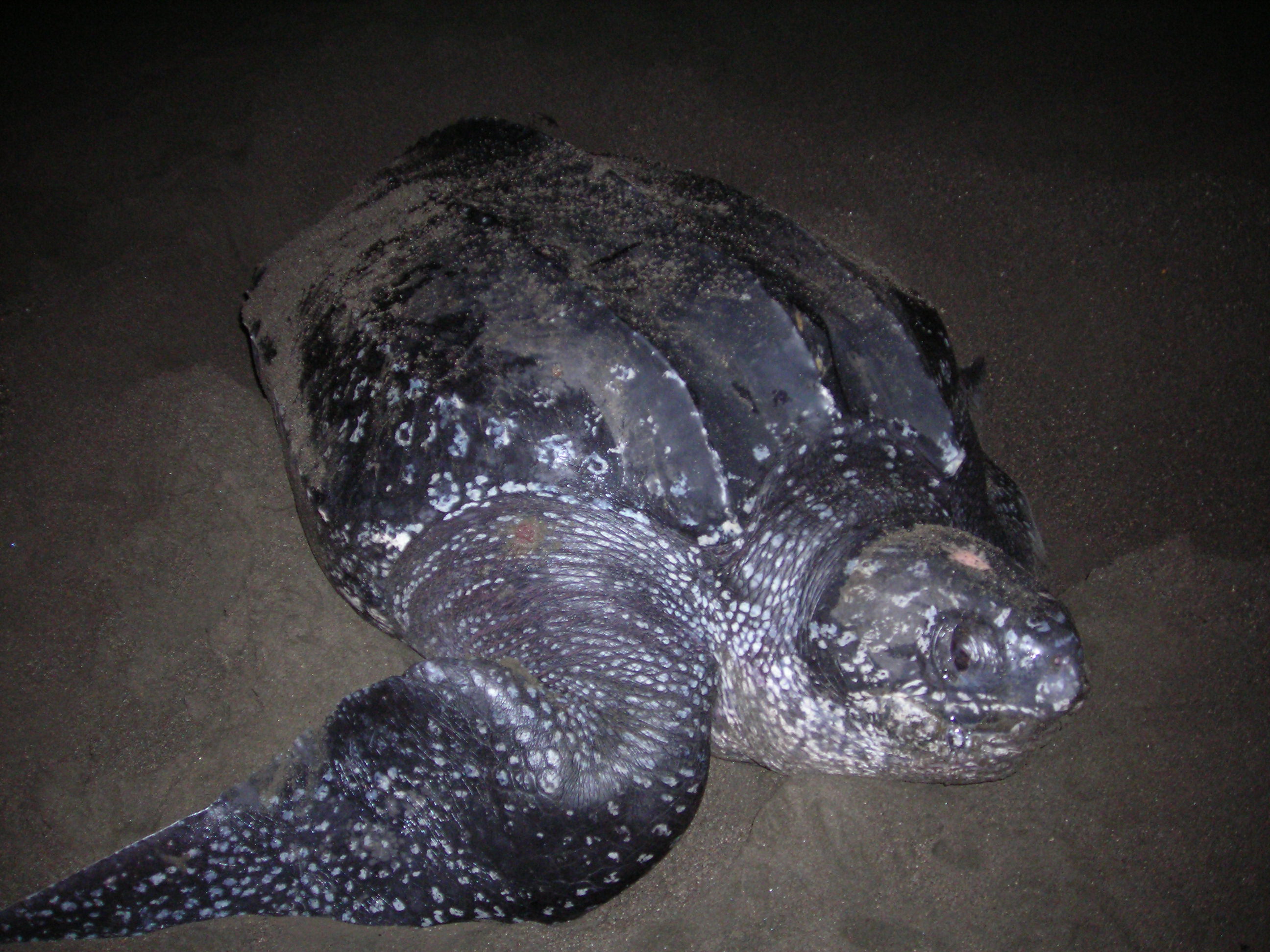
I patrolled one of Jamursba Medi beaches for three nights, and not a single leatherback appeared. On the fourth day, I went to Wermon, another nesting beach about 30 km from Jamursba Medi, with a small crew of people. That night around 10 pm, my walking partner’s keen eyes spotted the dark silhouette on the sand yards away and we rushed to it. I didn’t make out the silhouette right away, but I heard her front flippers hitting the sand as she pulled her heavy body forward and her laborious breathing. She was breathtaking! A leatherback’s carapace can get up to two meters long and their weight up to 900 kg. But the enormity of this giant was beyond my expectations. Such girth around the body! How strong must her front flippers be to pull such a heavy body! Her carapace was 167 cm long and 118 cm wide, and she could easily weigh more than 800 kg. She had smooth skin, and her muscular flippers reminded me of muscles of an elephant.
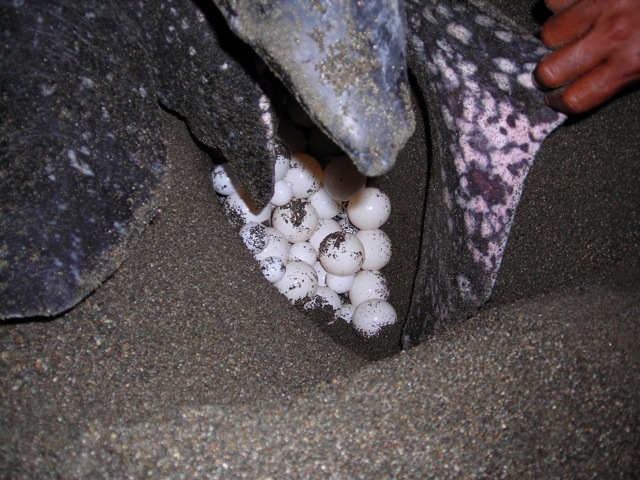
A female leatherback digs a hole with her flippers, then lays and covers her eggs in this hiding place.
Once she located a good place, she started excavating. She dug with her hind flippers, which are surprisingly flexible and maneuverable. She scooped a handful of sand with the tip of her flippers and tossed it to the side. As she scooped, the flipper grazed the side of the nest, effectively smoothing and compacting the nest wall, which prevented it from collapsing. Once an appropriate depth was reached, she started to lay her eggs. While she laid her eggs, one flipper covered the nest opening to prevent sand from coming into the nest. Female turtles are in a trance-like state when they lay eggs, which allows researchers to mark individuals, measure carapace length and width, and attach transmitters. When she was done laying her eggs, she covered the nest with sand using her hind flippers. Then with the weight of her whole body, she packed the sand above the nest. But it was not over yet. With her powerful front flippers, she moved the sand towards the back of her body. Sand was flying everywhere! Then she started to circle, dramatically tossing the sand back. She was camouflaging her nest. Once she was done, she headed back to sea. It was definitely a meeting to remember.
The Jamursba Medi coastline, Indonesia - the site of Deasy's memorable turtle encounter.
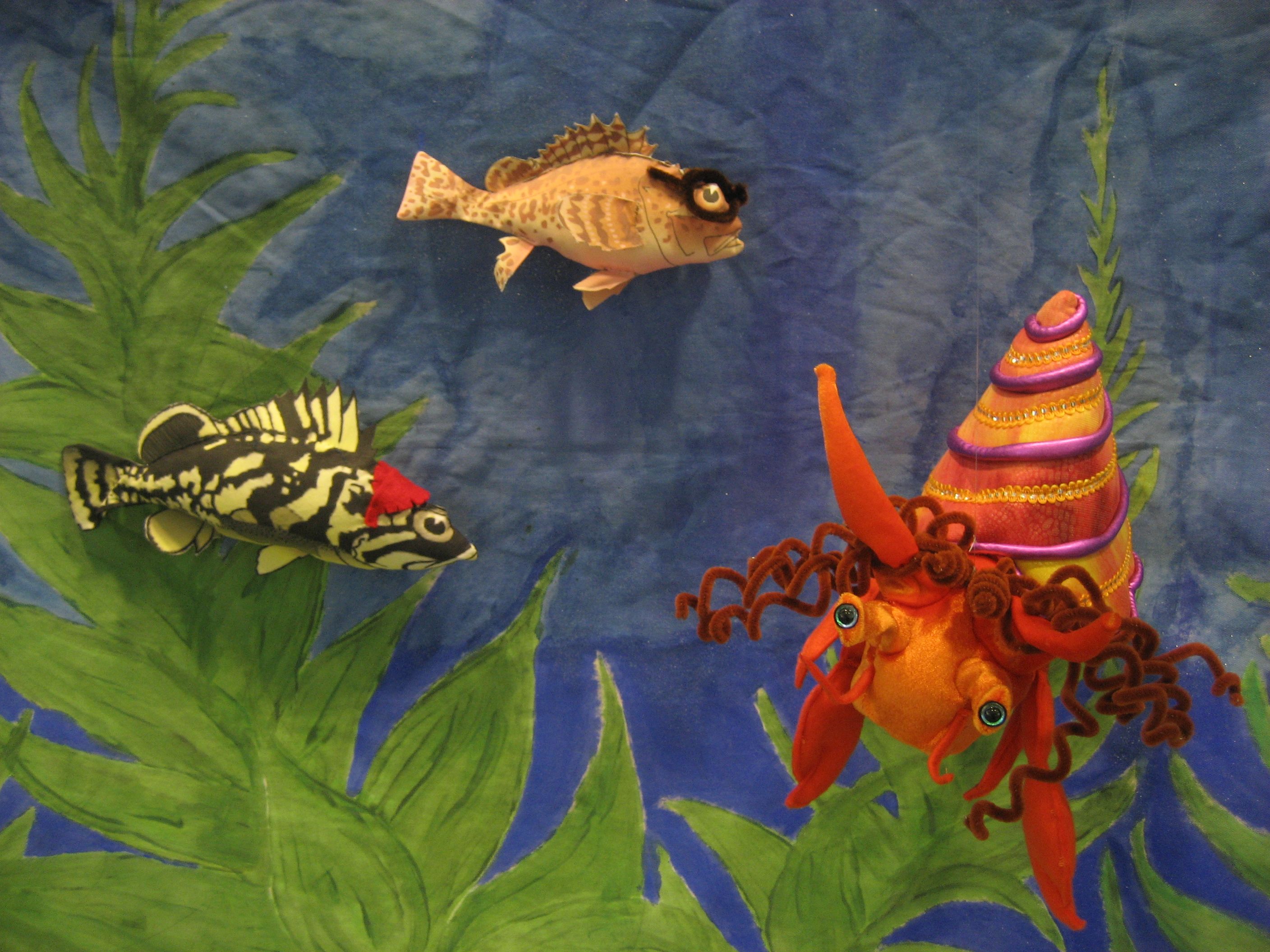
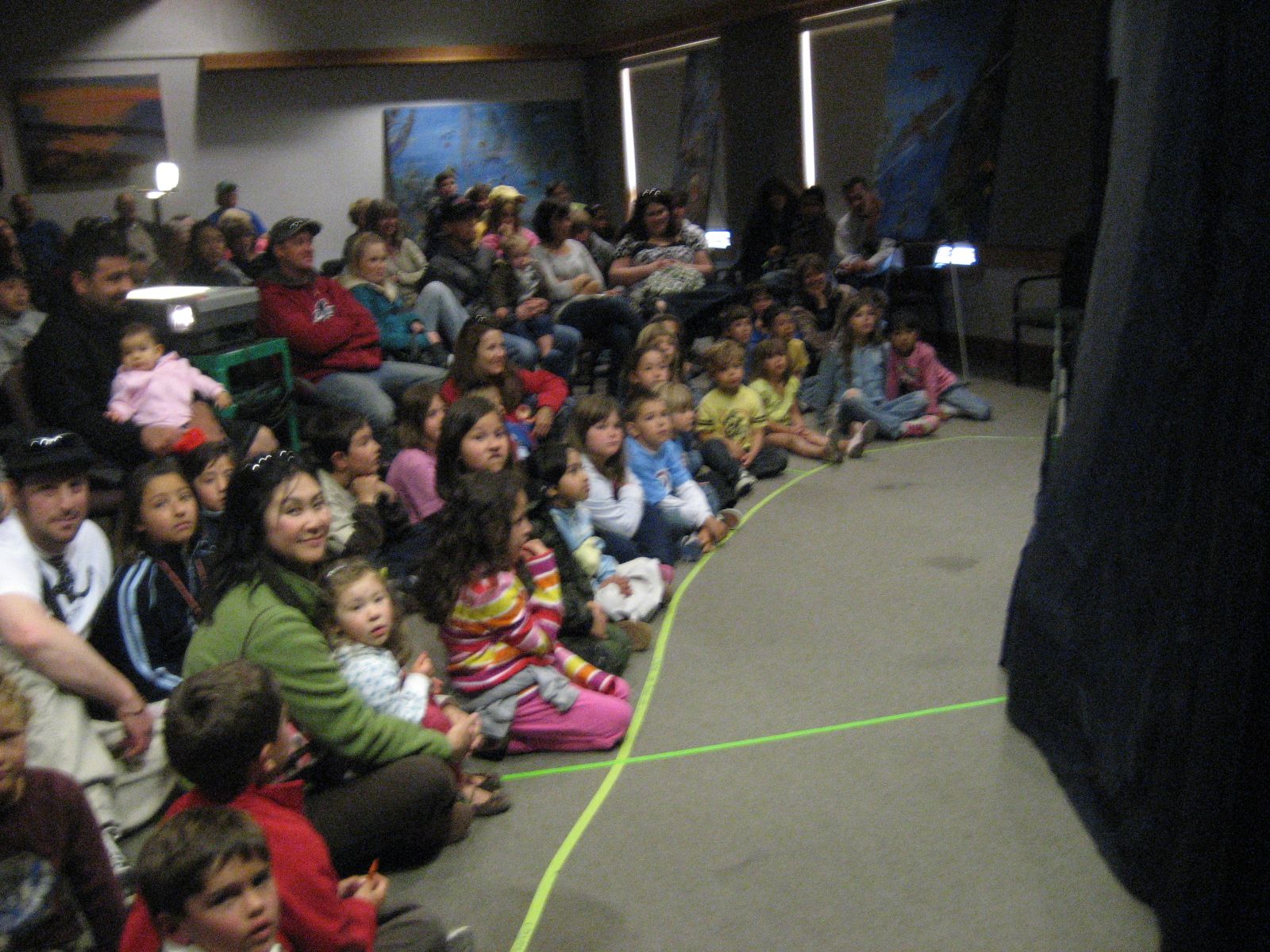
Anyone who has visited an MLML Open House knows that the puppet show is a longstanding tradition and major highlight for visitors of all ages. After much patience and anticipation, the 2009 puppet show is now available for your viewing pleasure!
Follow Harry Spotter the scorpion fish, Ron the rockfish, and Hermione the Hermit crab on a Darwin-inspired search for their relatives with shared adaptations. Their adventure takes them on a daring break-in to the Monterey Bay Aquarium, where they meet an array of colorful and musical coral reef inhabitants!
The show is divided into two parts – apologies for the poor lighting in the first 1:30 minutes of the show!
Come discover something new about marine science at the MLML 2010 Open House! (photo: E. Loury)
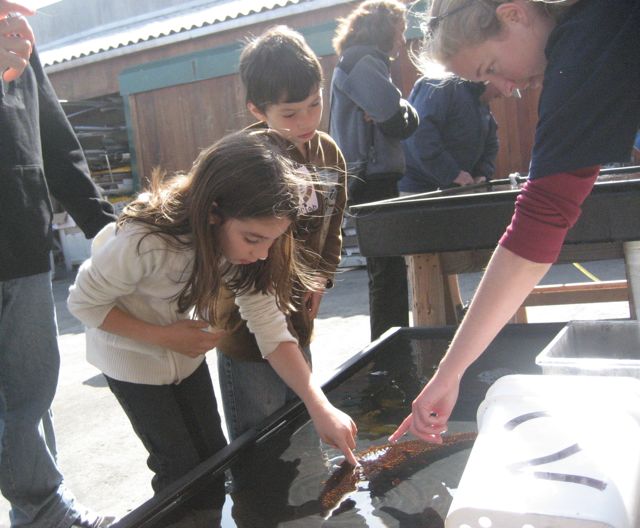
Mark your calendars, marine science fans! The MLML 2010 Open House is fast approaching!! Come join us on Saturday and Sunday, April 17 & 18th from 9 am – 5 pm as we throw the doors of our lab open wide for a weekend of fun hands-on exploration and discovery. Get a behind-the-scenes look at how we study the ocean! We will have live animal touch tanks, native dune tours, fish printing, an adventure puppet show, a science scavenger hunt, educational seminars, and much, much more!
Get up close and personal with a variety of marine creatures! (photo: E. Loury)
This is a free event that is great for families and marine enthusiasts of all ages. Delicious food will be available for purchase. You will also be able to purchase opportunity drawing tickets to enter to win a variety of wonderful prizes, while supporting the MLML student body at the same time. Join us for:
The annual MLML OPEN HOUSE!
Saturday & Sunday
April 17th and 18th
9:00am-5:00pm
8272 Moss Landing Road, Moss Landing CA 95039
For more information, call (831) 771-4400
See you there!
Come meet MLML students, faculty, and staff, and learn about our incredible research!
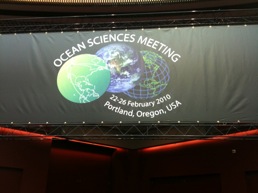
Well it’s been a while since my last post, but things have been busy! With my last sample season far behind me, my thesis writing is well underway. Many students at Moss Landing try to travel to conferences across the world to present the results of their research BEFORE they have to make a final defense, and I am no exception. As our decade came to a close, I tried to open as many future doors as possible by making a poster and attending the international Ocean Sciences (OS) Meeting in Portland.
The annual OS meeting brings together some of the top minds in oceanography to present the latest advances in all aspects of Marine Science and I felt privileged to be able to join them. I spent the January preparing and going through many many different drafts of my poster. Initially I’m always happy to work on a poster, it gives my poorly neglected artistic side a chance to mingle with the rest of my brain to create something both visually appealing and scientifically accurate. After a month of working on the thing my feelings changed and I began to hate spending hours on simple formating while my aging computer struggled under the weight of the behemoth Keynote file. In the end, the poster was printed, I got time off of work and everything was ready for the week-long conference.
After hours of hard work, and scientific and artistic struggle, my poster is a thing of pride (photo: J. Brower)
Unfortunately I developed a nasty flu just as I was leaving Moss Landing so I spent most of the conference groggy and drugged-up, but despite my poor health the event was a resounding success. I presented my poster and received some great feed-back from some of the key scientists whose past research served as inspiration for my thesis. There were some phenomenal presentations that represented a good variety of both field research and statistical modeling. Personally, I thought that results of field research are more compelling then ocean modeling, but there is value in both approaches.
I had to leave the conference early because my flu was becoming worse, but after I returned to the Monterey Bay I was able to recover and begin work on finishing my thesis! I used the feedback I received from Portland to re-structure some sections of my presentation and start thinking about what my data actually meant! As much of a pain as the poster ended up being, it forced me to start thinking about the conclusions of my thesis. The poster, while general in its representation of my research, provided the platform I needed to dive into writing my thesis draft. I was able to use the conference to organize my thoughts and present them to my peers both in and outside of the lab environment. Finally, the conference allowed me to assess how far I still had to go and plan the rest of the year.
A few weeks after Portland, I presented my conclusions at a lab meeting and with the help of my advisor and the blessings of my committee, I was able to set a date for my thesis defense in late May! There is a lot of work that still needs to be done, but I should have no trouble getting ready to present my final conclusions at the end of the Spring semester. I’m taking the last stage very slow: spending my weekends reviewing data and writing up my final conclusions, making sure everything fits into a nice little story. My advisor has stressed the “story” structure of my presentation because there are not many physical science defenses at Moss Landing, so my audience will be largely uninformed about the background to my research. My thesis has nothing to do with gut-content analysis of Harbor Seals or age and growth modeling of Skates (two of the more common Moss Landing thesis topics), so the challenge for me will lie in explaining to a room full of biologists why they should be interested in sand!
Why should you care about geology? Because it rocks!
To wrap things up, I can’t recommend scientific conferences enough! They force you to make some sort of order out of the chaos of your data and it exposes your research to the larger scientific community across the world. The rest of the year after my defense is a unknown factor. I don’t have any guaranteed jobs, nor am I moving directly into a Ph.D program (maybe in the future, but not now), but I can take a little comfort in the fact that I’m doing all that I can to expose my research and make those vital connections that will lead to future employment. For now, I just cross my fingers that my life retains some sort of stability that will let me finish my thesis. After that….I suppose the sky’s the limit.
Visitors from the Western Pacific: Some leatherback turtles travel across the Pacific Ocean, from Indonesia to North America, to feed on jellies (photo: D. Lontoh)
Deasy Lontoh
by Deasy Lontoh, Vertebrate Ecology Lab
It usually takes me 17 to 20 hours to fly from San Francisco to Jakarta, Indonesia, which covers about 9,000 miles of distance. Most of my family members live in Indonesia and I come to visit them every few years. Long hours in a plane seat and missing a day because of a 15-hour time difference are not my favorite things. But my journey is comparatively fast and plush. In 2007, I learned that a leatherback completed a similar trans-Pacific journey in 647 days covering 12,477 miles! On flippers! Scientists put on a satellite transmitter to track this turtle when it was nesting in Papua, Indonesia, which is about 2000 miles northeast of Jakarta. It traveled all the way from Indonesia to Oregon to feed on abundant jellies.
We know now that the leatherback turtles that feed all along the west coast of North America, including Monterey bay, CA in late summer and early fall, come all the way from the nesting population in Papua. Their satellite tracks show that these leatherbacks spend one season to forage on our west coast, spend the winter in Hawaii (probably because the water here is too cold), then come back to our west coast and eat more jellies. The body of a jelly consists of mostly water, although their gonads are a richer source of nutrients. Can you imagine how many jellies they need to eat? They have to eat enough jellies to fuel their return migration to the nesting beach in Indonesia and to produce eggs. Scientists predict they can their weight in jellies per day to get that much energy – about 800 pounds!
To learn more about the leatherback visitors to Monterey Bay, check out Scott Benson’s great blog through the TOPP project.
There’s nothing like seeing the food-chain in action to make you appreciate how important eating is in an animal’s life – and why it’s so important to study (says the fish guts girl)! For many things in the ocean, it’s just a matter of time before they become something else’s lunch. It’s a fish eat fish world out there!
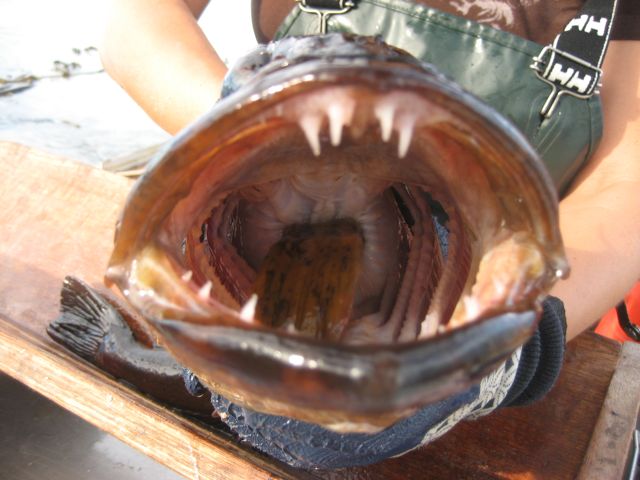
This week’s photo comes from summer surveys I participated in with the California Collaborative Fisheries Research Program while we surveyed new marine protected areas in central California. The photo is of a lingcod, and shows off the feature that is probably most important to appreciate when working with these fish – TEETH! Those are a clear indication that this fish is a predator, and it means business!
What you see in its mouth is the tail end of a hapless rockfish experiencing the ultimate “game over.” This particular lingcod ate the rockfish right out of the fish trap that both were caught in, but are also big predators on rockfish in the wild too.
Chances are you’ve probably eaten rockfish or lingcod yourself if you live in California – meaning this photo really shows three levels of the food chain – rockfish, lingcod, and humans. Humans are probably the most voracious predators of all in the marine environment, emphasizing the need to appreciate what we eat, and what it eats in turn! So the next time you get that fish taco or fish and chips, think about how you are taking part in the bigger ocean food chain.
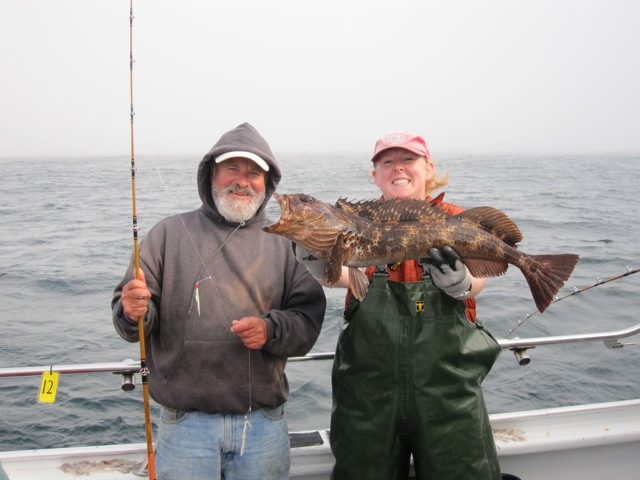
The long view: MLML student Katie Schmitt shows off a lingcod caught during a tagging survey in California's new marine protected areas (photo: N. Yochum).