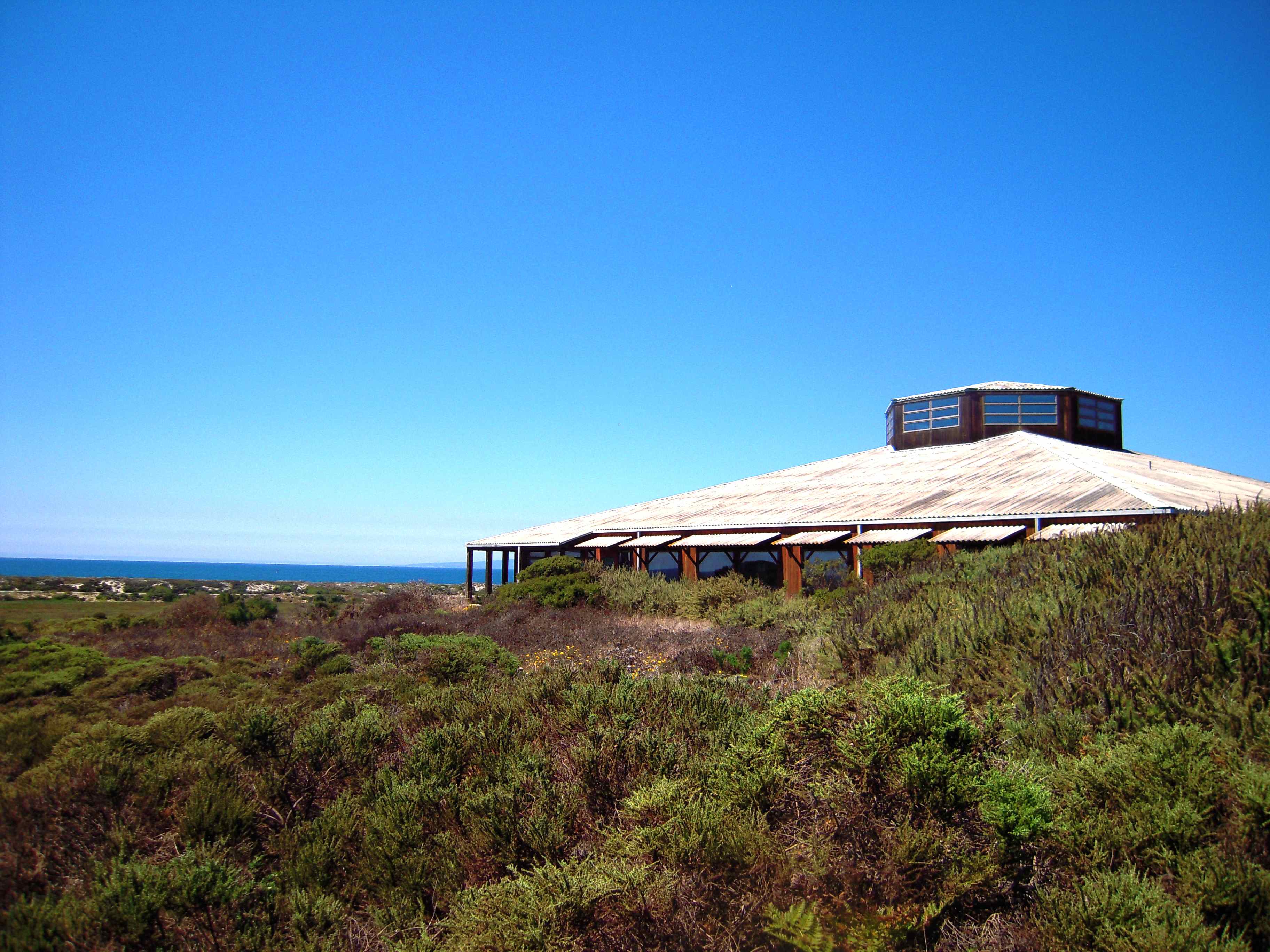
When the current Moss Landing Marine Labs facility was built in 2000, the Habitat Restoration group of the Benthic Ecology Lab restored the surrounding dunes from nonnative ice plant to native California vegetation. The lab itself seems to blend into the hillside. This photo of the MLML Library reveals a view that offers plenty of reasons for procrastination…
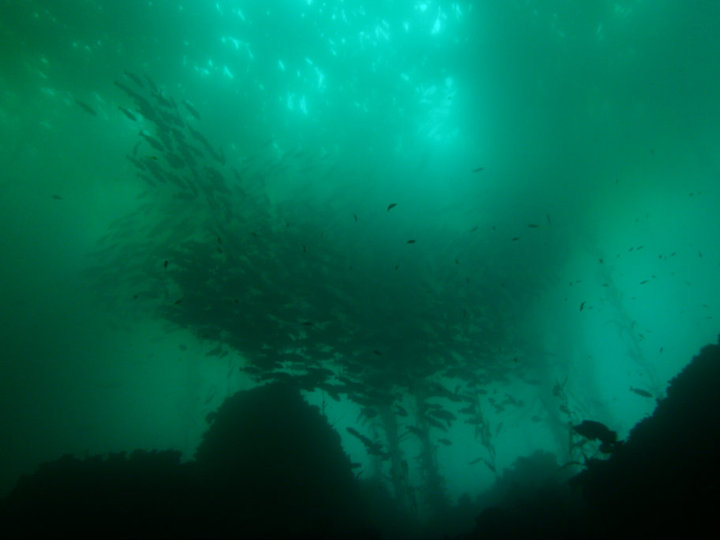
Beneath the waves lies the stunning world of the kelp forest. This school of blue rockfish casts a mysterious shadow among the towering kelp plants. Unlike other species of rockfish that hunker down among the rocks, blue rockfish spend more of their time in the water column where they feed on plankton and jellyfish.
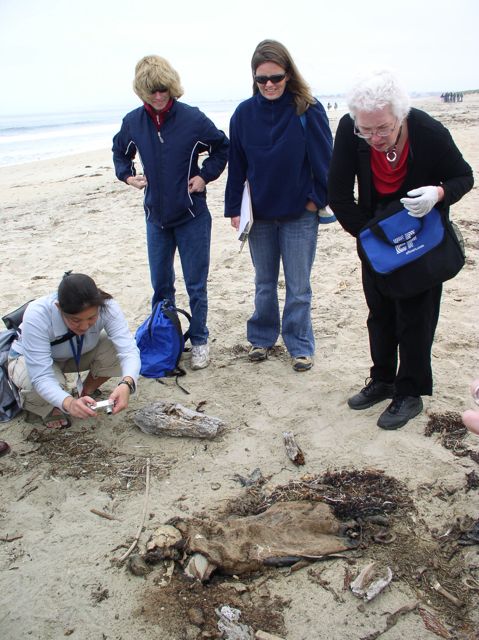
A dead body on the beach surely warrants an investigation. Teachers from around the country inspect a California sea lion carcass on Moss Landing State Beach as part of the National Marine Educators Association conference. MLML students from the Teacher Enhancement Program talked to the teachers about MLML’s participation with beach COMBERS, or Coastal Ocean Mammal and Bird Education and Research Surveys, run by the Monterey Bay National Marine Sanctuary. Program volunteers collect data on how often birds and mammals strand on the beaches around Monterey Bay. Though the researchers try to determine cause of death when they can, this particular whodunit will likely remain unsolved. Read a testimonial from a beach COMBERS volunteer here.
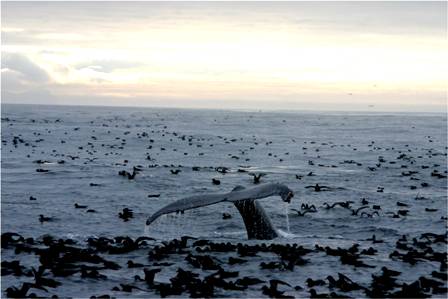
Humpback and Shearwaters, Unimak Pass. Photo: NMML
The magnificent power, the grace, the vigor of truly giant life. BUT, where do whales go when they die??
And, what about all those seals, sea lions, dolphins … heck, walruses, even?!
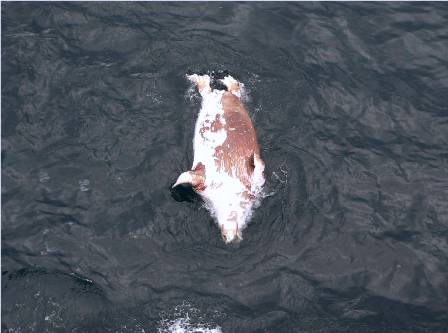
A Walrus carcass makes it into the 300m strip transect! Turns out even veteran at-sea researchers like USFWS Marty Reedy can still be surprised by new experiences. Photo: M. Reedy
What happens to them if they die at sea, as you might expect most of them would do? To explore this question, we might think to ask a marine scientist (naturally!). And, of course, there are scientists that are studying dead marine mammals (you aren’t surprised, are you?). In fact, Moss Landing’s very own Gillian Rhett is focusing her MSc research on dead whales! Turns out, studying the afterlife of marine mammals is every bit as intriguing as chasing them in the living flesh. Scientists are still learning about what happens to these animals after they die, and it’s a remarkable story.
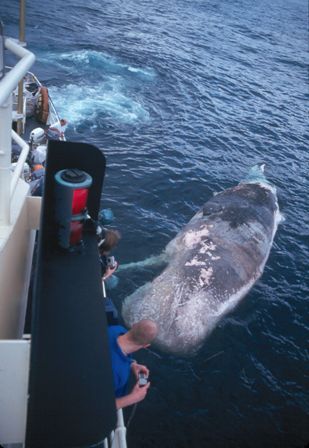
Scientists and crew (Nate Jones, among them) encounter a dead Sperm Whale, seen from flying bridge of USFWS R/V Tiglax. Photo: N. Jones
Nate Jones first saw this whale at about 2 km distance; a mysterious, looming chunk of something, floating low in the water, unmistakably immobile in the snotty tumult that is a typical Bering Sea day. Whatever this thing was, it was large. And probably of animal origin; there were about half a dozen gulls swarming the area, looking for a free meal. Sure enough, a Sperm Whale carcass.
You can see how tall tales are born on the high seas! Some of them are true…
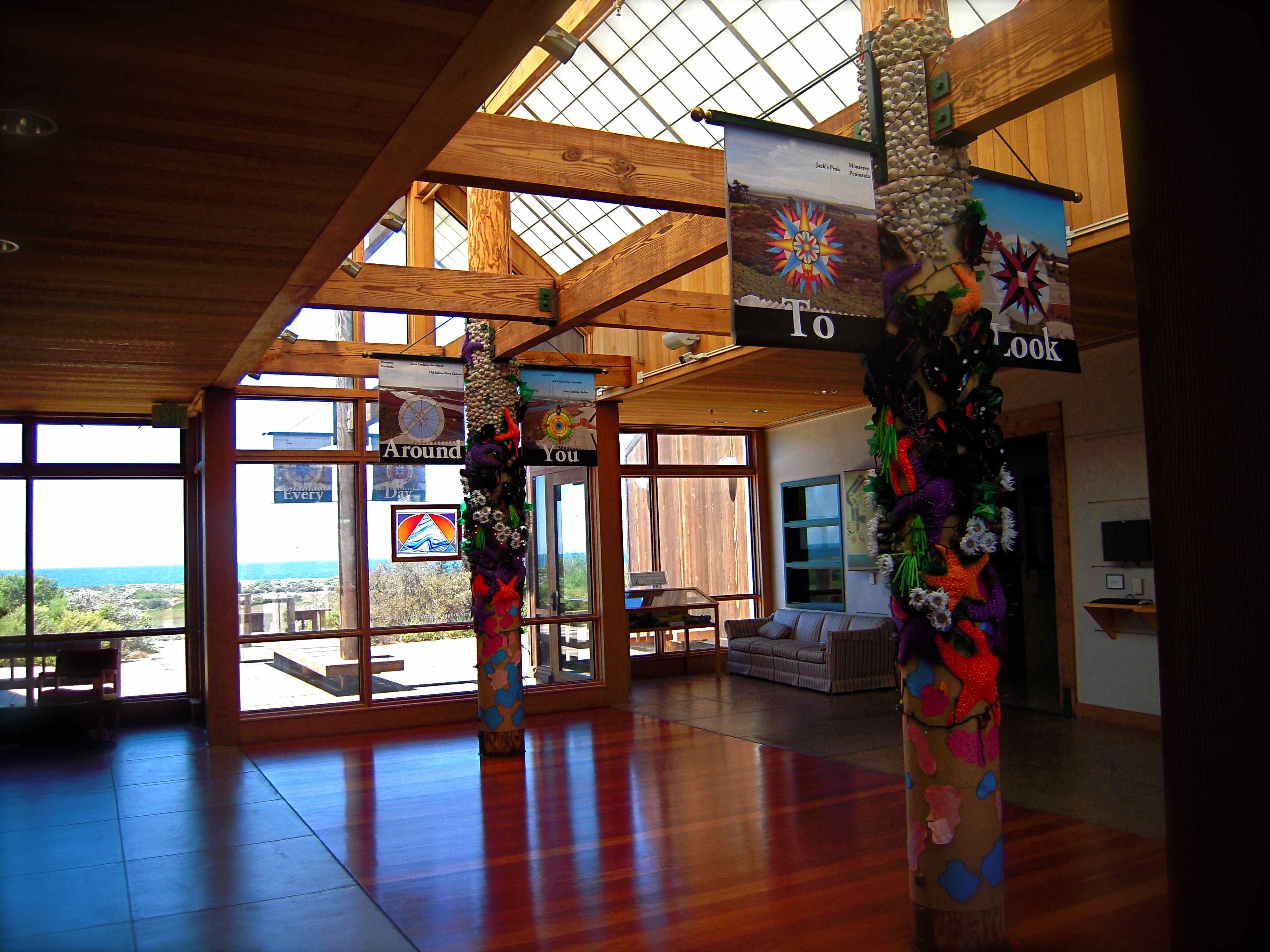
The entrance to Moss Landing Marine Labs provides a warm welcome with its stunning ocean view. It’s also a great reminder of our community creativity: the intertidal invertebrates adorning the pillars were all constructed by MLML staff, students and faculty.
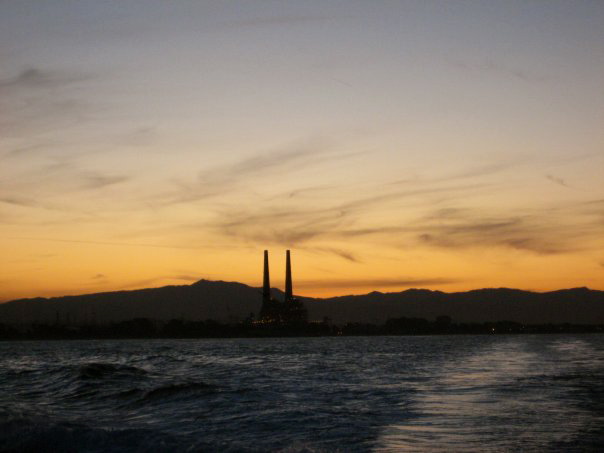
Cast a look back from whence you came – Moss Landing is an easy port to spot from the water because of its landmark smoke stacks. Though residents may find them picturesque only at sunset, the stacks make navigation handy for the ocean wayfarer.
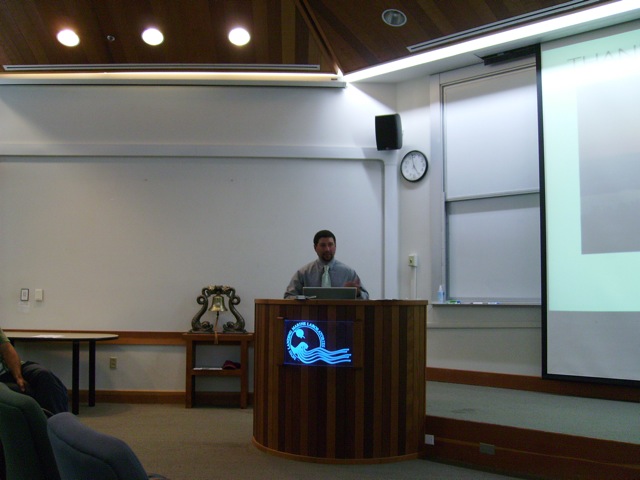
That’s Master Brower to you – Jeremiah at his thesis defense.Jeremiah Brower
by Jeremiah Brower, Geological Oceanography Lab
Greetings from your resident geologist blogger, who I’m happy to say is recently graduated! This last year has consisted of me going to conferences, writing my thesis, RE-writing my thesis, RE-writing it AGAIN and then finally defending my thesis to the MLML faculty and my peers, parents and friends. There was a lot of frantic writing followed by long periods of downtime while I watched the clock tick by and the end of the year get closer – but overall it was a great experience and a incredible relief to finally get the thesis done!
The thesis was the main focus of my life for nearly 4 years and the defense on October 4th went incredibly well, but I have to say it was a bit anti-climactic to have a four year project summed up in a hour. I also had to run back to work immediately after the defense, so the reality of my situation didn’t really sink until several weeks after the event. So the question now becomes “now what?” Read more →
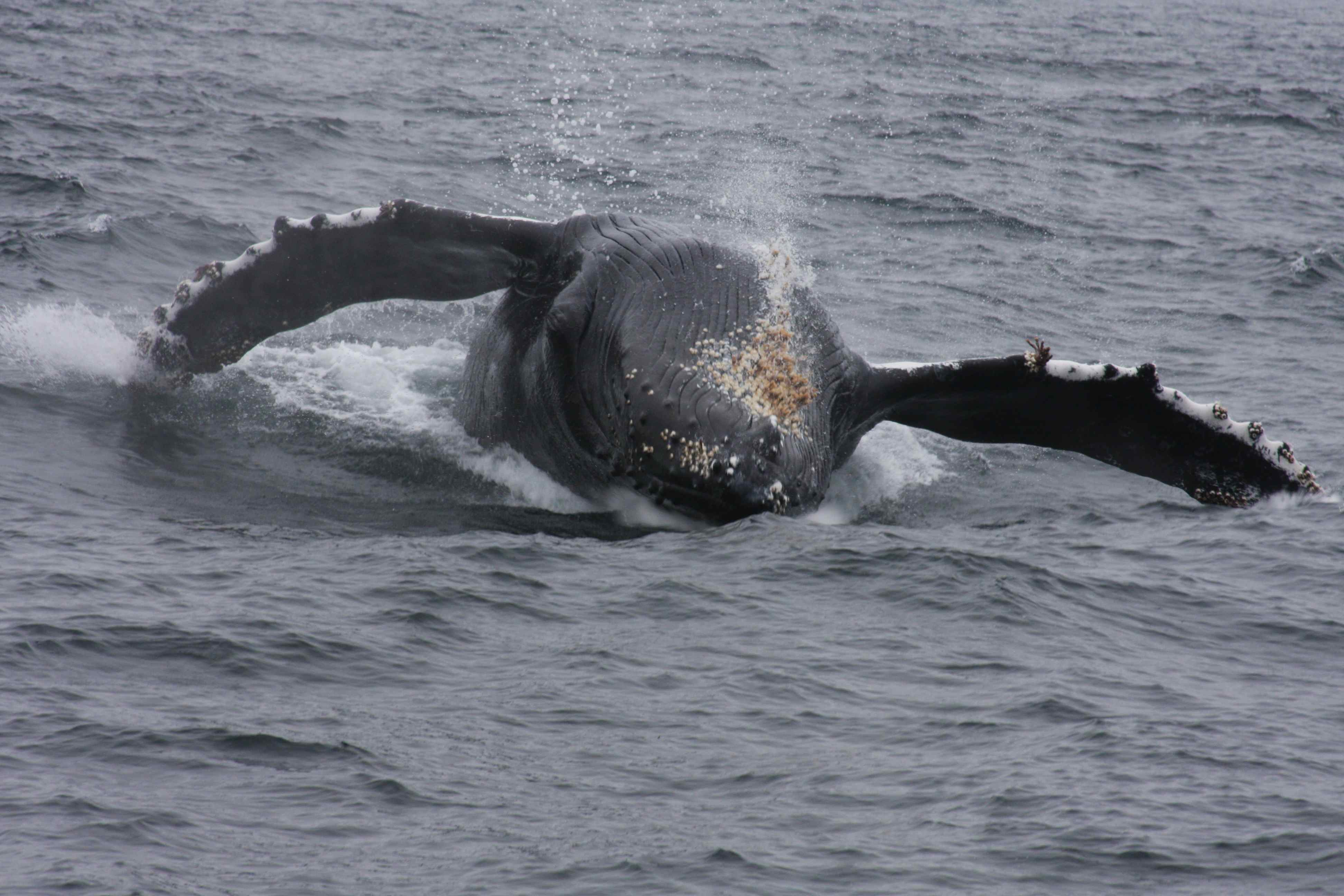
Graduate student Scott Gabara caught this fantastic photo while out in the field with PISCO. This humpback was putting on a great display for the eyes with its enthusiastic breaching. MLML student Casey Clark is currently conducting research on humpback whales – check out his student profile to learn more!
MLML Physical Oceanography student Alexis Howard observes a sediment grab performed by the crew of the R/V Point Sur. (photo: S. Gabara)
For the Physical Oceanography class at Moss Landing Marine Lab field research trips aboard the R/V Point Sur are a fun way to experience different field oceanographic equipment. Here student Alexis Howard looks on as the crew of the Point Sur retrieves a sample of sediment from the depths of Monterey Bay by means of a sediment grabber.
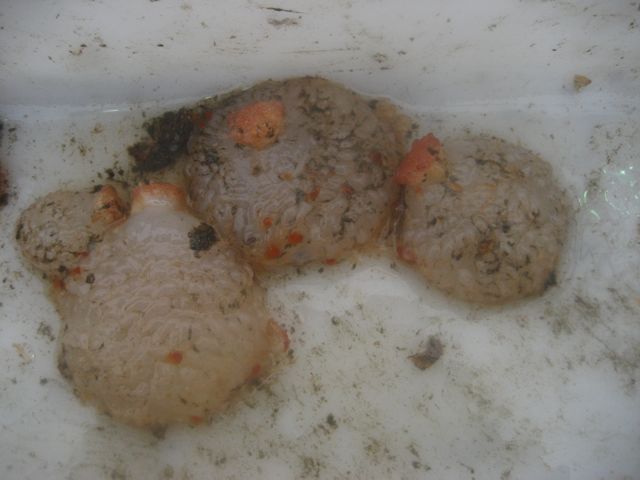
OK, so maybe you won’t find Sponge Bob at home here. But these sea pineapples, a type of tunicate or sea squirt, did come from several hundred feet under the sea (and are little muddier to show for it). This little crop was collected during a government trawl survey off of southern California. These squirts are definitely juicy, if not fruity!