Thank you so much for everyone who came out to our Science Cafe featuring “The Drop-In” this week! We really enjoyed talking to all of you, and we appreciate your great questions – which we will work on answering on the blog in the near future! We also unveiled the latest feature of the blog, our “Ask a Grad Student” page that you can use as your go-to place to ask those burning questions about marine science, anywhere, anytime! We may not answer right away, but be patient and we will reward you with a shiny new post featuring your very own question.
Thanks to Andy Stiny, who wrote a nice article about us in the Monterey Hearld (click here to read). Now that the word’s out, we look forward to connecting with all of you and chatting up the topic we love most – the wet, weird, and wonderful world of marine science! Stay tuned for more great updates from The Drop-In, and join the conversation!
Because tonight, November 12th at 7 pm, the Science Cafe at MLML (hosted by Friends of Moss Landing Marine Labs), features none other than – us!
That’s right, “The Drop-In” team is being turned loose in a public setting, and the result should be a fun exploration of this site’s many features, and a discussion about what you want to see on it.
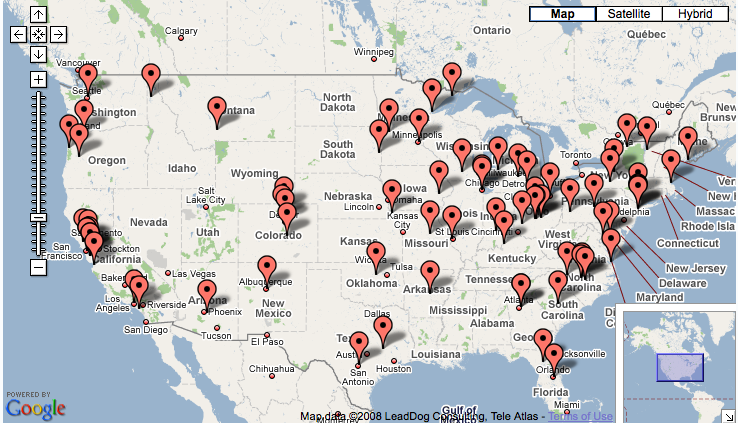
And we’re on the map – science cafes are springing up across the country, bringing you exciting science in a welcoming, conversational atmosphere. Come grab a toasty warm piece of the action!
We are part of a nation-wide movement. Click here to find a Science Cafe near you, including the one at Moss Landing Marine Labs!
Over the last couple of years I’ve learned that certain grants have been difficult to get because some people don’t consider Marine Geologists (or Geologic Oceanographers…the terms are interchangeable, one just seems to roll off the tongue better) as “actual” geologists because they don’t consider us to be “field scientists.” While there is a certain amount of truth in that, due to advances in software technology (much of our work involves computers and mapping programs), we still need to go outside to collect the data in the first place! Even the oceanographers who focus on the creation of habitat maps need to spend years surveying in the field before they can sit down in front of a computer and decide how best to play with the numbers.
A microscope view of glauchonite - that's fish poop you're looking at!
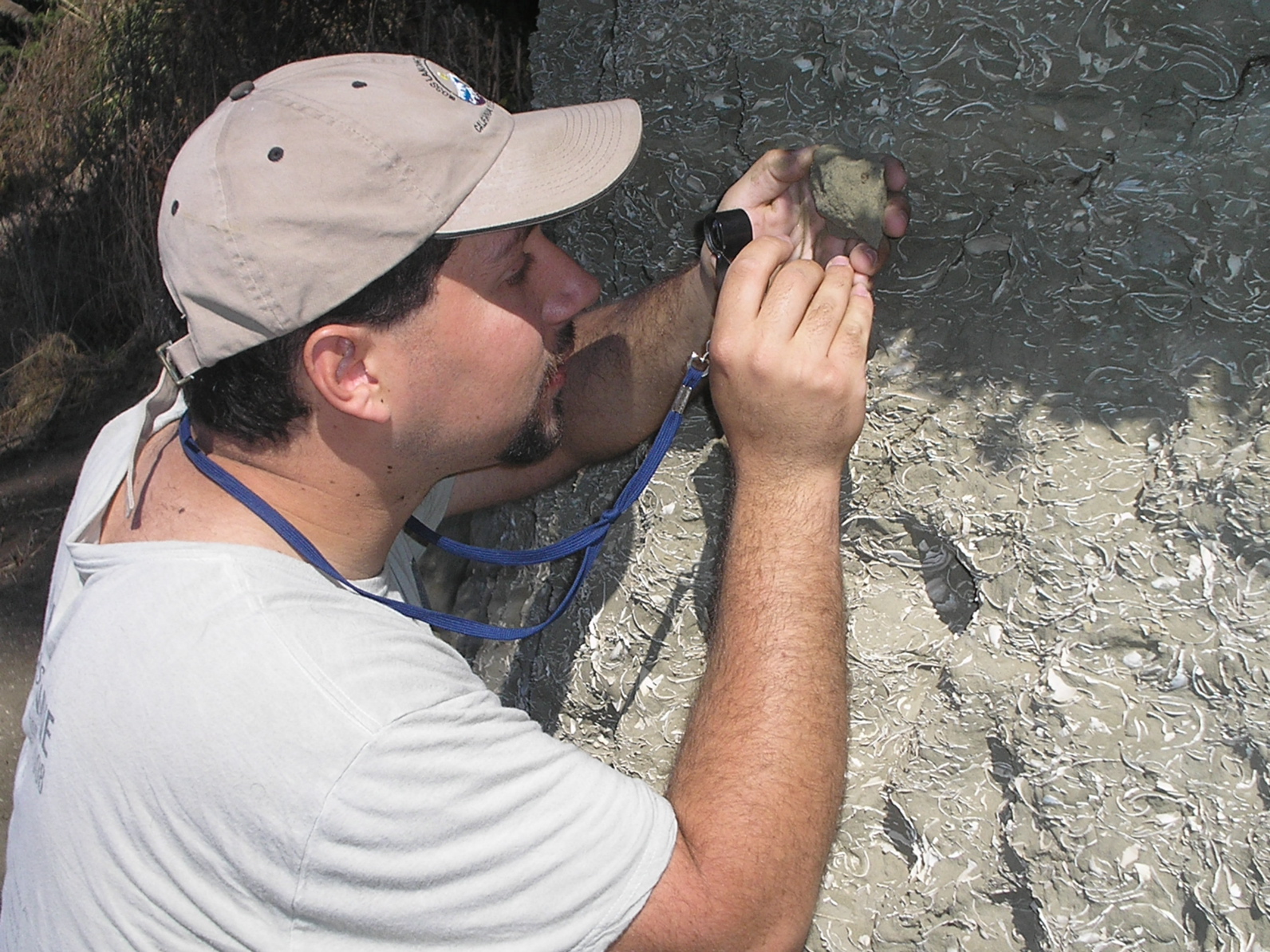
Case in point – early one Saturday I was out on the beach, hunting not for shells like so many tourists, but little green rocks. Another student from Moss Landing needed to find iron-rich rocks to see how iron affects the growth rates of various species of kelp. I offered to help him out and so I grabbed my rock hammer, hand lense, field notebook and we meet up at a beach just south of Santa Cruz. It was early in the day but we still needed to weave our way through a plethora of tourists to find a good exposed cliff-face. We were on a hunt for Glauchonite, a green, rounded rock that is formed in shallow marine sediments by the compaction of iron ore and…..well…….fish poop! (Or ‘fecal pellets’ as they are very scientifically called.) Small samples of Glauchonite can be found all over the Purisima formation I wrote about earlier, and they are rich in iron, so would provide a good test for the kelp experiment.
Traveling down the beach and climbing up cliffs, I guided my kelp-loving friend through thousands of years of history until we found a promising exposure of rock. Hacking away at it may have drawn some questionable looks from the beach-patrol, but humans are agents of erosion anyway, so we were just doing our part! We found some good samples of the green rock and took a moment to enjoy the day before heading out. I think it was a smart move to pick a profession that would let me spend most of my life on a beach, and Saturday’s “rock hunt” was a perfect example of why I love the science. Marine Geology IS Geology……now if we could just get that grant we could buy a new cappuccino machine!
Trying to tie scurvy-plagued sailors of yore to the field of marine biology might be a bit of a stretch, but I had such an awesomely geeky “Ah-ha!” moment regarding this classic maritime disease that I just had to share. (Plus I was reminded recently that we are fast approaching the 200th anniversary of Darwin’s birthday next year, so what better time to start with the throw-backs to 19th century explorers?).
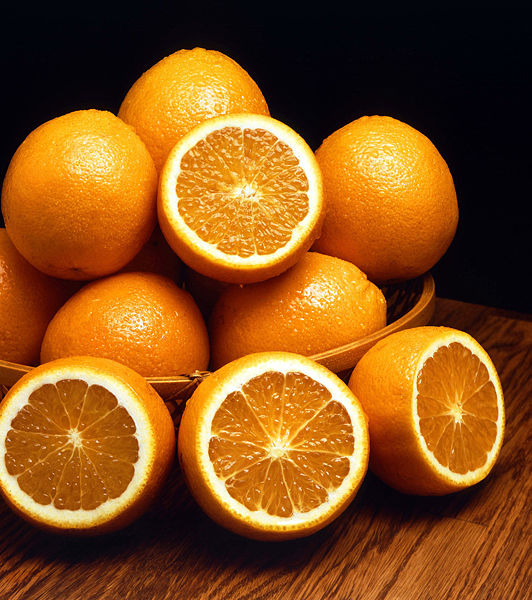
Thank your lucky oranges for preventing scurvy
My light bulb moment went something like this. Any school child could probably tell you that the disease scurvy (causing bleeding gums, spotty skin, and general nastiness) is caused by a vitamin C deficiency. We’ve all heard how things finally got better when those historic mariners sat around sucking limes. (Where is the team mom with those orange wedges when you need them?) But I never really understood how Vitamin C actually saves the day – until I came across the write-up of a biomolecular archaeology symposium in Science magazine (a U.K. researcher is finding some evidence for scurvy by looking at the proteins in 17th and 18th century sailor skeletons), and which explained the basic connection.
The answer, it turns out, is collagen – the most abundant protein in the human body. Twisted collagen fibers are in our hair, our tissues, even our bones. Anything that messes with this protein signals is bad news for the body – and scurvy is just that type of news. Collagen is chock full of proline, one of the of the amino acid building blocks that make up all proteins. So it stands to reason that anything that messes with proline messes up collagen, and before you know it, it’s a scurvy mess.
Your dime-a-dozen proline molecule
So what goes wrong? Well, some proline molecules need hydroxyl groups added to them to help reinforce structure of the whole protein molecule. A hydroxyl is simply an oxygen and hydrogen hanging out and sharing electrons. These hydroxyl groups don’t just appear on proline, enzymes have to put them there. And one of the cofactors (helpers) that these enzymes need to stick on the hydroxyl groups is – wait for it – Vitamin C!
There you have it – without the right tools (Vitamin C) to help you construct proper nuts and bolts (proline), your beams (collagen fibers) won’t be structurally sound.
Proline rocking an extra hydroxyl (OH) group - work it!
And without a good framework, whatever you try to build is going to have some serious problems (like say, a human body). The builders of the Titanic should have known better than to go against this string of logic, just to throw in another maritime example…
So now when mom tells you to drink that orange juice, you can thank her for saving you from gum disease and further misery – and you can tell her how. Those poor sailors eating things like hardtack (which by all accounts, had the nutritional value of thinly disguised cardboard) didn’t stand a chance. But in scurvy’s defense: without it, Shakespeare would have been deprived of some of his choice insults. What do you say to that, you scurvy jack-dog priests?
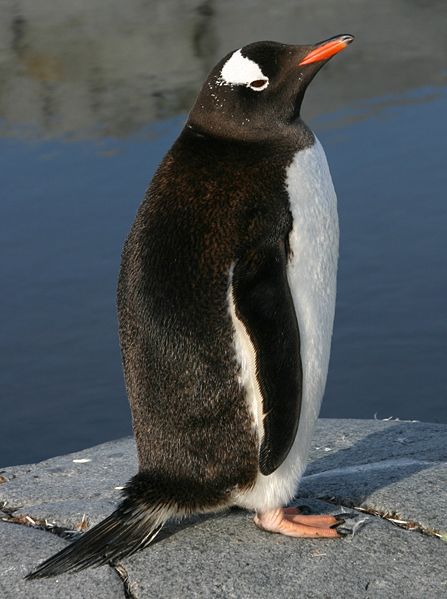
I’m adjusting to this new and strange reality in Antarctica, and luckily we have been incredibly busy. The work we are doing is dynamic and interesting. Right now we are monitoring the reproductive success of penguin species here on the island. The Gentoo penguins were already starting to lay eggs, and another species, the Adelies, were getting ready to lay eggs.
Gentoo penguin (Wikipedia)
We spent the first few days setting up sites, checking for eggs, and banding penguins for future monitoring. We each have our own colonies to monitor, and it takes about 4-6 hours to make your ’rounds.’ Our schedule can be erratic, with some nights we work until dusk (which is at 10 pm right now) and others we are done earlier, or have data or other hut chores to do. Our weather forecast system is as simple as looking at the window: if it’s nice outside GO!
If you are wondering how showering and laundry get done in this remote place, this provides an excellent segue to a description of my Saturday night at the Polish research station. Arctowski is a few miles away and we go there once a week. Getting there on this particular Saturday was quite a process. We first carried a canoe ¾ mile to the edge of the bay, where we will keep it for the rest of the season (thank goodness!). Then we navigated a dicey canoe crossing in front of a glacier with four people, four heavy packs, and a little bit of swell. We made it across safely, but with only a few inches of freeboard above the water and some wind and swell – it was an exciting trip. We then hiked another mile or so to Arctowski.
I was looking forward to hot showers and laundry, which we got, but the showers are set up in what looks like a Russian engine room from the Cold War era. Conveniently, though, after you wash your clothes, you hang them in front of one of the huge generators in the room which create about a 15 mph hot wind. Needless to say my clothes dried quickly, albeit crunchily.
The next day was long; we had to weigh 50 struggling penguins the next day at a site near the Polish station, and then after we returned home, we had to do the rest of our penguin rounds near our field station. We didn’t finish until dark We’re getting ready for dinner right now, and it is a little stormy outside. I can hear the penguins from my room and I’m starting to not even notice their noisy cries – I guess penguins can’t tell themselves apart either, so they recognize their mates by voice, which means a lot of “communicating!”
One of the reasons I love being a Geological Oceanographer is that you can walk along the beaches of Santa Cruz and travel through thousands of years of history in a few short miles. Much of the coastline here is actually made up of shallow marine plankton deposits that have been crushed over the years into a fine silt and sandstone layer that is greater then 150 m thick.
Basically, the coastline of Santa Cruz was once underwater and has been slowly rising through a tectonic process called “uplift” for the better part of the last two hundred thousand years. Because of uplift, these previously submerged sediment deposits of the continental shelf are now exposed above the ocean, and natural erosion has cut them back to the cliff walls we see today.
Geologists identify this cliff layer we find on our coastline as the ‘Purisima formation’ and date it to the late Pliocene era (1.6-5.3 million years ago, which is young as rocks go, if you can believe it!). The Purisima formation is structured with thousands of shell fragments from clams and various other plant and animal life forms that used to live on the sea floor. By examining the different layers of the formation you can see when the ocean was more full of life, or when the sea floor was a sort of dessert (just another cool aspect of geologic oceanography).
A certified time detective and rock hunter in action.
No matter where you go in the field, you tend to find that the land has been affected by the ocean. The Santa Lucia range of central California is another great example: it was created by the compaction of millions of marine carbonate shells left behind by various planktonic life forms.
So I suggest that the next time you’re hiking in the mountains or hanging out at the beach with a cold mojito, consider the sand and rocks around you. Most of this planet is covered in water, and that water has affected most of the land we stand on – so don’t be surprised if you’re hiking in Montana and find a shark’s tooth at your feet!
Since it’s Halloween, I just wanted to share something that will really scare the squarepants off your sponge – or at least it should if you’re a marine scientist, educator, or communicator because it shows how frighteningly far we are from helping the “general public” understand how the ocean works.
The actual inspiration for this blog came in part from Dr. Kenneth Coale, chemical oceanography professor and valiant director of MLML, sharing the following article with our chem oce class earlier this year. The December 2007 issue of Oceanography contains an article by Dr. Robert Feller, who shares a list of misconceptions about the ocean that he has gathered over the years. Many are the top response in multiple choice polls he gives to his non-science undergraduate classes using “clicker” devices (which let students answer anonymously and see everyone’s answers displayed on a screen).
You can view the full article by clicking here. While some of the 110 misconceptions are humorous (e.g. #67. “Sea monkeys” are really some sort of marine monkeys,” and #104. “Sailors can outdrink and outcurse anyone” – wait, that’s a misconception?), most indicate that we as marine scientists clearly have a long way to go to help people understand the system that we study, and the work that we do. (And lo, “The Drop-In” was born!)
I’ll admit, some definitely give me cause for pause (like #39. “A water spout is not the same thing as a tornado” – uh, what’s a water spout? Thank goodness for Wikipedia), but most are enough to make your blood run cold. Here are some of my personal favorites that we’ll try to dispel on “The Drop-In” (Mythbusters style!) in the future.
9. The deep sea is stagnant, never changes.
15. The ocean is basically a bowl, deepest in the middle.
23. The three big oceans are not connected; each acts alone.
47. Table salt + water = seawater.
48. Salty oceans are not linked to land’s freshwater cycle.
53. High latitudes, being cold, must be unproductive.
68. A sponge is a sponge is a sponge; same for nematodes. [Surely Amanda will have something to say about this one!]
77. Sharks are out to eat humans, thus shark attacks are
premeditated.
79. Whales spout water through their blow holes.
90. Fishermen don’t catch enough bycatch to have to change
their fishing methods.
98. All areas of the ocean are monitored regularly—we’re
on top of it. [Wow – it’s great they think so highly of us but...]
And perhaps most frightening of all:
100) The ocean is like a sponge, so just dump stuff in and it will absorb it.
Does it surprise you to discover that some of these things aren’t true? Can you think of reasons why that might be? We’ll try to get to the bottom of these in future posts, but feel free to post your thoughts in the meantime.
And for all you scientists out there, good luck sleeping tonight….bwahaha.
Punta Arenas, Chile, is a windy, lonely, port town, at the very tip of South America, where I arrived October 12th. Tourists arrive here to board expensive luxury cruises to Antarctica, wandering backpackers flag down buses to the Patagonia region, and stray dogs roam the streets everywhere.
Another group of ephemeral travelers haunts the city: folks frantically packing boxes at the port, making last minute shopping trips for approximately 6 months worth of toiletries, hoarding email time at the internet cafes, and in the evening, engaging in serious rounds of pisco sours, the national Chilean cocktail. These are the scientists with the US Antarctic Program, and this is how I spent my few days in Punta Arenas.
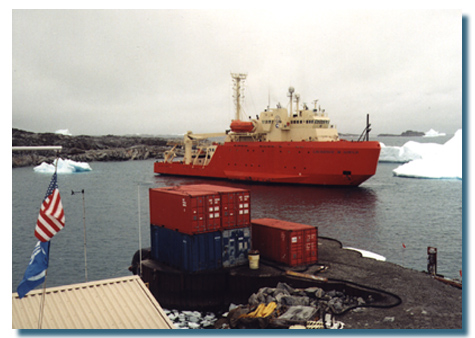
There were about 25 scientists all waiting to embark for the Antarctic aboard the Research Vessel (R/V) Laurence M. Gould. This is a large ice-strengthened ship that transports scientists and staff to several US field camps and research stations on the Antarctic Peninsula. The trip takes 5 days, including a few days in the much talked about (and often hazardous) Drake Passage, but we had pretty good weather. The ship arrived in Admiralty Bay, on King George Island October 18th. While there are enormous, permanent glaciers on the island, there was actually not very much ice and snow around the station, which is right on the shores of Admiralty Bay.
The Laurence M. Gould - built for ice! (Photo by NSF)
It is very strange to observe the small structure where you will be living for the next few months slowly to come into view, yet, not look all that much bigger the closer you get! The field station has a main room with a kitchen and pantry, and bunk room. There is also a small lab with another bunk room attached. Three of us will be working here continuously for the next five months: Myself, and Dave and Amy, a couple from Alaska. Sue, along with her husband Wayne, are in charge of the project and have been working here since 1981. Sue is starting the season with us, but will be replaced by another researcher in 5 weeks, who will in turn be replaced by her husband Wayne.
The Copacabana station relies on wind and solar power for our energy, with a generator for backup. Our drinking supply comes from a “sophisticated” rain catchment system: snow melt is collected off the roof into barrels. Water and energy conservation are critical. Our toilet is even more sophisticated: a five gallon bucket that is emptied and buried in the intertidal area when full. Communication consists of VHF radio, satellite phone, and the slowest internet connection you can imagine, through the satellite phone. It is much, much slower than dial up, and very temperamental!
There was a lot to do to get ready for the season; and everyone on the ship came ashore to help with the major offload of all the dry, fresh, and frozen food that will sustain us for the next five months. We won’t get another shipment of fresh food until January, and already some of our fresh vegetables are getting moldy. I miss fresh produce in Santa Cruz already!
by Amanda Kahn, Invertebrate Zoology and Molecular Ecology Lab
Hi again. I received a few questions in my previous post that I would like to address in this post. A user named doughnutfan asked three great questions about sponges.
Q: Are the spicules themselves responsible for filtering out the food particles?
A: Sponge spicules do not filter food particles out of the water – what they do is support the cells that do. I often think of sponges as skyscrapers (yes, I really do); it makes it a lot easier to visualize what different body parts of sponges are good for. Spicules are like the beams and internal structures that support the skyscraper – they provide support and give the sponge its shape. Spicules also make sponges hard to eat; very few animals can handle passing glass shards through their digestive systems!
Instead, what is responsible for filtering food out of the water is a type of cell called a choanocyte (ko-AN-oh-site). It looks like a funny name at first, but it’s named after a group of microscopic single-celled organisms called choanoflagellates. The choanocytes in sponges look just like the free-roaming choanoflagellates, but intsead of being solitary, single-celled organisms, sponge choanocytes are clustered together and work together to get food. As a side note, the strong similarity between the way choanoflagellates and sponge choanocytes is no coincidence. Currently, the favored hypothesis of how animals first evolved from single-celled organisms is that choanoflagellates evolved into sponges (specifically, the choanocytes in sponges). Read more →
Check it out blog fans – Amanda is guest blogging today at the awesome Deep Sea News blog! (Which is the place to get the lowdown on weird critters lurking in the darky deep.)
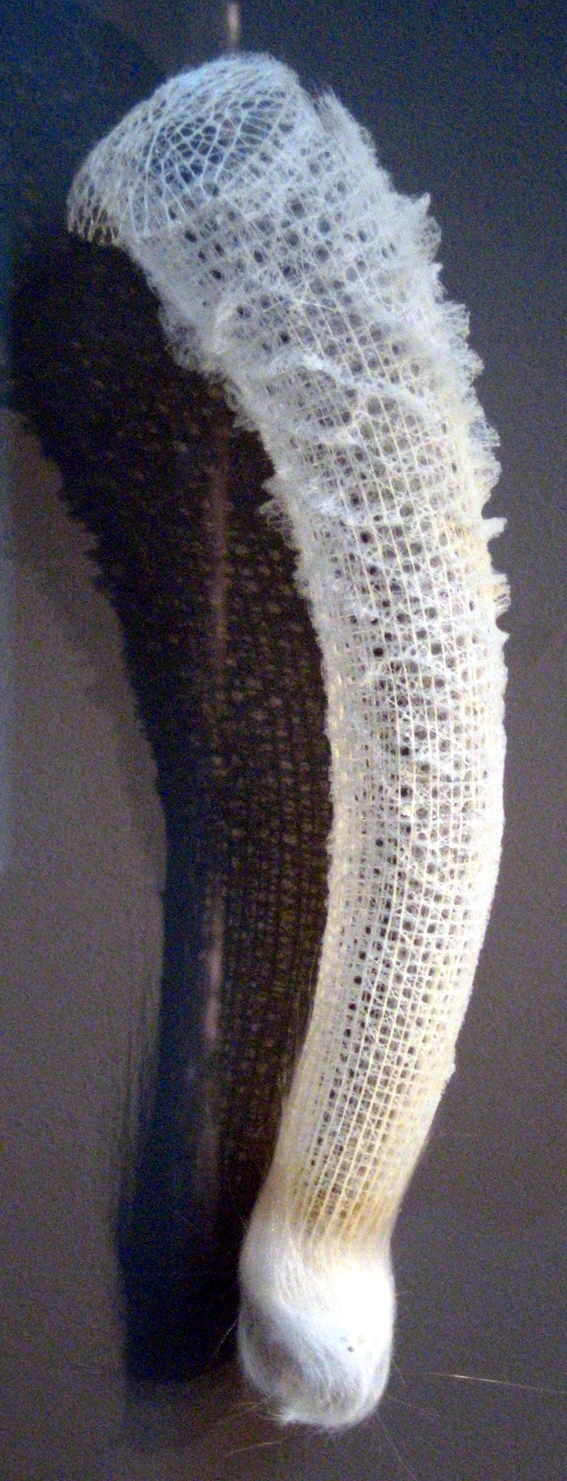
Euplectella: sentimental yet structurally sound
As part of the DSN countdown to Halloween, featuring the 27 coolest deep sea creatures (Why 27, you ask? “Because it’s 7 more than 20,” they reply), Amanda shines the spotlight on a deep sea sponge called Venus’s Flower Basket (Euplectella), a brainless but beautiful architectural marvel.
“Running transects across the abyssal plain is about as exciting as driving across Nevada…until you run across Euplectella,” Amanda writes. Click here to visit Deep Sea News and read the whole story – and find out why this sponge makes an excellent wedding present in Japan!







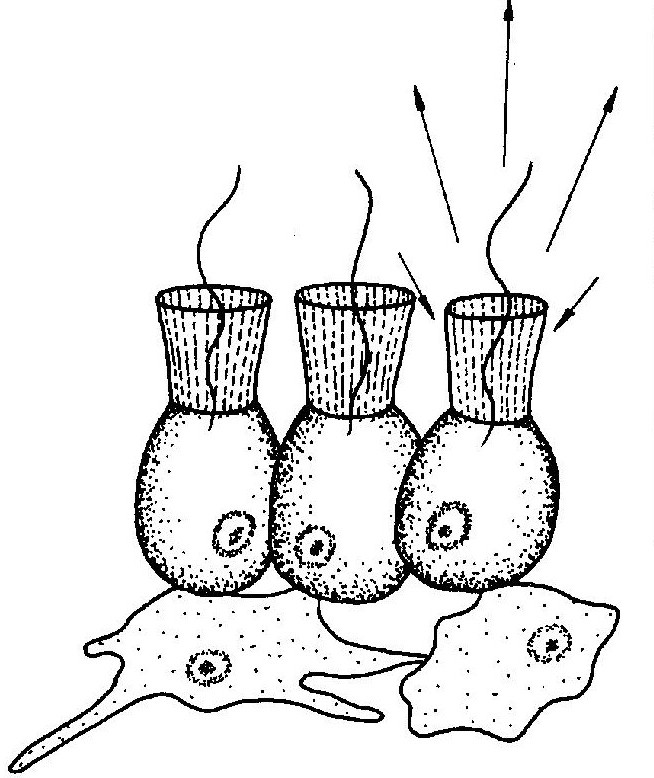 Instead, what is responsible for filtering food out of the water is a type of cell called a choanocyte (ko-AN-oh-site). It looks like a funny name at first, but it’s named after a group of microscopic single-celled organisms called choanoflagellates. The choanocytes in sponges look just like the free-roaming choanoflagellates, but intsead of being solitary, single-celled organisms, sponge choanocytes are clustered together and work together to get food. As a side note, the strong similarity between the way choanoflagellates and sponge choanocytes is no coincidence. Currently, the favored hypothesis of how animals first evolved from single-celled organisms is that choanoflagellates evolved into sponges (specifically, the choanocytes in sponges).