
Unimak Bliss – A Dizzy Dance of Birds and Whales

Nathan Jones
Nathan Jones

by Nate Jones, Vertebrate Ecology Lab

(Note:  I last posted about my Alaskan surveys  loooong ago in October, with a post about how stormy it’d been out on the Bering Sea…)

10 June, 2008: Today has been marvelous.  The storm had passed, and wildlife was everywhere! My seabird surveys are keeping me very busy, but the whales are stealing the show.

The ocean is impossibly calm, like glass; when I got up to the bridge to look out over the surroundings, it was difficult to tell even if the boat was moving – so smooth was its progress, and so monotonous is the gray sea surface.  Spotting birds today has been a treat.  Lots of little auklets, looking like buzzing avocados, their stubby wings flapping furiously.  We also have had some good whale sightings.  At least three Fin Whales… and two groups of Killer Whales have passed within viewing distance.  It’s so peaceful here today.  The ship’s engines just rumbling along, and only a very slight rocking under me to bring water to mind.
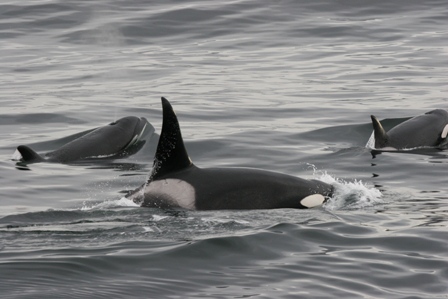
Killer Whales
Killer Whales

(Photo: NOAA/NMML)

And, then, this evening I had one of those peak life moments that I feel so privileged to experience: a feeding symphony of birds and whales

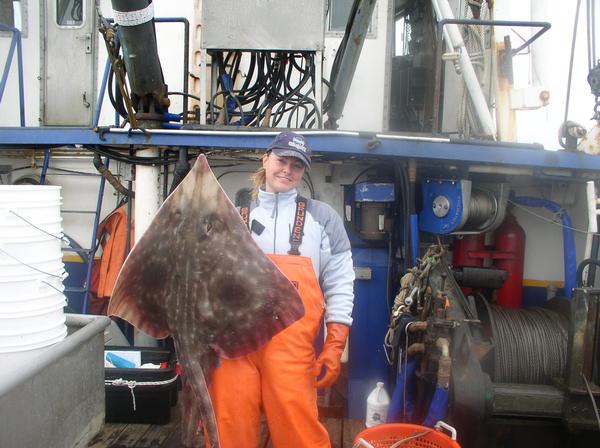
We had slowed for a trawl to try to catch some pollock (fish) to sample.  It was going on about 10:30pm, and still plenty of dim light left in the day.  Marty and I don’t survey for birds during trawls because the flocks of scavenging fulmars and gulls present during fishing exercises confound our estimates of what free-ranging birds are “normally” doing.  So, I was done for the night.
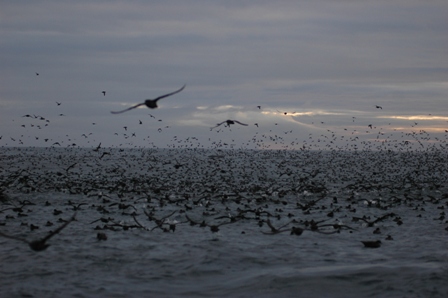
Shearwaters
Shearwaters (Photo: NOAA/NMML)

But, we were fishing right on the north side of Unimak Pass, one of the larger gaps in the eastern Aleutian chain, and a major funnel through which water and animal life move between Pacific and Bering waters.  There is often an abundance of marine life at these Aleutian passes, so I stuck around upstairs on the bridge to see what might show up…
Read more

The Case of the Missing Sperm Whale Teeth – a Fijian Mystery

Mariah on Whale Lookout in Fiji
Mariah on whale lookout duty in Fiji
Mariah Boyle
Mariah Boyle

by Mariah Boyle, Ichthyology Lab

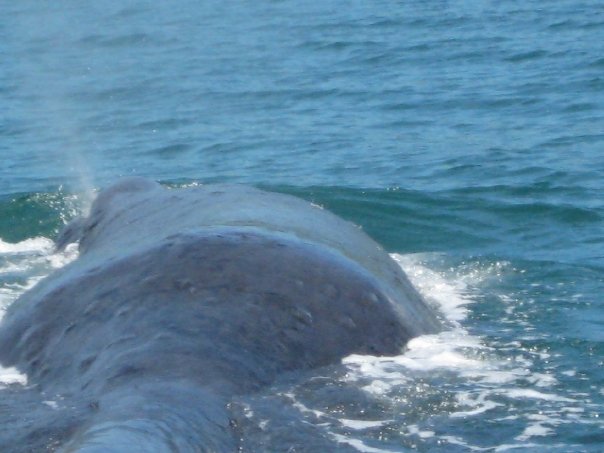
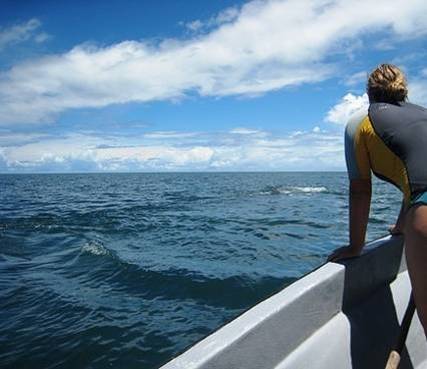
December 2008: Our boatload of kai vulagi (visitors) are heading towards Survivor Island (the one they used in Survivor: Fiji) for some exploring. All of a sudden, a whale spouts only about 50 yards away from our tiny boat. The whale is small, a juvenile. We follow it for a while – it is breathing often and doesn’t dive even when we are close. I know it is stressed. I can’t get a great look at it but notice its blowhole is offset to the side a bit.

A sperm whale - note its blowhole offset to one side

I snap a bunch of photos to send back home to my marine science friends. I’m an ichthyologist, after all – I study fish, and I was out of my element trying to identify this whale in Fiji!

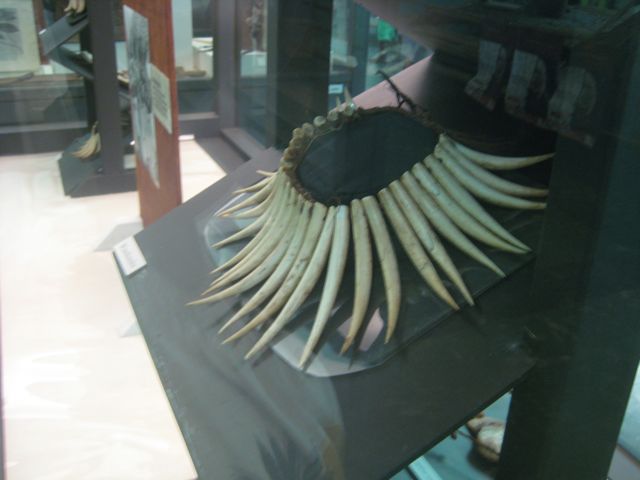
After returning home from the trip I looked up pictures of whales that live in the waters around Fiji and tried to identify it. Before finding a definitive answer, I got an email from Fiji: the whale had died and washed up on shore. A friend emailed me a Fiji Times article on the whale, which reported that upper teeth were not found in the whale, while the bottom 40 were removed using a ladder because the whale was so big! A lot of villagers thought that the whale’s top teeth had been stolen very early in the morning, as the teeth are used for tabua in Fiji, a sacred singular whale tooth on a string used for all sorts of formal ceremonies. I’d seen one right before I left Fiji presented to the island’s chief, Tui Mali, asking him to bless the engagement of a couple working on the island.

A ceremonial Fijian neclace made of sperm whale teeth
A ceremonial Fijian necklace made of sperm whale teeth

After reading that article it all clicked: no teeth in the upper jaw meant it must have been a sperm whale, which only have teeth in their bottom jaw!   I looked up sperm whales online and sure enough they also have an offset blowhole. I showed the pictures to a friend and she agreed on the identification. I had been getting lots of messages asking me to try to identify the whale, and now I knew what it was!  I researched a bit about sperm whales and wrote a blog for our group’s website to tell everyone about the whale. I felt good about identifying the whale and putting to rest the mystery – little did I know how it would be connected to my next visit to the same island… Read more

Penguin Chick Roundup

A gentoo penguin chick looking mischievous
A Gentoo penguin chick looking mischievous (photo: Lara Asato)
Kristen Green
Kristen Green

by Kristen Green, Ichthyology Lab

February 4, 2008:  It’s February, and it’s starting to feel like the season is coming to a close. The Gentoo chicks have been on the deck most nights…..looking guilty as usual when I open the door at 3 AM. They used to scatter, face-planting off the deck in a rush. Now, the bolder chicks nonchalantly waddle away from me; cleanly executing the foot drop-off from the deck. Those chicks have spent substantial time on the deck and it shows. Ten minutes later, the pitter-patter of little penguin feet and tap-tap of beaks betrays the curious chicks again. We’ve built elaborate barricades to keep them off the deck using two-by-fours, ice chests, and old propane tanks, but the stealthiest chicks still find new loopholes. I think our barricades are just training them to jump higher. I came out the other day to find a chick sleeping on top of an ice chest we used to block off an access point.

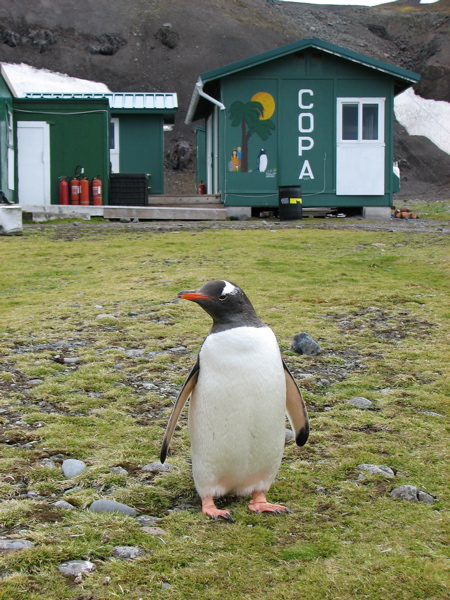
A gentoo penguin poses by the research station
A Gentoo penguin poses by the research station (photo: Lara Asato)

The chicks on the deck are entertaining, but they are also a sign that the penguin work here is almost over. We held the ‘Chick Round up’ last week, a muddy affair where we herd dozens of squawking chicks at a time into a small seining net, like the kind you would drag through the surf to catch fish. We then place metal bands on their flippers. 250 Adelie and 250 Gentoo chicks are banded this way each season. The Adelie fledglings have already begun their migration to find southern pack ice, and won’t return to King George Island to breed until they are three year olds. Castle Rocks, the largest Adélie colony, was filled with thousands of birds the day I arrived. Suddenly, the colony is deserted, and only the distinctive smell of penguin guano lingers. The metal bands on the “known-age” chicks (called as such since we know the exact season they were hatched) are numbered and wrapped with a strip of red electrical tape, which will help to identify the incoming Adélie three-year olds in the 2011-2012 season. Meanwhile, the Gentoo fledgings will stay here, and follow their parents into the ocean and back for short foraging trips all winter.

In addition to the chick banding, this week is our last big push to wrap up all the penguin work. The Chinstrap penguins are the last penguin work we do, as they breed a few weeks later than the Adelie and Gentoo penguins. Last week we hiked all the gear to deploy satellite transmitters and take diet samples to Demay Point, four miles away, where the closest Chinstrap colonies are located. We had good weather, and were able to get the first stage of our work done at these Chinstrap colonies. However, we’ve been waiting all week for a good day to retrieve satellite transmitters and take the final diet samples from the Chinstrap colonies. The end of the penguin work isn’t the only sign that the season is drawing to a close. Most of December and January, it never really got dark at all, now the sun sets at 10:30 pm. The weather patterns are also changing; the frequency of low pressure systems have been increasing. The rapid falls in pressure are usually accompanied by snow storms from the southeast. Read more

Featured Profile: Mariah Boyle

Mariah Boyle
Mariah Boyle

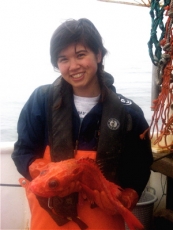
This week’s student spotlight is on Mariah Boyle, a graduate student in the Ichthyology Lab.   Mariah is currently studying the feeding habits of the roughtail skate for her thesis.  Check out her student profile to discover how she got her start in marine science – with a father who manages a dive shop and a mom who teaches swim lessons, it’s a logical step!   “Since they are both part fish, I was close to developing gills for a while as a kid,” Mariah writes of her parents.  Some advice she has for people interesetd in marine science: “While marine science may be a tough field, if it is what you truly love to do, stick with it. Too many people out there are not doing what they love for work.”  Read more!

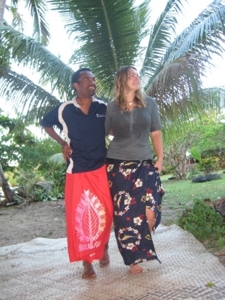
Speaking of jobs you love, Mariah has used her flexible grad-school schedule to  take advantage of the kind of opprtunity most people only dream about:  becoming part of Tribewanted, a unique, environmentally aware, cross-cultural community tourism project on Vorovoro Island, Fiji.

Mariah in Fiji
Mariah in Fiji

By joining  Tribewanted, she was given  access to the online side of the project (voting rights and message forums on www.tribewanted.com) and then could schedule a visit to the  island for however many weeks she chose. The land is being leased by a British company, and in turn the Fijians get to share their culture and earn a good wage. The project has a low impact on the island – the drinking water is captured rainwater, the shower is a natural waterfall, the fish is speared right off the beach.

Members of Tribewanted can be elected as chief for a month by posting a manifesto and being voted in by the other members online.  As chief this summer, Mariah was in charge of the on-island operation for a month -making sure there is enough water, managing the budget, organizing trips to villages, and making sure everyone is having an amazing time.  Mariah wrote a series of blog posts while serving as chief, including topics such as marine safety, sharks and sustainable seafood.   Check back soon and we’ll post even more stories about her tropical adventures!

Adventures in the Antarctic

Amanda Kahn
Amanda Kahn

by Amanda Kahn, Invertebrate Zoology and Molecular Ecology Lab

Buenos dias, everyone!

I am writing to you from Punta Arenas, Chile right now.  For the next six weeks, I will participate in a research cruise to the Weddell Sea near Antarctica.  During that time, I will be blogging from another website, so please come check out what we’re up to at a web site created especially for our cruise by MBARI.

Sweet Toothy

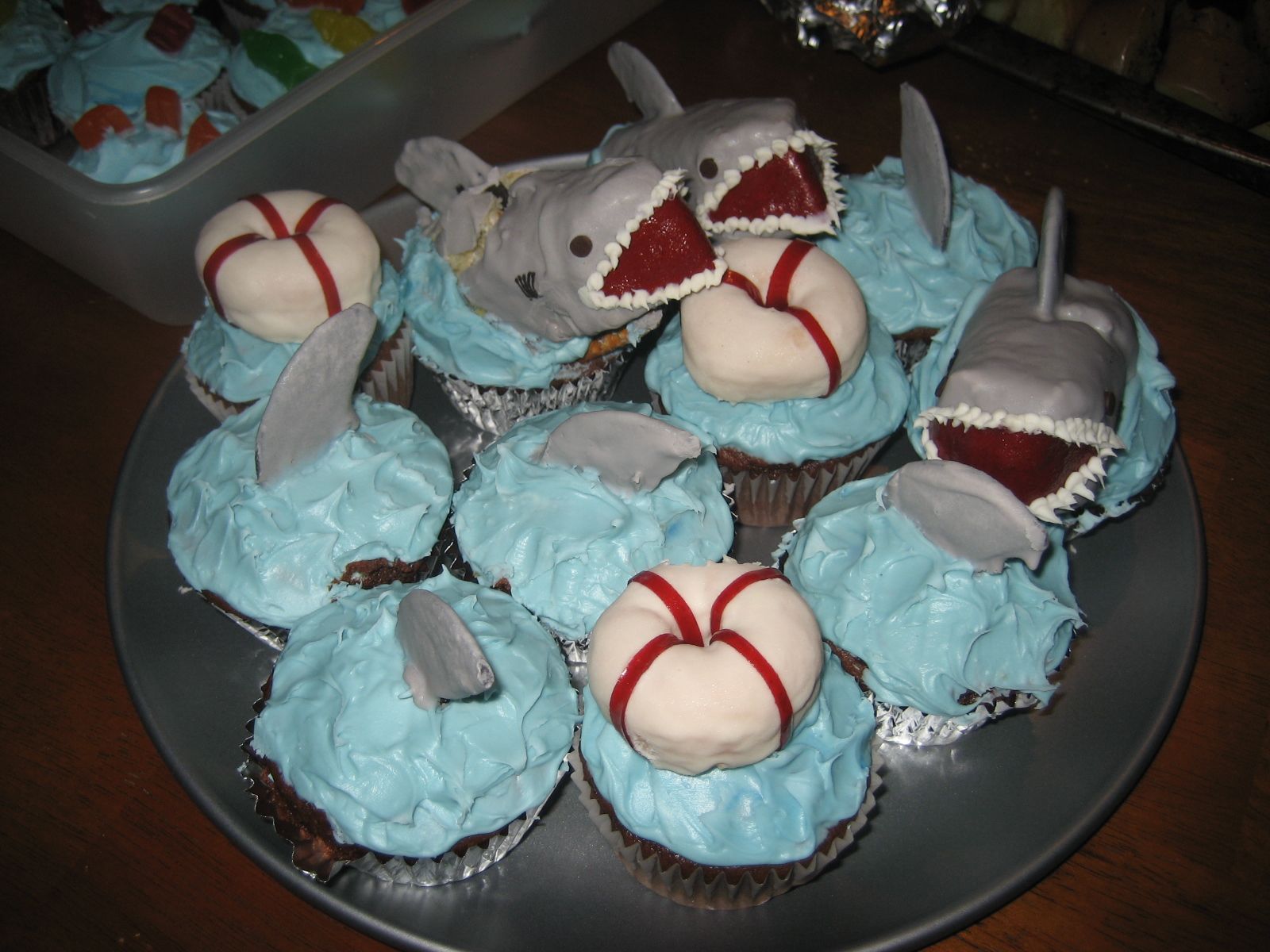
For an instant sugar/adrenaline rush, check out these fearsome cupcakes created by Ichth Lab crafter extraordinaire, Diane Haas.   Made in honor of shark expert Dr. Leonard Campagno and shark geneticist Dr. Gavin Naylor, who visited our lab last week.

Worthy of a great white-sized bite! (photo: E. Loury)

The most ferocious twinkies ever!

The Shifty Eyes of Flatfish

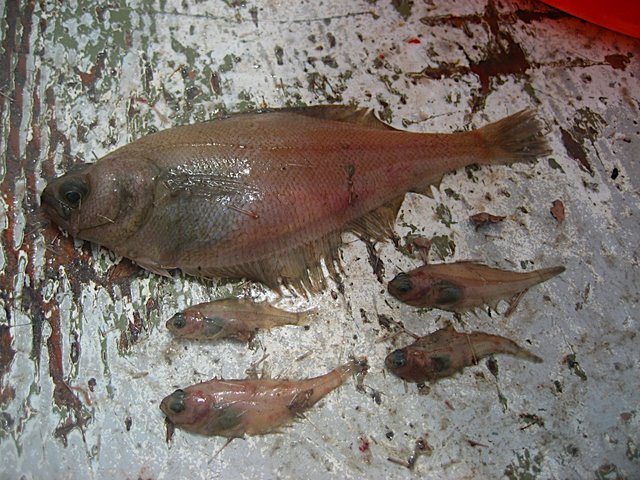
Even these little sanddabs have two eyes on one side of their head - but they weren't born that way. (photo: E. Loury)
Erin Loury
Erin Loury

by Erin Loury, Ichthyology Lab

Have you ever stared in the mirror and convinced yourself that your eyes are different sizes? Even if they are, or even if one is a little higher than the other, don’t worry, you are still considered symmetrical. That is, you could draw a line down the middle of your body from head to toe, and your left and right sides would be more or less equal to each other, just mirror images. Most animals share this condition called bilateral symmetry, with left and right mirror images – everything from whales to ants. A few animals like sea urchins and jellyfish have radial symmetry, meaning that you can draw many lines through them to get mirror images (they’re symmetrical in a circular way).

Symmetry is so common than nature that scientists get pretty excited to study any animal that deviates from this norm. A bizarre and fascinating example is the asymmetry of flatfish – fish like halibut, sole, sanddabs, etc. – which can’t be divided into equal right and left sides. Instead, they have two eyes on one side of their head – which isn’t such a bad idea if you make your living with your other side buried in the sand. The crazy thing is that these fish aren’t born that way – they’re born with bilateral symmetry just like most other fish!

(photo: E. Loury)
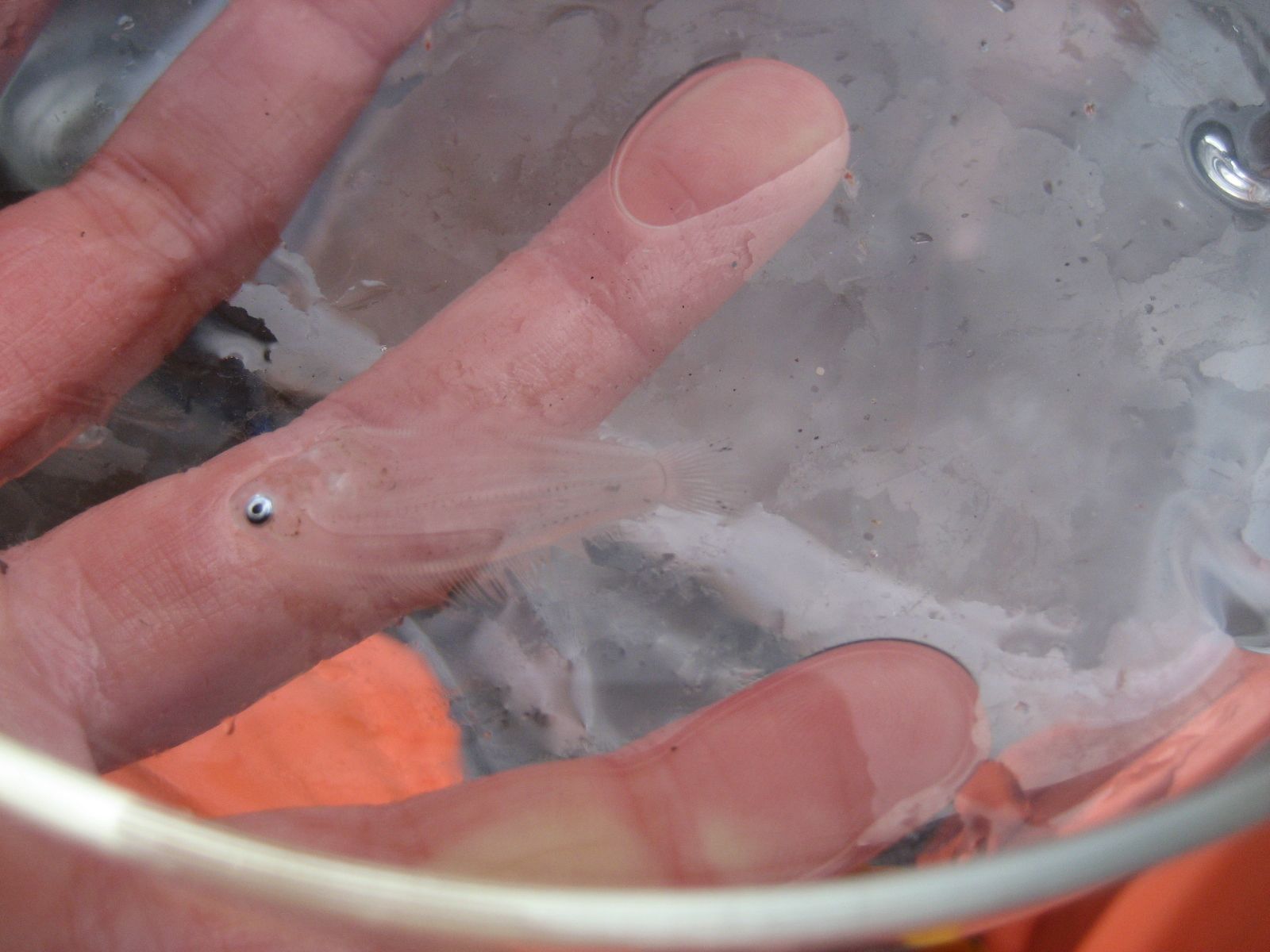
This larval flatfish is symmetrical because it only has one eye on each side of its head - but soon one eye will migrate to the other side, making the fish assymetrical (photo: E. Loury).

On our ichthyology class cruise last week, we pulled up examples of both the “before” and “after” flatfish conditions. The picture above is of a larval flatfish we found in the plankton. If you have to look closely at the photo, you can see that it still has only one eye on each side of its head! The fish will eventually undergo metamorphosis, during which its entire skull will twist, and one eye will migrate over to the other side of its head! The whole process takes between 5 days and a few hours, depending on the species of flatfish. This leaves flatfish with a blind side (the one with no eye), which it can keep buried in the sand. Check out the video below to see this metamorphosis in action!

Watch that Fish with a Wandering Eye

Check out this video from Science News that shows the changes a flatfish goes through as it develops into an adult fish.  One eye socket  actually grows toward the other as the skull twists, leaving the fish with both eyes on one side of its head! (Video courtesy of Alex Schreiber, the Carnegie Institute of Washington and St. Lawrence University in Canton, N.Y.)

[vodpod id=Groupvideo.2144481&w=425&h=350&fv=clip_id%3D1309417%26server%3Dvimeo.com%26autoplay%3D0%26fullscreen%3D1%26md5%3D0%26show_portrait%3D0%26show_title%3D0%26show_byline%3D0%26context%3D%7Cnewest%7Cfish%26context_id%3D%26force_embed%3D0%26multimoog%3D%26color%3D00ADEF%26force_info%3Dundefined]

more about “FROM FRY TO FISH on Vimeo“, posted with vodpod

Read more about this bizzarre adpation.

Penguin Day Care – Safety in Numbers

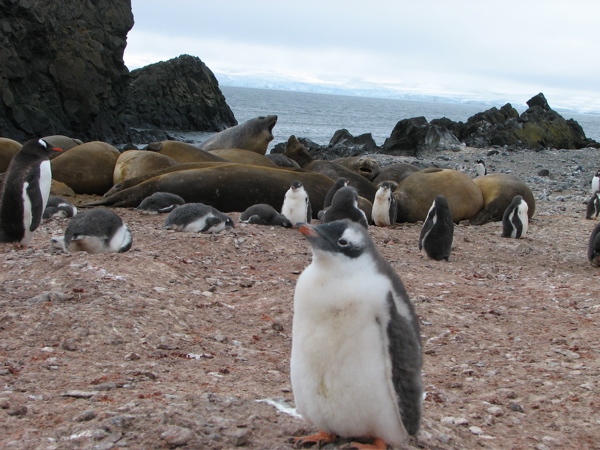
Gentoo penguin chicks
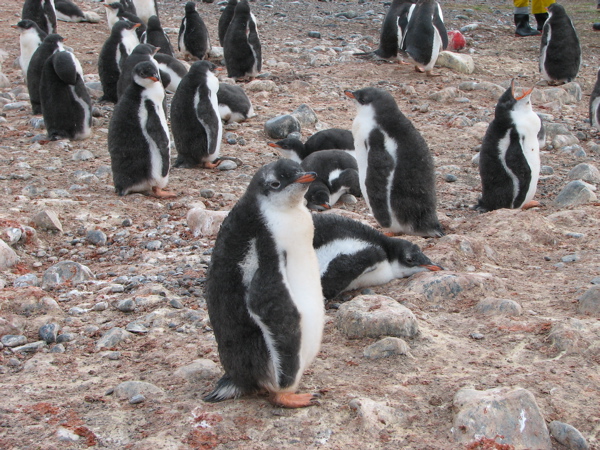
Gentoo penguin chicks keep company at Copacabana (photo: L. Asato)
Kristen Green
Kristen Green

by Kristen Green, Ichthyology Lab

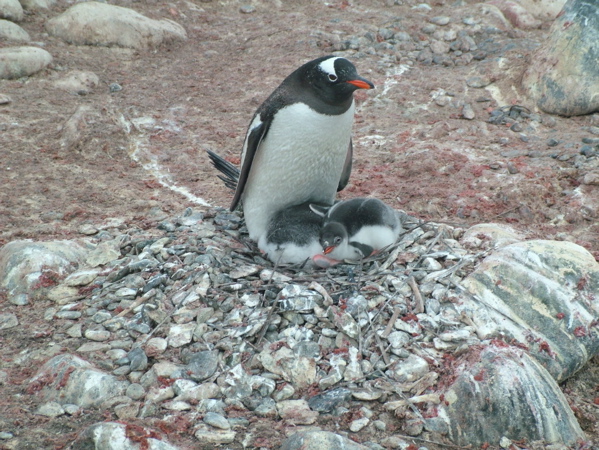
January 2009:  A mosaic of rock nests that defined the penguin colonies at Copacabana has erupted into a chaos of chicks in the past week. When we arrived in mid-October, each colony had distinct borders, and within a colony, each individual nest was spaced exactly one pecking distance away from its neighboring nest. Three months later, the nests have been almost completely disassembled and thousands of birds have merged into one super colony. Soon, a reddish-pink stain of penguin guano will be all that remains of the colonies until the next spring.

The disintegration of the colonies is simultaneous with the crèching stage of the Adelie and Gentoo chicks. ‘Creche’ is French for ‘day care,’ and is the period when both parents leave the chicks unattended in the colonies while they go to sea to forage for food. The Gentoos will return each day with a full load of krill for their chicks for another month, but most of the Adelie chicks will have molted into their waterproof adult plumage and be on their own in another week. Gentoo chicks have a slight advantage here; they are fed by their parents for much longer, and chicks may also accompany the adults for their first few foraging trips at sea. As a result, the Gentoo chicks are likely to be in better condition and have more experience foraging for krill before winter. Meanwhile, hunger forces the Adelie fledglings into the ocean, where they must rely completely on instinct to catch krill for the first time.

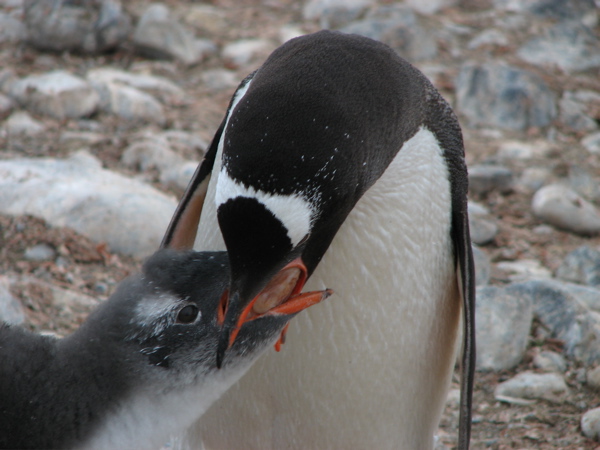
Feeding (photo: L. Asato)A A gentoo penguin chick  scores a meal from mom (photo: L. Asato).
For now though, all the chicks are ignorant in their chunky bliss of these future hardships. They spend most of their time eating, sleeping, or in loosely organized, but highly mobile masses, presumably on their way to either eating or sleeping. Depending on the time and place, Copacabana is either a kind of narcoleptic nursery ground, or brimming with aimless mobs of chicks.

The groups of creched chicks form a security-in-numbers daycare. The skuas still shop the colonies for dinner, but they focus their efforts on chicks that are alone and small. The easy pickings of eggs and tiny chicks in early summer will be over soon, but the skuas are no less determined; they have chicks of their own to feed now. Yesterday, I saw a skua pair (the same pair that fought successfully for control of the lower penguin colonies) bullying a late-breeding Gentoo that was still incubating two small chicks. The skuas attacked with impressive synchrony; one flustered the Gentoo from the front and other worked the rear.

dscf2212_sm
A Gentoo penguin guards its nest with two chicks (photo J. Warren)

The Gentoo, extremely agitated and trying to fend off an attack from multiple directions, was soon outmatched. One skua found a quick opportunity to nab one of the tiny chicks. This chick was swallowed whole in seconds, while the second chick was pulled out with the same effective technique. The skuas enjoyed a brief tug of war with the second penguin chick, and each gulped down its share. One skua stayed just to harass the Gentoo defending its empty nest for a little while longer. The other skua flew back to the nest to regurgitate the penguin chick to her own chicks; irony is an anthropogenic invention.  It  pays in nature to be doing the same thing as everyone else; the few tiny chicks that still have weeks before creching are an easy target for the skuas.  I watched all this with awe and a little bit of horror, but above all with the feeling that biology has a way of letting you know exactly where you stand in the world.

Plankton Soup

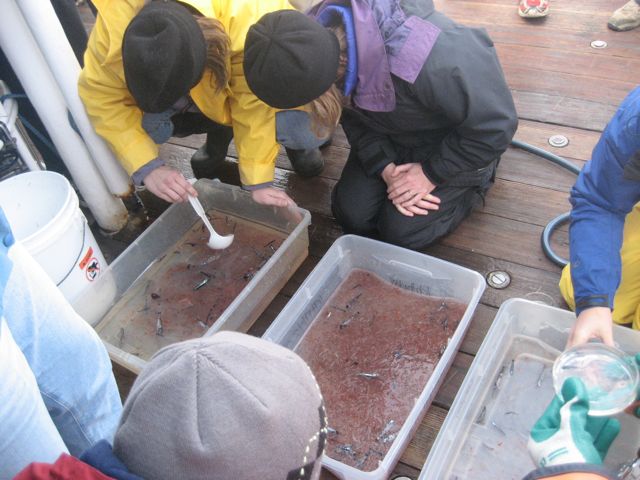
Scientists sift through plankton soup, searching for their favorite bits
Scientists sift through plankton soup, searching for their favorite bits (photo: E. Loury)

Erin Loury
Erin Loury

by Erin Loury, Ichthyology Lab

The swell was up and the rain in and out on Tuesday, but our ichthyology class braved it all for our class cruise in Monterey Bay.  The Point Sur, MLML’s largest research  vessel, was loaded with our class, an invertebrate zoology class from San Jose State, and various scientists from the Monterey Bay Aquarium and the Monterey Bay Aquarium Research Institute (incluing Kyra Schlining, featured in our alumni profiles!). We were all on a treasure hunt of sorts – ready to dip our big nets in the water and see what kind of fish and invertebrates would come up.  It was anyone’s guess.

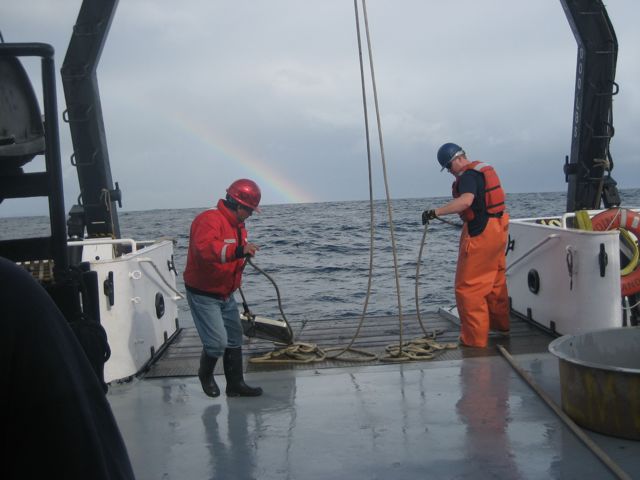
The crew hauls in the net, while a rainbow offsets the less-than-ideal weather (photo: E. Loury)

Like most cruises, there was a lot of downtime  – waiting to get to our trawl location, waiting for the net to go out (about half an hour to reach our desired depth of 900 m!), waiting while the net dragged along catching things, waiting for it to come back in… But just trying to hold on to your balance (and your lunch) can be keep you plenty occupied on a rolling boat.  It was a rough day for the faint of stomach, which I’m sure left many pondering Amanda’s timeless question: “Can I still become a marine biologist even if I get seasick?” The short answer is yes – but it’s certainly not always fun.  Or pretty, for that matter.

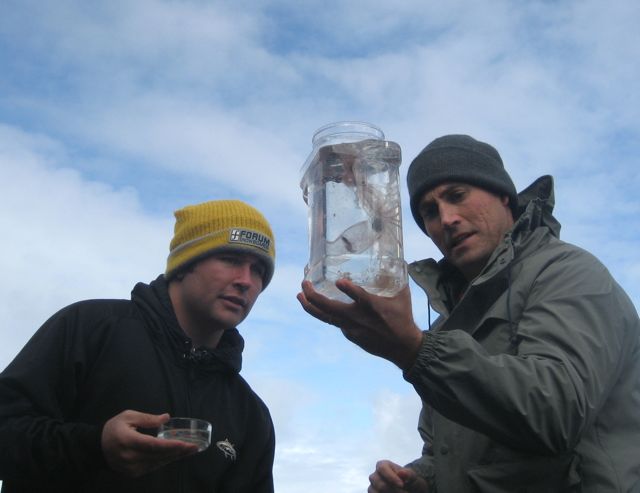
What a find!  Bottling up a squid (photo: E. Loury)
What a find! Bottling up a squid (photo: E. Loury)

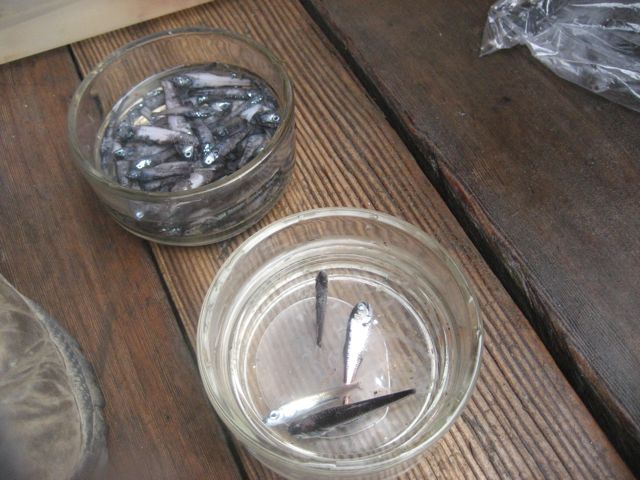
Our first trawl came up empty, because the net didn’t make it to the sea floor where it was designed to sample.  But our second trawl of the midwater brought up a whole slurry of things to pick through and distract us from our queasiness.  We huddled around tubs sloshing with a bright red soup of krill, the choice food of many whales, birds and fish.  These little critters like small shrimp and are called euhpausiids.  Lots of other interesting things were floating in the mix – the visiting scientists scooped up some squid, little jellyfish, and other gelatinous blobs.   The fish class picked out the various myctophids, or lanternfish, which are little, black, deepwater fish that have a line of glowing photophores along their sides.

Some shiny myctophids, or lantern fish, from the deep (photo: E. Loury)

We sifted though the animals that lived in the water that surrounded us, down at depths we could scarecly comprehend.  It was a rare chance to pluck them from their hard-to-access homes and bring them to our world of the surface, where we could poke, stare, and try to understand.