The queen of marine creativity stikes again! Diane Haas, an Ichthyology Lab student (who you may know as creator of some sweet, toothy shark cupcakes) crafted this vision in frosting for labmate Tom Wadwsorth’s thesis defense last week. The lucky subject? A China rockfish (Sebastes nebulosus). What a delicious complement to Tom’s thesis, “Trends in Abundance Surveys of Nearshore Rocky Reef Fishes in Central California 1959-2007.” Congrats, Tom, and two thumbs up to Diane! (Oh, would this cake qualifiy as sustainable seafood?)
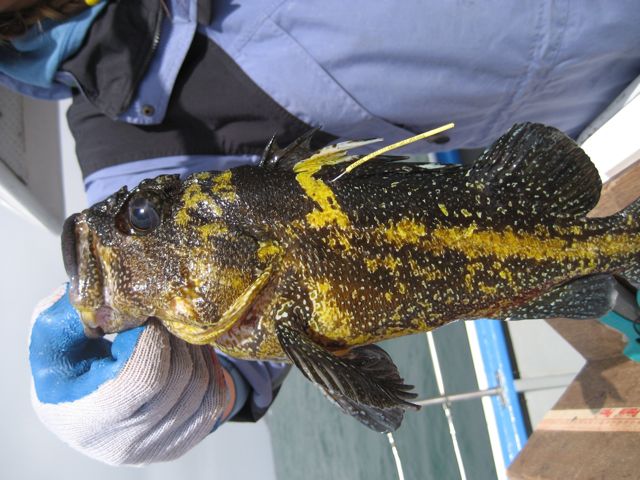
An actual factual China rockfish (Sebastes nebulosus) - how does Diane's artistry measure up? (photo: N. Yochum)
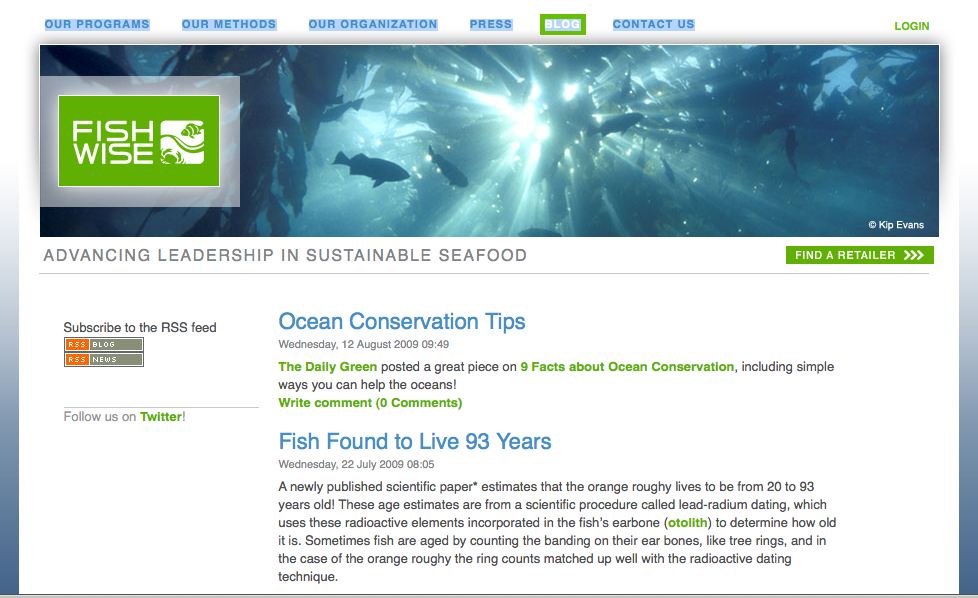
At MLML, many graduate students need an outside job to help pay the bills while working towards their degree. My outside job that gives me a different perspective on the oceans – I work at FishWise, a non-profit sustainable seafood consultancy in Santa Cruz, that helps seafood producers, distributors, and retailers source and sell more sustainable products. Working with seafood consumers and the seafood industry allows me to apply my background of research in fish science (ichthyology) to the real problems facing our oceans today like contaminants, overfishing, and pollution.
Sure we all think about the oceans when we pick up litter off the beach or don’t pour anything down the street drains that lead to the oceans, but what about when we shop for groceries? It is time we all took responsibility for what seafood we eat, whether in the grocery store or at a nice seafood restaurant.
Now there is a new blog that can help you do just that! FishWise has launched a blog on our website to help consumers think more critically about the seafood they eat.
Take this seafood quiz to learn if you are FishWise!
1. What is more sustainable, farmed or wild salmon?
2. True or False: Fish can live to be 100 years old.
3. True or False: Some catch methods, like bottom trawling, have high amounts of bycatch, even including turtles!
To learn more about the above questions, check out our blog to read the full stories and become FishWise (check the comments section below for the answers).
The FishWise blog covers such topics as farmed versus wild salmon, fishery-specific problems, fish-farming practices, and new fish science!
Want to do even more? Shop at a FishWise member retailer to support stores that source more sustainable seafood. All FishWise member retailer partners label the sustainability of their seafood right on their seafood signs!
Is your local grocery store not FishWise yet? Tell them to go to www.fishwise.org to learn more!
by Amanda Kahn, Invertebrate Zoology and Molecular Ecology Lab
Summertime at the labs is an industrious time, with many of us working hard on our thesis projects while we don’t have to worry about classes. Our time here at MLML is divided into two major stages: the stage when we take classes like oceanography, laboratory techniques, and background classes (like marine botany or a class about birds, turtles, and mammals), and the stage when we work on our own research project. The class stage is really important–it allows us to choose what field interests us, and what kinds of research are going on in that field. We take the classes so we can learn about a field and start asking questions. We keep asking questions and learning more until finally our questions can’t be answered–because the answers haven’t been figured out yet. That is where the thesis research comes in!
Once we come up with a question that is interesting to us and unknown in the world so far, then we design a research project and follow the steps of the scientific method to address that question to the best of our abilities. It’s a little sample of what scientific research is like. From doing a thesis project, we students can figure out if we are interested in becoming scientific researchers or if we prefer non-research science pursuits.
Even if a student ultimately decides not to go into research, however, everyone conducts research while they are here at MLML. That is why the hallways are quiet right now–everyone is holed up in their labs working on their research projects, or sitting at home reading about possible project ideas.
Or, the hallways may just be quiet because it’s summer and the beach is only a 5 minute walk away…
It's hard to keep working when the beach is so close by! Credit: Amanda Kahn 2006
Klutzes like me have to look lively when boarding a boat. The first rule of thumb is to mind your space, because it’s at a premium! Heavy equipment, sharp things and moving parts can be around every corner, people are hurrying past you to get to their stations, and to top it off, the whole shebang is typically rocking under your feet with the waves.
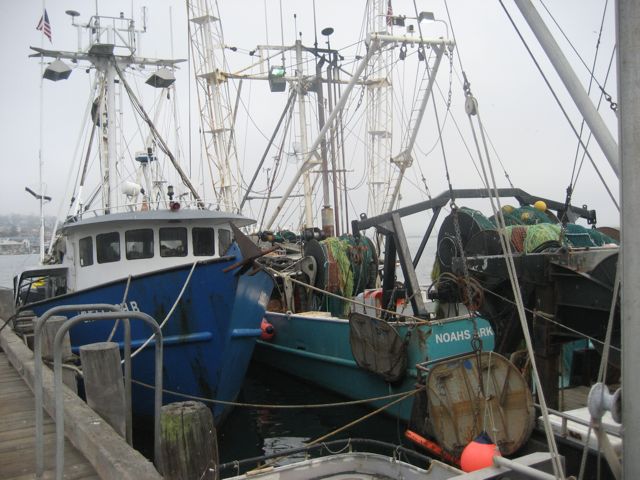
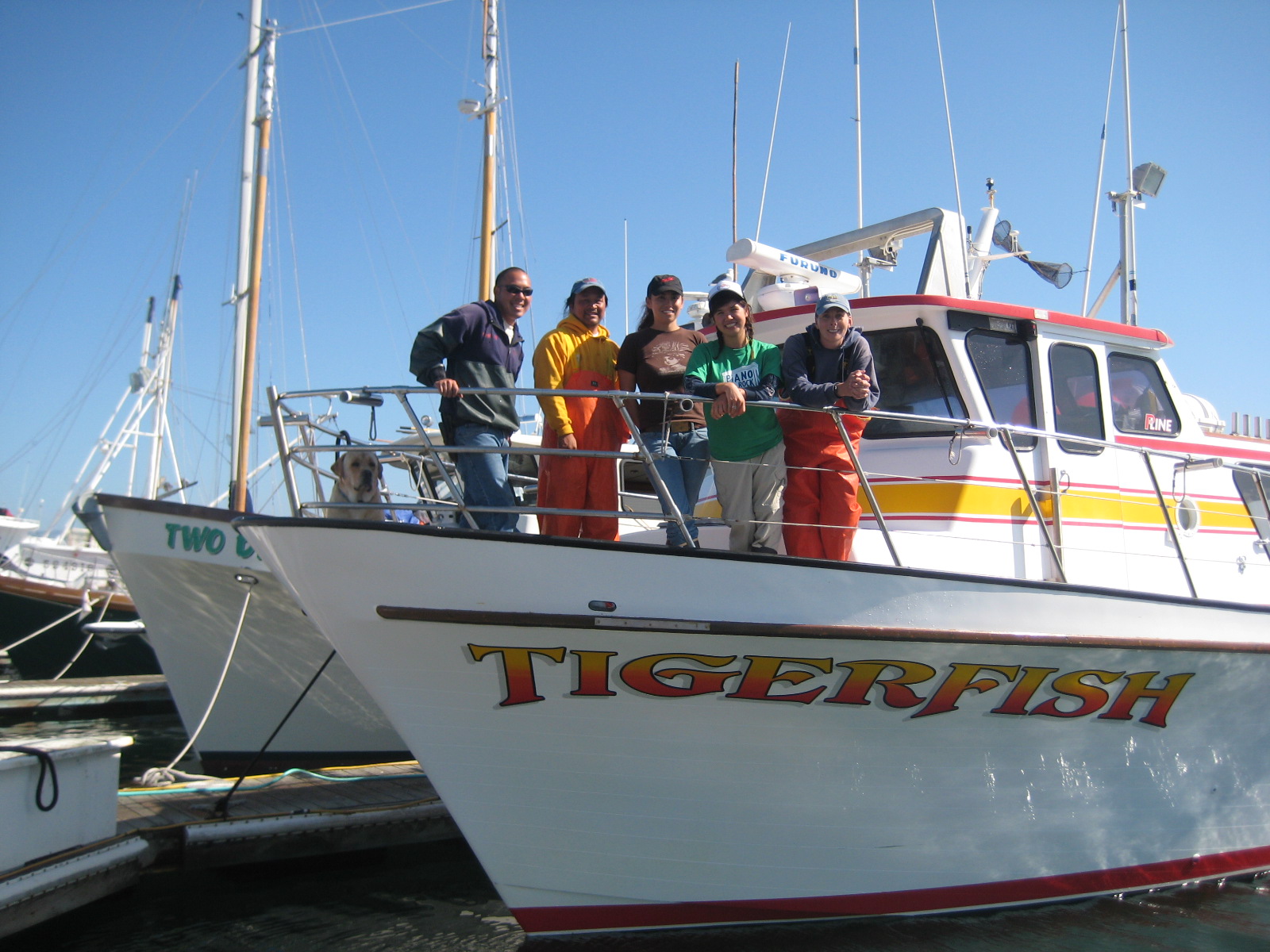
Last summer, I spent 10 days at sea aboard an 85-foot fishing boat as part of a trawling survey for the National Marine Fisheries Service (NMFS). Just getting on board was something of an adventure. The whole “Mind the gap” philosophy definitely applies when jumping from pier to boat, to boat, while ducking under railings and passing gear over a narrow-but-steep drop to the water below. And I quickly learned once I stepped inside that there’s generally not a lot of personal space. Three scientists, three crew, and one bathroom (or head, as you’d say on a boat) – you do the math.
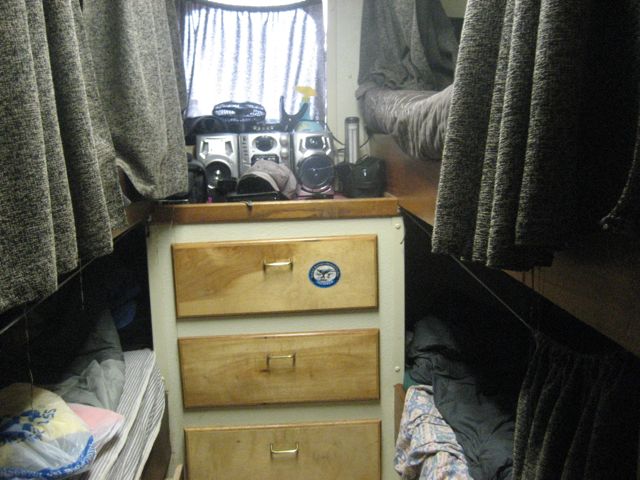
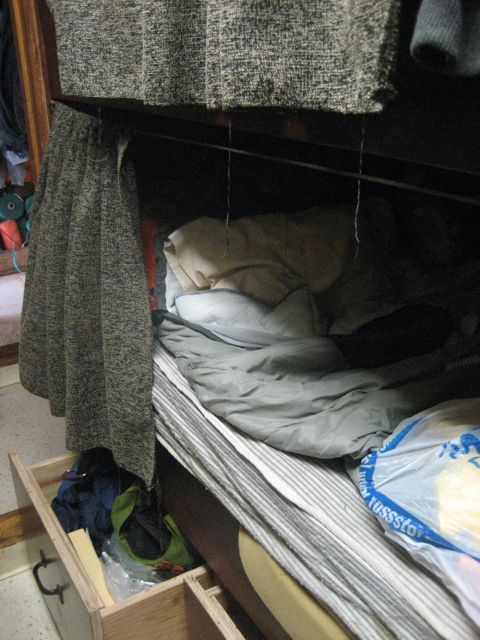
Bunkroom for four – feeling like a packed sardine is probably an appropriate feeling for a fishing survey!
Surprisingly, bathroom time was not much of an issue, but the sleeping arrangements sure were cozy. My bunk became even smaller once I wedged in my bulky survival suit – about the size of a large sleeping bag – so that it would be handy to grab should any Titanic-style drama ensue. Fortunately, except for one safety drill, there it stayed and provided something of a lumpy backrest.
Home sweet bunk - the space to call my own for 10 days.
My first night at sea was probably the roughest. We left port about 4 pm and were steaming through the night to get to our first trawling location on the southern California coast. The way the bunks were laid across the boat caused me to rock slightly from head to toe like I was lying on a seesaw – not at all conducive to falling sleep. I found myself suddenly commiserating with immigrants of yesteryear crossing rough seas to the new world, enduring seasick nights in their crammed quarters. Oh dear, I thought. This is going to be a long 10 days.
Luckily, after my first full day at sea, my nerves – and my stomach – quieted down. Between the crew rapping on the walls at 3 am to switch out their turns on watch, to the 6 am wake-up as the winch let out a hydraulic squeal to set the first net, I was more than ready to fall asleep at the end of each long day. And never once did I tumble out of my bunk in the middle of the night.
What is a marine scientist’s vehicle of choice? Ships, boats, and anything that floats!
Summer is an exciting and busy time for marine scientists, especially graduate students. With classes done for the time being, our lives are consumed by the a few hectic months of field work. As a marine scientist in Moss Landing, our “field” is the entire ocean! Our vast study area stretches from pole to pole, and includes everything from the waves crashing on the rocky intertidal shore, to the dark abyssal depths of the Monterey Submarine Canyon.
So how to we explore and poke and probe a body of water that is so deep and wide? In the ichthyology lab, we use boats to scour the sea for our fishy specimens in a variety of ways. This month I’ll be posting lots of photos from our ship-side adventures that will put you right in the field with us – minus the wind and seasickness! Stay tuned and enjoy!
by Amanda Kahn, Invertebrate Zoology and Molecular Ecology Lab
Land ho! Two months ago, I left MLML and California on a flight to Chile to help out on a 40-day research cruise in Antarctica’s Weddell Sea. During the months leading up to the cruise, I worked dual lives–struggling to keep up with work at school while also making arrangements for travel, going through the necessary medical tests and preliminary cruise preparation, and starting up on my job as a public outreach person on the ship (I wrote a blog, just like my posts here).
Being out at sea for 40 days was an incredible and unique experience. Many of the things we take for granted on land are just different on a ship (stable ground, for example!). I was worried about being seasick the entire time, but I got my sea legs after a few days and was able to function just fine in almost any weather. Since everything on a ship is constantly moving, everything must be tied down or secured to prevent it from sliding around or falling. Laptop computers were tied down to tables and sat on non-skid mats to protect them–actually, anything that we didn’t want to have slide off the tables sat on non-skid mats, including our dinner plates! We had safety drills every week, which included fire drills and abandon ship drills. Also, we only had whatever we brought on the ship with us from the beginning, which meant that for six weeks, we had to make fresh foods last! Over the course of the cruise, our fresh foods progressed from a salad bar brimming with fresh fruits and veggies to a meager selection of hardy vegetables, like iceberg lettuce and carrots, and finally to preserved foods such as olives, pickles, and canned peaches and pineapple slices.
For the most part, I found life on the ship to be rather exciting, but certain aspects were difficult. We had no internet connection, and the email system transferred emails by satellite three times a day. That meant limited contact with people on shore. It also meant no YouTube, Google, or any other online websites. The science we did onboard more than made up for the lack of online entertainment, however. Trawls through the top 300 meters of water brought up animals like Antarctic krill, salps, jellies, swimming worms, and even swimming snail relatives called pteropods.
Antarctic krill, the main food source for baleen whales that migrate to the Southern Ocean, were collected in trawls.
I’m now back in action at MLML, and ready to write again about what life is like here at the labs. It will be very different from life on the ship, but I think certain things are quite a bit nicer here on land (stable ground, for instance!).
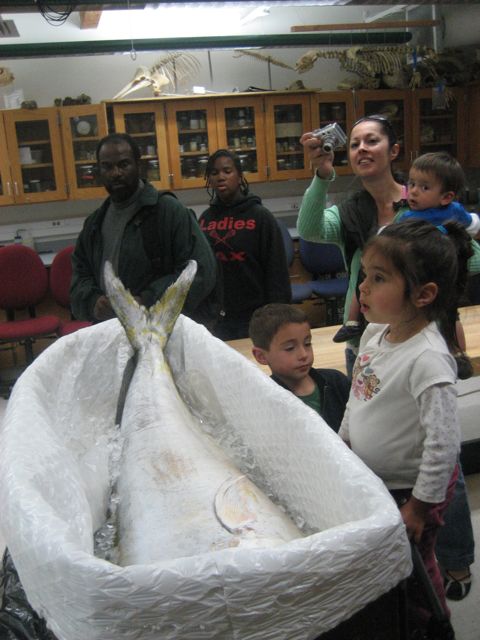
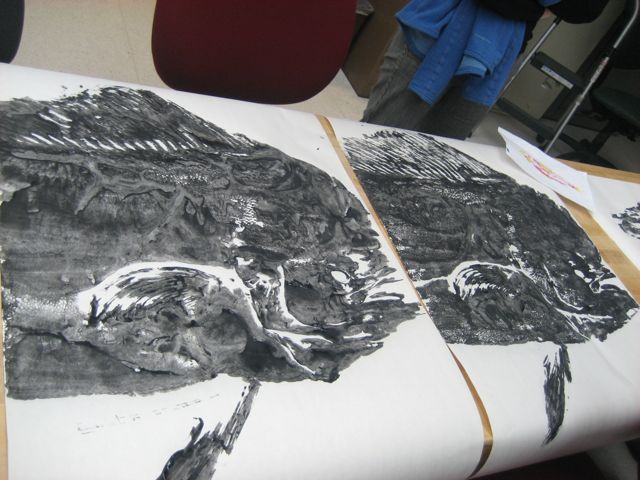
It’s generally a good practice to get the most “bang for your buck” out of a rare opportunity – such as a giant mahi-mahi specimen. After dissecting this impressive fish in our ichthyology class to study it’s feeding musculature and internal anatomy, we put it out on display for our April Open House (butchered side down, of course!).
Our giant mahi-mahi wowed the crowds during April's Open House.
If you were one of the many wowed by the chance to see such a large fish up close, you may be wondering what became of the specimen after all the crowds went home.
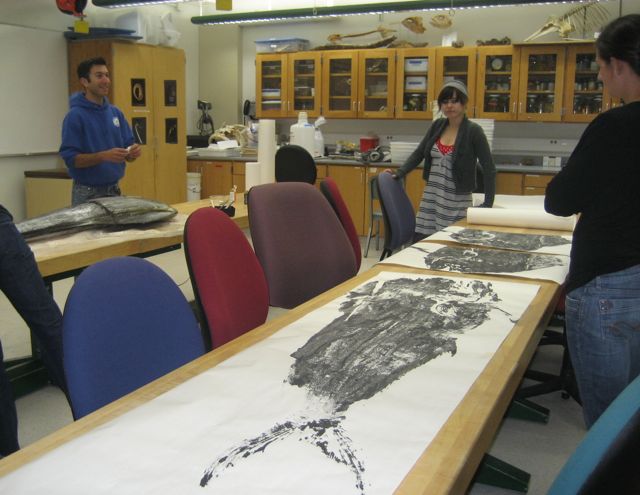
Perhaps you also made a fish print while here at Open House – with a fish you could easily hold in your hands. We didn’t think we had done justice to our massive mahi-mahi until it too had its impression preserved in paint.
Fun fact: Mahi-mahi only live to be 4 or 5 years old, and are some of the fastest growing fish in the world!
And what next for this specimen of multiple lives? Grad student Katie Schmidt is undertaking the task preserving the entire fish for posterity by cleaning its skeleton – one shining vertebrae at a time. Stay tuned to see photos of the work in progress!
Free wall art for the starving grad student apartment is also a plus.
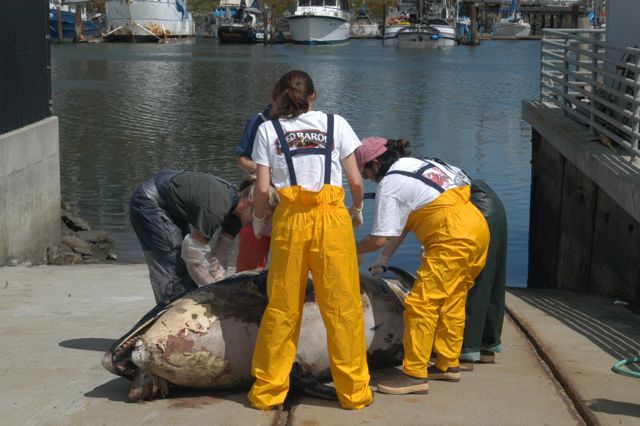
MLML students dissect a dead killer whale to try to determine its cause of death.
Colleen Young
by Collen Young, Vertebrate Ecology Lab
Did you know that Vertebrate Ecology Lab (VEL) at MLML is part of the National Marine Mammal Stranding Network? As Stranding Network participants, we collect data on pinnipeds (seals and sea lions) and cetaceans (whales and dolphins) that wash up dead (strand) on beaches in Monterey County. By keeping track of the local strandings, we can determine baseline estimates of what’s “normal,” allowing us to identify “unusual mortality events,” when more animals than usual strand. We rely 100% on the general public (you!) to report dead marine mammals that are on the beach, so if you see one, give us a call…you may present us with an opportunity to learn about a rare or poorly studied species, like the killer whale that was called in earlier this month!
On Sunday, April 5, residents in a community south of Carmel found a dead killer whale floating in their cove. Luckily, they knew to call us, and we went out that afternoon to investigate. Upon arrival, our team determined that the animal was a female, juvenile killer whale, probably about 1 year old. There were no obvious external clues about the cause of death, so we decided to anchor the carcass and come back the next day to get a closer look.
Monday we came armed to collect some serious data. The animal had been washed onto some rocks, and was no longer floating, allowing us to take a variety of measurements and a skin sample. Unfortunately, the ocean conditions were too rough to bring the animal by boat back to Moss Landing for further examination, but still got some valuable data.
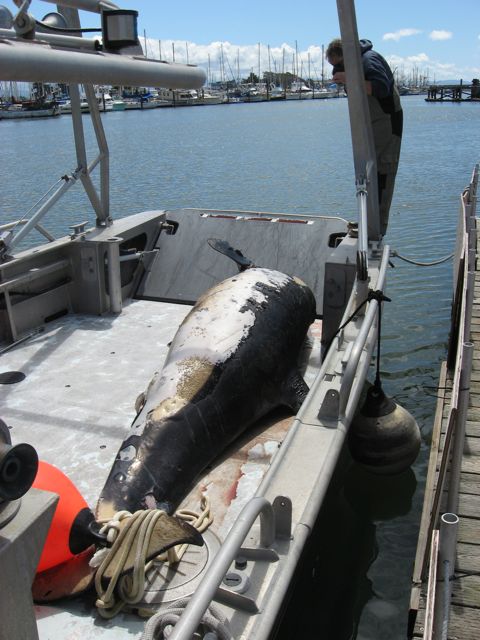
The killer whale pulls into Moss Landing aboard the Research Vessel Shilea B.
Once word broke out that we had a killer whale, researchers all over the Pacific Northwest started requesting samples. Given the great number of researchers who would benefit from getting more samples, we decided to pull out all the stops to get the animal back to Moss Landing for a necropsy (an animal autopsy).
On Tuesday we went back to the animal and attached a buoy around a caudal peduncle (the area right before the tale). The ocean still wasn’t cooperating with us to allow transport back to MLML, so we wanted to make sure we could re-locate the animal the next day.
Finally, on Wednesday, the ocean had slightly calmed, so we decided to retrieve the killer whale. A team of snorkelers swam the animal out of the cove to a waiting rigid-hulled inflatable boat (rhib), which towed the carcass until meeting up with MLML’s aluminum front-loader, the Shiela B. We transferred the animal to the deck of the Shiela B, and she sped off towards the team of researchers eagerly awaiting her arrival.
In about 3 hours, with the help of a marine mammal veterinarian, and several students from the VEL, the killer whale was fully necropsied. We obtained tissue and organ samples, measurements of blubber and muscle thickness, and other important data. Samples have been mailed all over the west coast of the US for further processing to try to figure out why this young whale died.
While we await the results, the VEL is standing by to investigate other marine mammal stranding incidents in Monterey County. Please help us stay informed about dead stranded marine mammals by calling 831-771-4422 if you see one!
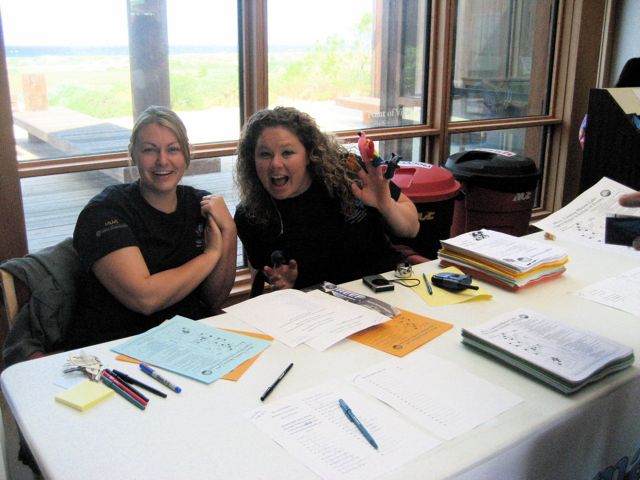
Congratulations to all our Open House science detectives!
Were you a science sleuth who complted a scavenger hunt at MLML Open House this year? Check how well you did! The answer keys are posted on our Teacher corner page, and you can also download them here:
We can't wait to see you at Open House this weekend!
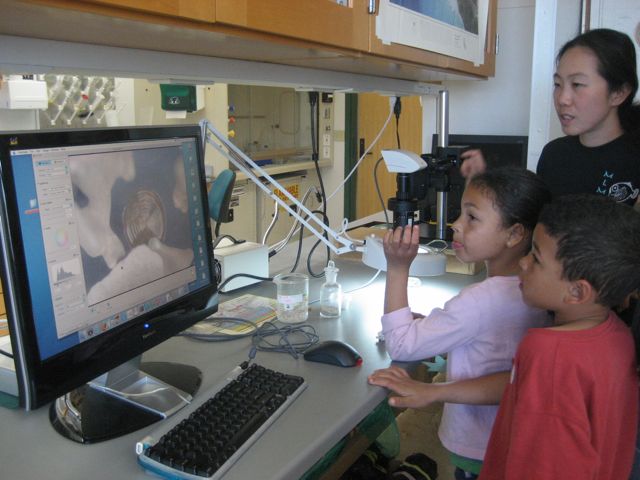
At last, the moment you’ve been waiting for! The count down is over, and Open House is here! We hope you’re as excited as we are to learn about all the amazing research that we do. This is your chance to meet dedicated students and faculty, and find out first hand just what it means to be a marine scientist. So bring us your questions! Ask us what we’re doing and how we got started. We can’t wait to meet you – because we love what we do, and we think you will too!