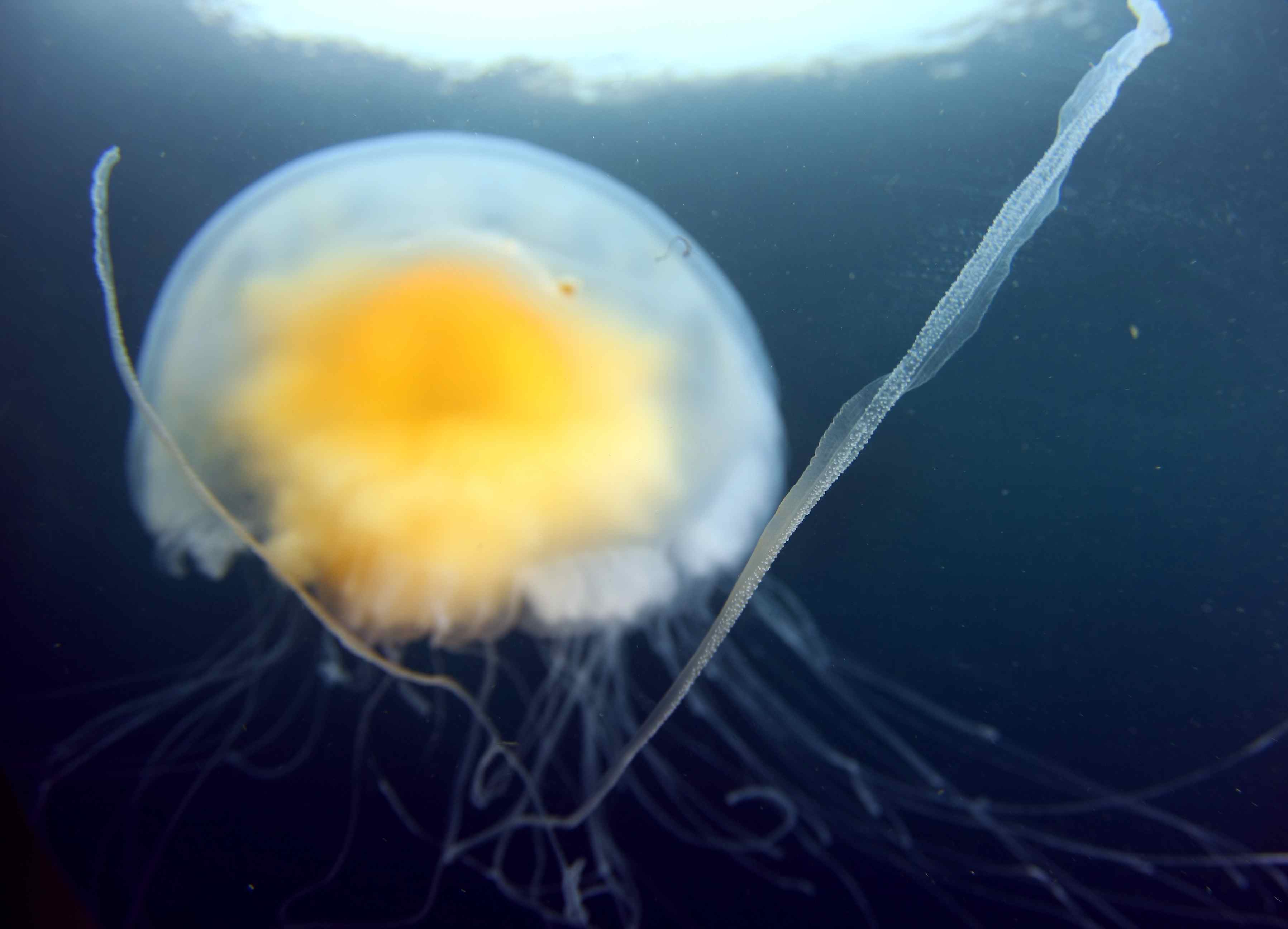
This incredible picture of an Egg Yolk, or Fried Egg Jelly was captured by MLML grad student Scott Gabara while diving for PISCO – the Partnership for Interdisciplinary Studies of Coastal Oceans. Scott was conducting subtidal fish transects in Bluefish Cove, California when he came upon the jelly. The scientific name of this jelly is Phacellophora camtschatica.
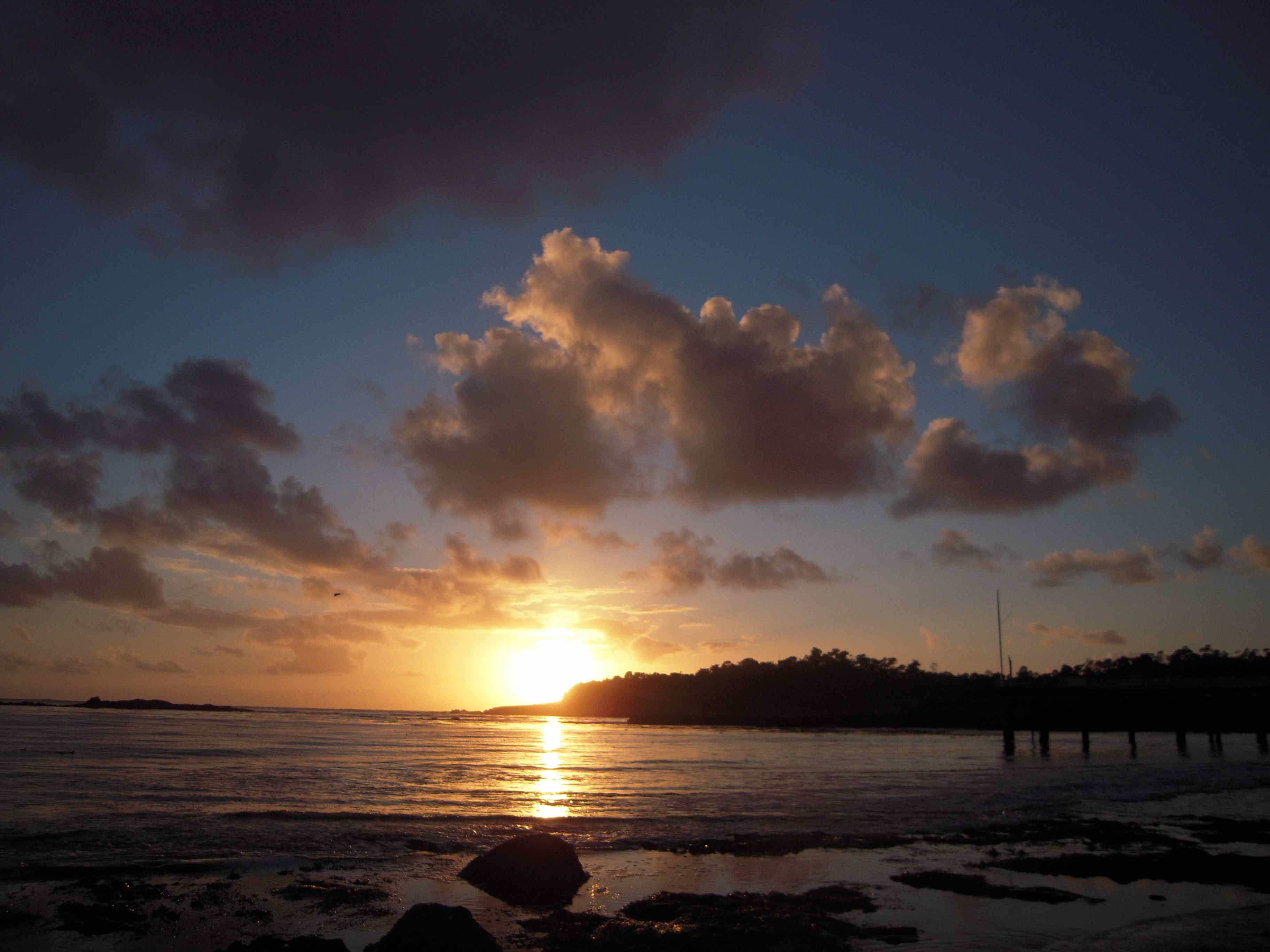
Sometimes it’s hard to believe that many MLML grad students consider this location a place of work. Countless thesis projects have taken place in Stillwater Cove in Carmel Bay, and on occasion, students catch a sunset as beautiful as this one.
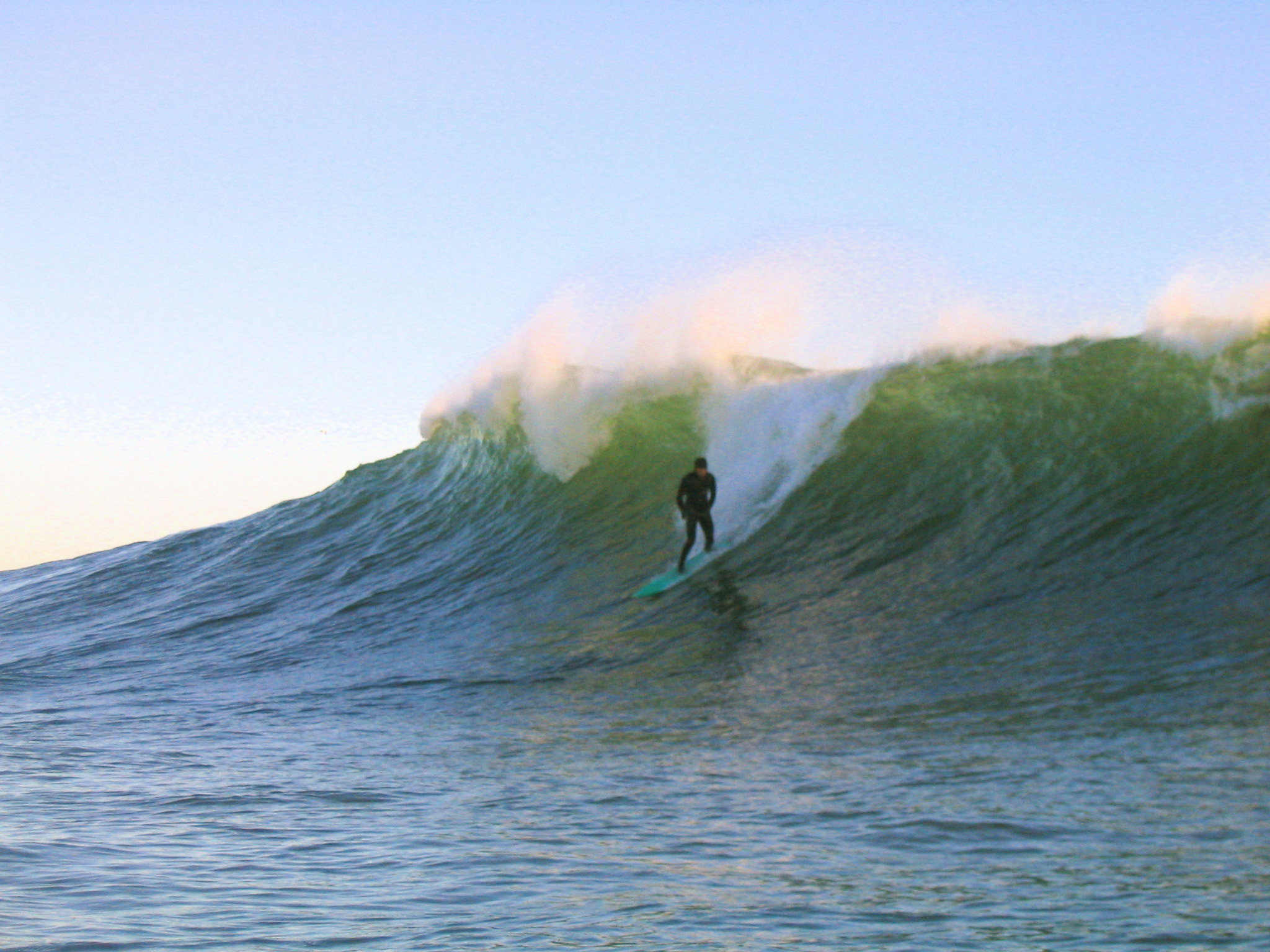
The gulls first caught my attention, a small flock in a tight swarm above the waves just beyond my surfboard. Others floated on the surface below. Suddenly the sea below them erupted, and the birds on the surface took flight. A frothy pink spray of water shot into the air; there was blood in the water. As the water calmed the gulls swooped and dove, feeding. A few seconds later the scene repeated itself, another violent splash of bloody water. My instincts were screaming, telling me turn and paddle in, to get out of the water.
My curiosity got the better of me, and I sat transfixed as something was being ripped to pieces only a few hundred yards away. Other gulls were making a beeline to join in the feast, and the flock grew. I watched the attack for another minute, until at last a large black fin broke the horizon and my suspicions were confirmed. This was no sea lion or orca, but a large white shark, eating lunch.
I swung towards the beach, catching my last wave on the way in. As I crested the dunes to get a better vantage, I saw the shark hit twice more. I ran to the parking lot to grab my binoculars. By the time I looked back to sea, the gulls had stopped flying, all were swimming on the surface. I peered through the lenses for a few more minutes, but the attack had ended. I walked back down to my car, relieved that I had been a witness to a raw display of nature’s brutality, rather than an unwilling participant.
Everyone knows how you catch a fish: With a net, or with a pole, right?
NOAA ship Oscar Dyson, Bering Sea, 2010 (photo: N. Jones)
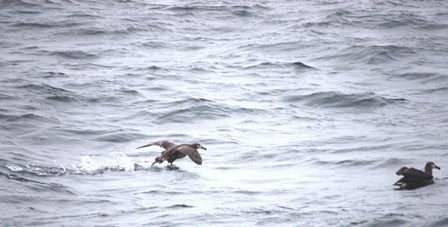
But, how do marine scientists manage to catch sea birds? Can’t they just “fly away”?
Black-footed Albatross, NE Pacific; (photo: Bert Ashley)
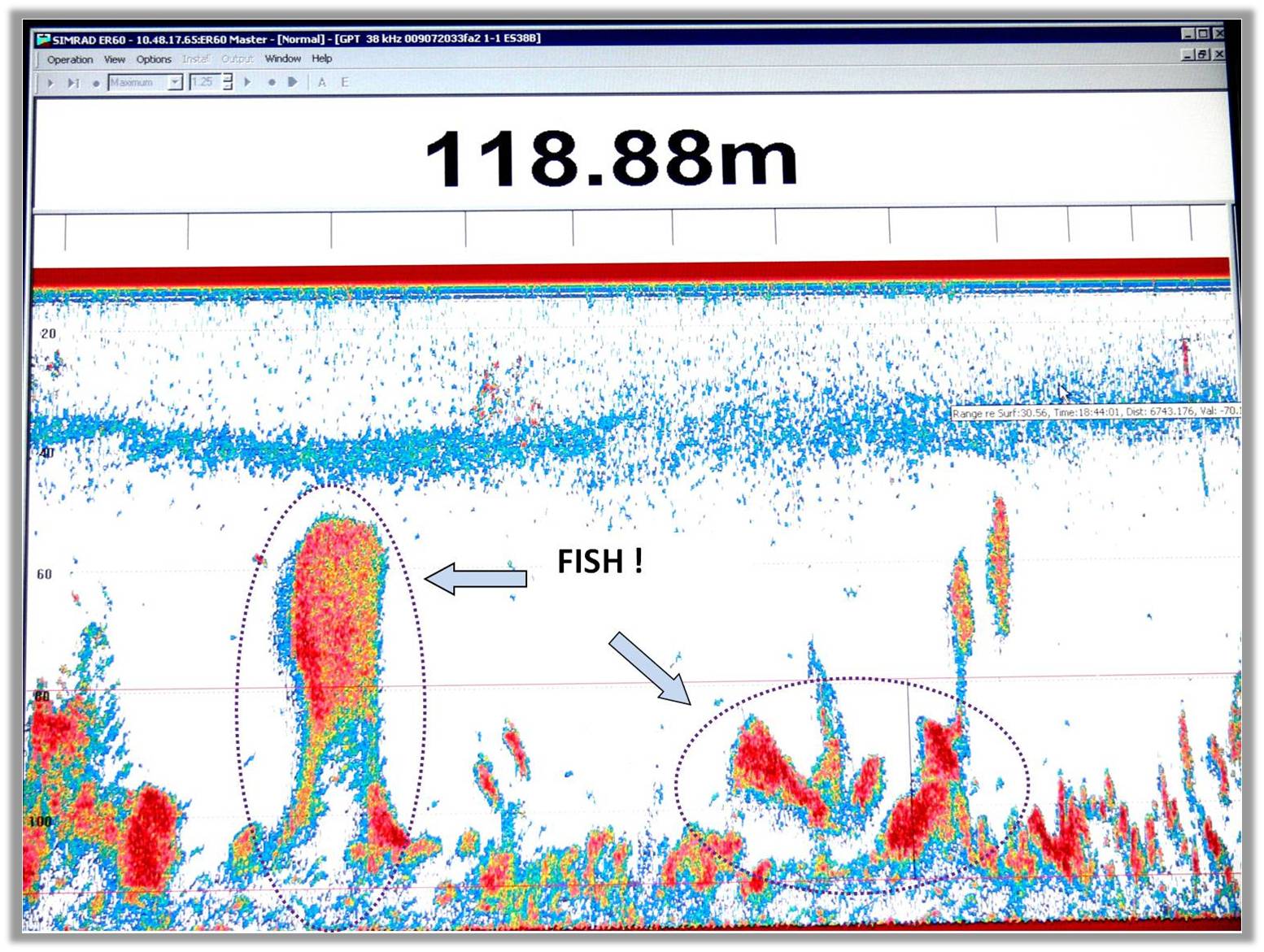
Of course, most species can do just that! So, how to get your hands on these shy creatures? Wouldn’t it be nice if the birds just gathered in groups, like so many fishes do?
Fish aggregations recorded by echosounder
Wait …
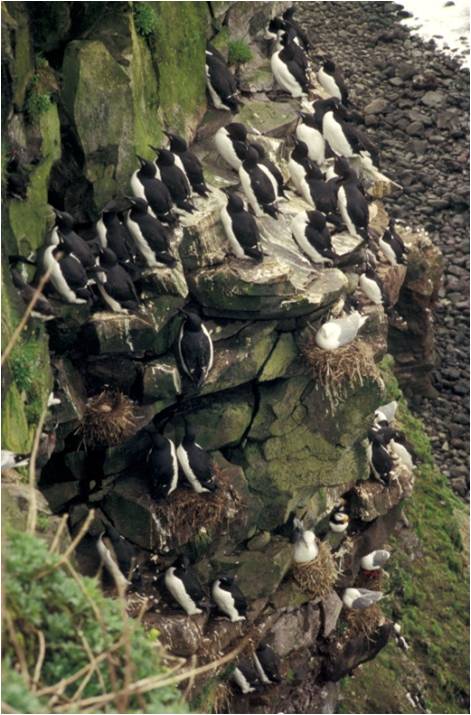
Seabirds DO gather in groups – to nest at their breeding colonies,
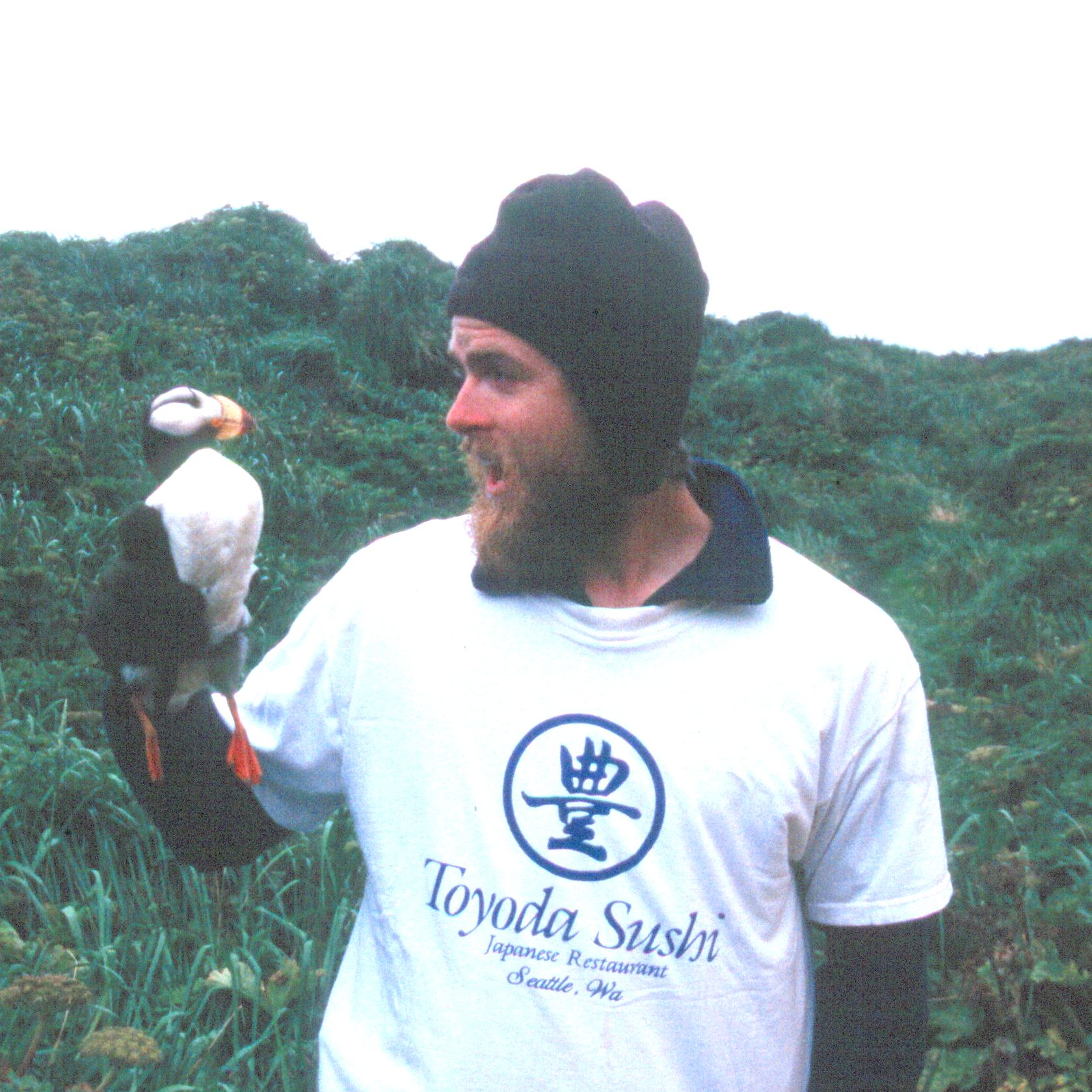
Seabird colony on Buldir Island, Aleutians (photo: N. Jones)
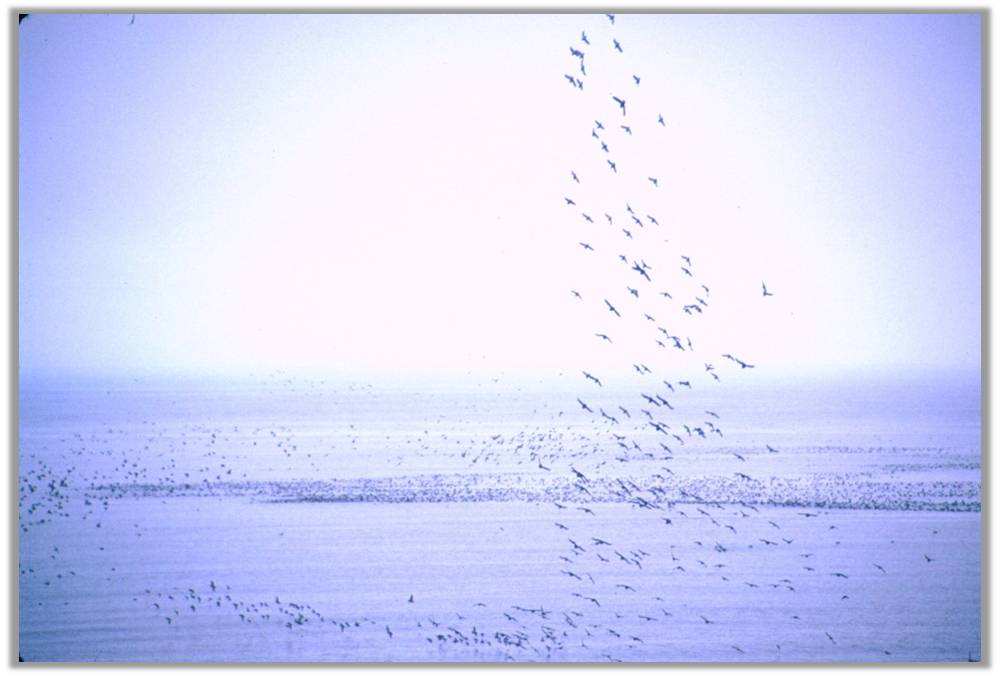
… and sometimes at sea in large, drifting “rafts”!
Auklets (-Least, -Crested, -Parakeet), Buldir Island, Aleutians (photo: N. Jones)
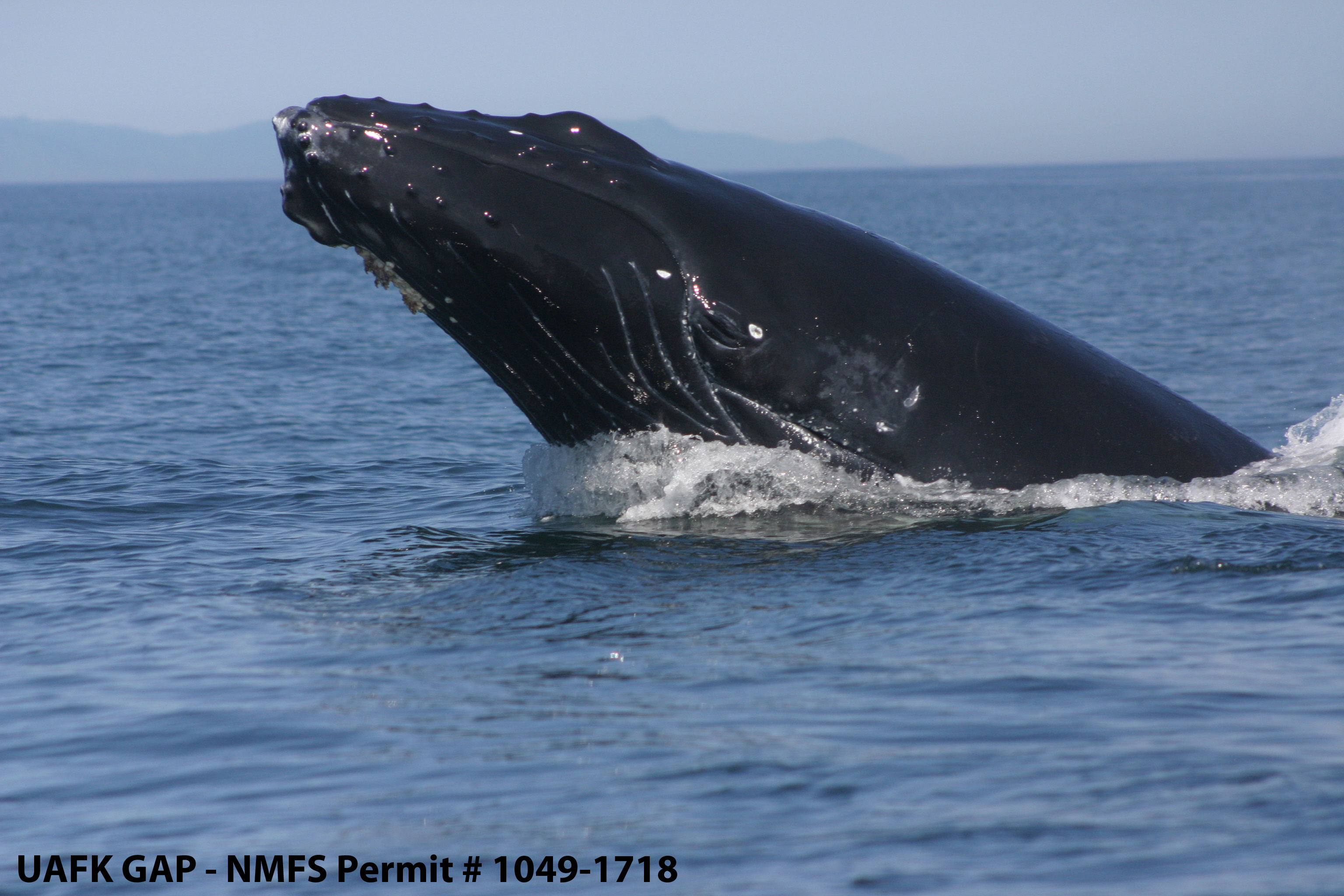
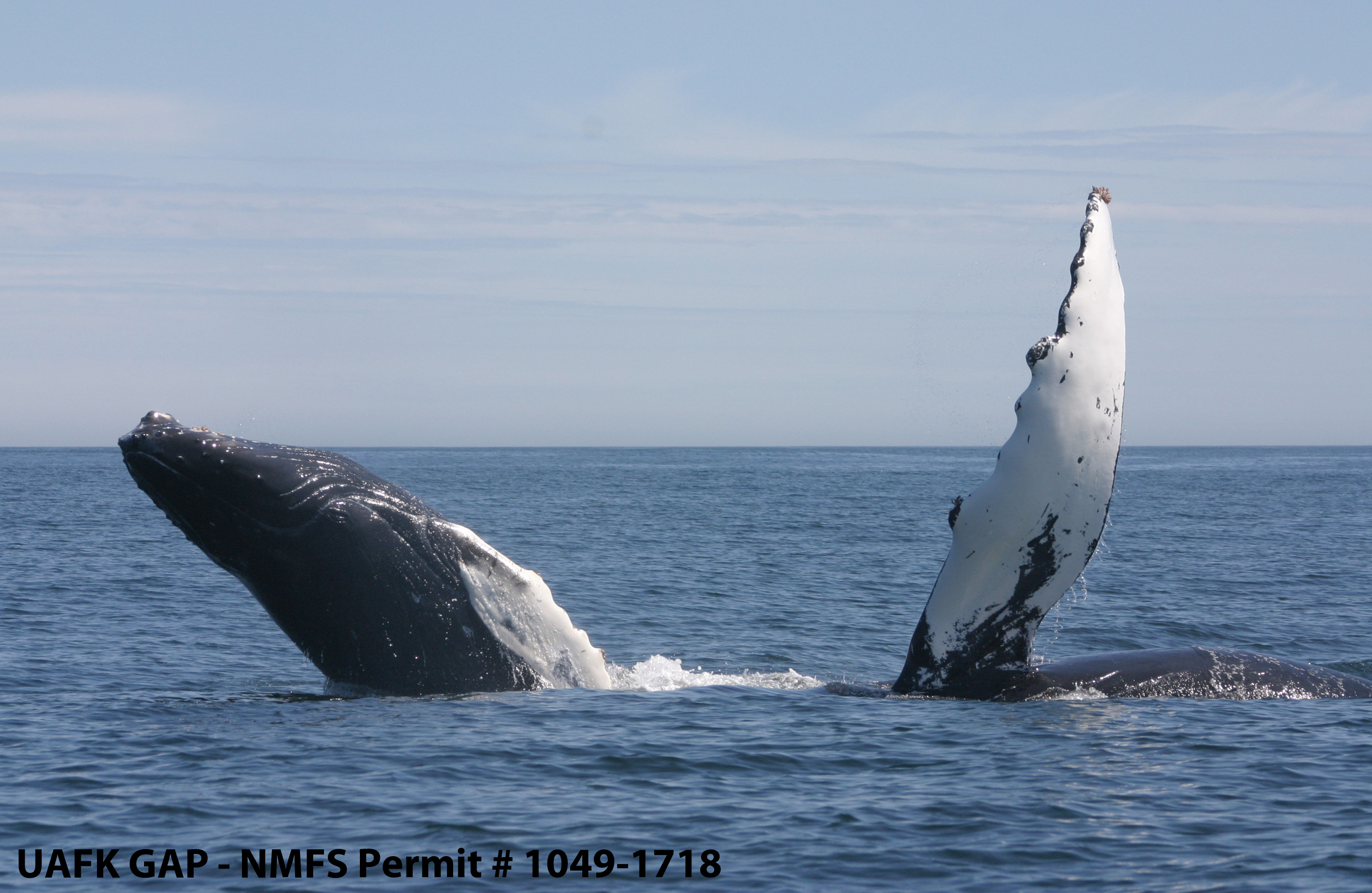
Each year, humpback whales migrate between their feeding areas in high-latitude places such as Alaska, California and Antarctica to their breeding areas in more tropical regions such as Mexico, Hawaii, Central America, and the South Pacific. This means that during the winter, all of the animals should be in the breeding area and none should be in the feeding area. It turns out that this isn’t true. All around the world, people have seen humpback whales in feeding areas during the winter when they are expected to be in the breeding area. This leads to the following questions: Who are these animals that spend their winters in the feeding area? Are they mostly males? Females? Juvenile animals? Why would they give up their chance to reproduce for the year?
It was these questions that led me to choose my project. For my master’s thesis at Moss Landing Marine Labs, I will attempt to answer at least some of them. To do this, I will look at the animals off the coast of central California, an important feeding area for humpback whales that breed off the coast of Central America. I will be looking at the sex-ratio (the number of males present compared to the number of females present) and the proportion of juvenile animals (the number of young animals compared to the number of adult animals) in this area throughout the year. By seeing how the sex-ratio and the proportion of juvenile animals change from summer to winter, I will be able to determine who is using the area in the winter. For example, if the sex-ratio is 1:1 in the summer (1 male present for every 1 female present) and 1:2 in the winter (1 male present for every 2 females present), I will know that there are more females than males using this area in the winter.
Humpback whale in Kodiak, Alaska (photo by Casey Clark)
The different sexes and age groups of humpback whales are known to migrate to the breeding area at different times. Adult males are the first to begin the migration to the breeding area, followed by non-pregnant females, juvenile animals and finally pregnant females. This pattern would suggest that female animals in the late-stages of pregnancy remain in the feeding area longer than most other whales. This theory is supported by observations from the feeding area and during migration, but it has never been confirmed that pregnant females remain in the feeding area longer than most other members of the population. I will test this theory by determining the pregnancy rates of females found in the feeding area in the late fall and early winter. If a greater proportion of these females are pregnant than would be expected, this theory would be confirmed. The identification of this area as critical habitat for these pregnant whales would have profound implications for their conservation and management.
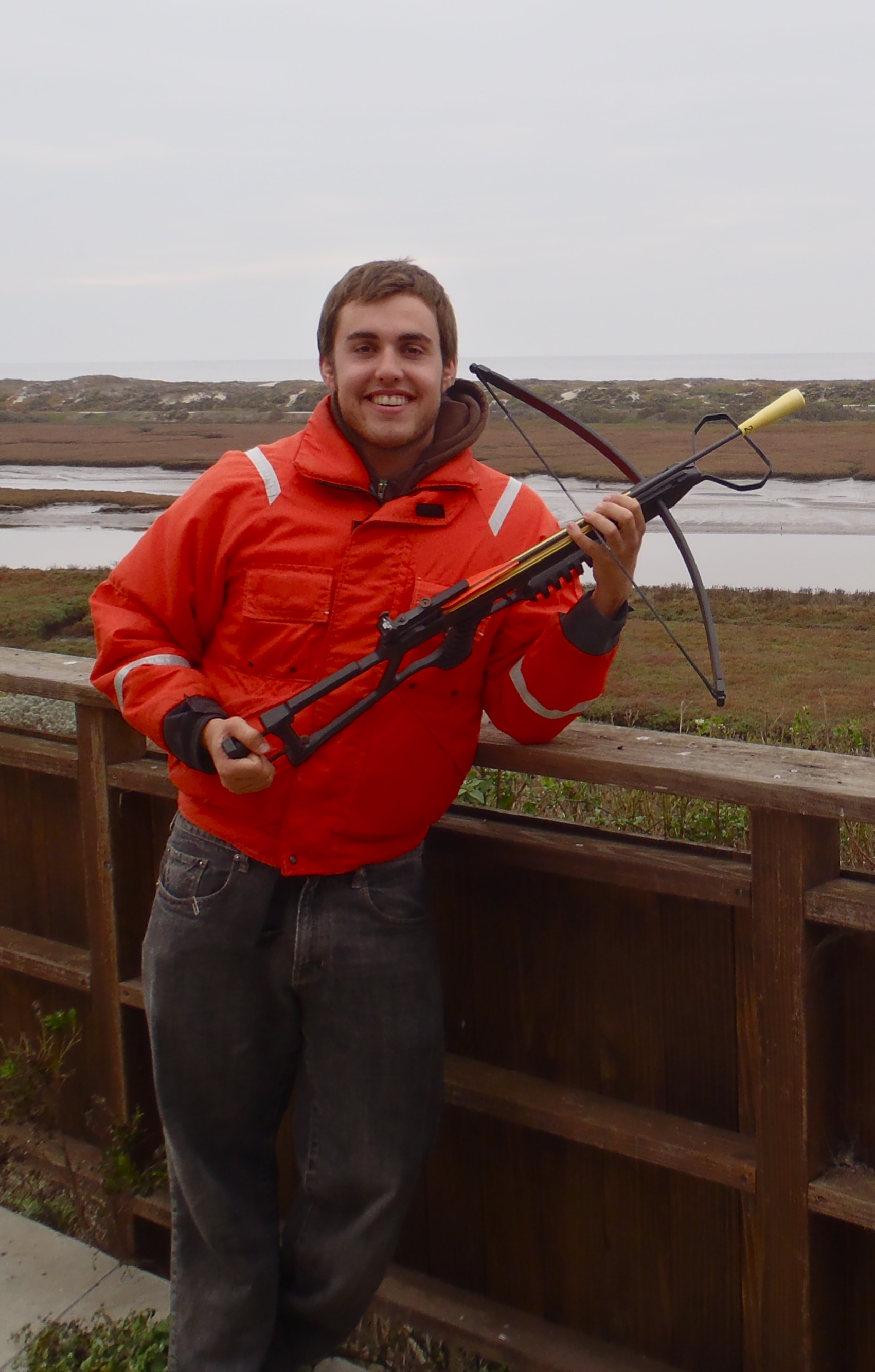
Casey and his sampling crossbow
Stay tuned to find out how I find the whales, and then collect samples with a crossbow!
Rhodoliths (photo by Paul Tompkins)Jasmine Ruvalcaba
by Jasmine Ruvalcaba, Phycology Lab
edited by Brynn Hooton
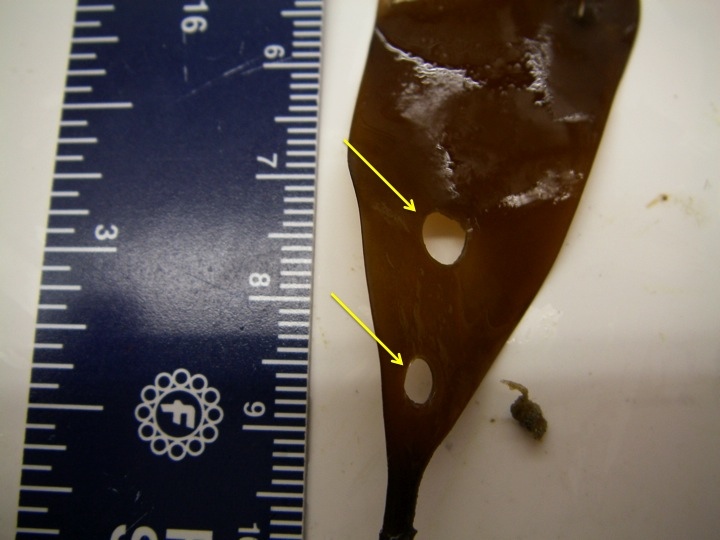
We’ve all heard the giant kelp Macrocystis can grow up to one meter per day. So, how do phycologists, people who study seaweeds, measure growth of different species of algae? With most, you can use a ruler of some sort. For instance, Dr. Graham, advisor of the phycology lab, has a National Science Foundation grant going right now to look at effects of climate change on intertidal and subtidal species. One factor he looks as is algal growth. To do so, we punch holes in the vegetative blade with a regular, run of the mill one-hole puncher near the base of the seaweed, and then each month go back to the same plants, and punch a new hole. We measure from the base of the blade to new the punch, from the new punch to the old punch, and the old punch to the tip of the blade. Wow, sounds like a lot to do underwater, right? Practice makes perfect.
This is a kelp called Laminaria sinclarii. The arrows show the different hole punches, which show how much the kelp has grown. This one has grown 11 millimeters. (photo by Jasmine Ruvalcaba)
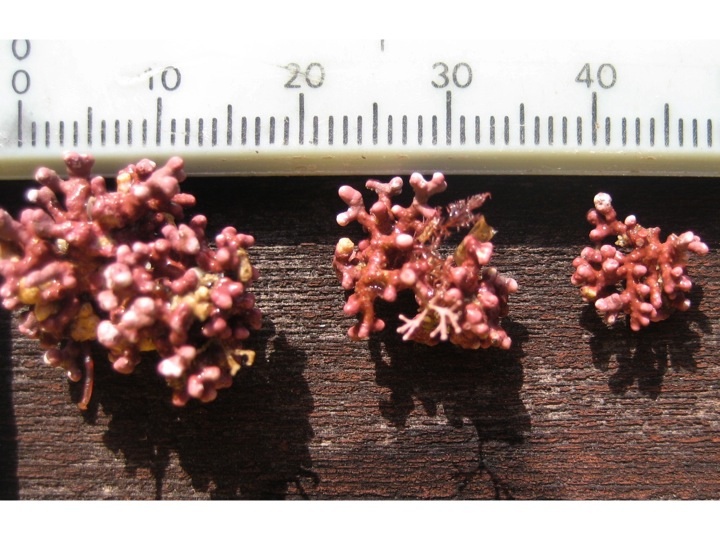
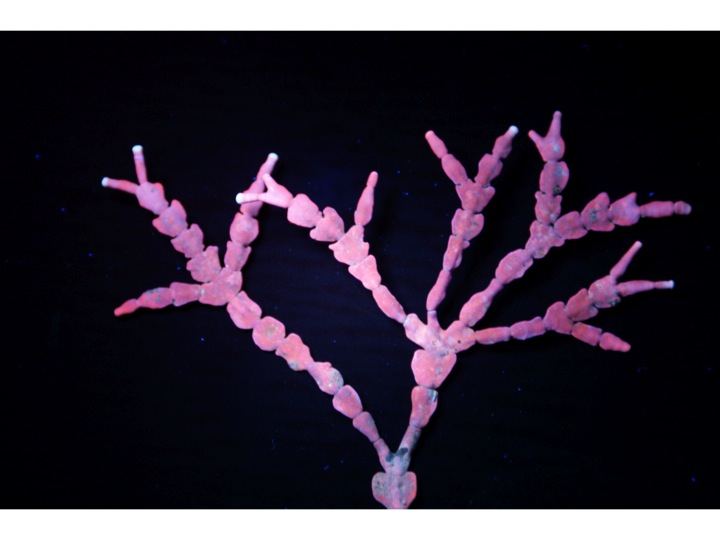
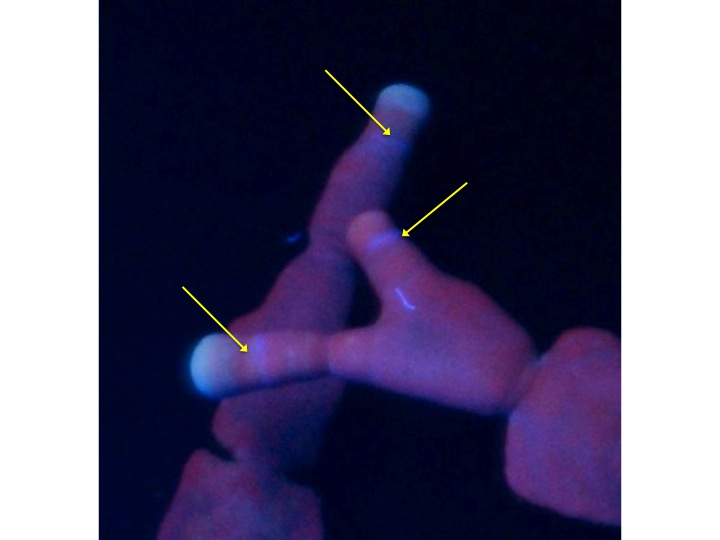
That method is great for species that are fleshy and can grow centimeters per day, but how do you measure growth with calcified species, that grow very slowly? That’s what Paul Tompkins and I, Jasmine Ruvalcaba, are doing as a part of our thesis research. Paul studies rhodoliths, which are calcified red algae that form “beds” over soft sediments all over the world. I am studying their relatives, the articulated species. In a nut-shell, we soak our plants in stains anywhere from 5 minutes to days, depending on what type of stain we’re using, and let the stain mark the alga’s outer cell walls. After the plant is stained, we then put it back in clean seawater and let it grow. Any new parts of the plant that have grown after we took the plant out of the stain should be visible, and we know how long it’s taken to make this new growth. So, here is what we see…..
This is Calliarthron sp., an articulated coralline species. This photo was taken under UV light, because the particular stain that was used on the algae lights up, or shows up under UV light. (photo by Jasmine Ruvalcaba)This is a close-up of the articulated coralline branch tips. The arrows show where the stain stops. The white tips, that aren't stained, are growth of the coralline algae that occurred after we stained it. We measure from where the stain stops to the tip of the plant. This particular individual has grown 1.2 millimeters in 1 month. (photo by Jasmine Ruvalcaba)
Keep in touch to read about my future adventures with coralline algae!
Skeletons are not just the stuff of Halloween at a marine lab – bones galore grace these halls of science year round. Although being surrounded by dead things can lead to some unfortunate stereotypes of mad scientists with macabre fetishes, getting up close and personal with bones is one of the best lessons in basic anatomy.
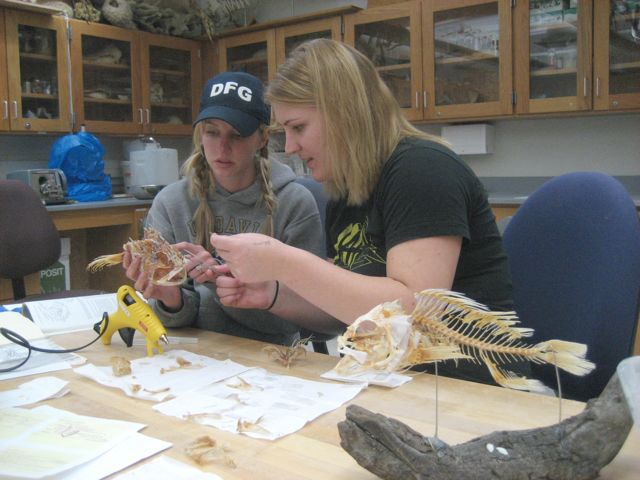
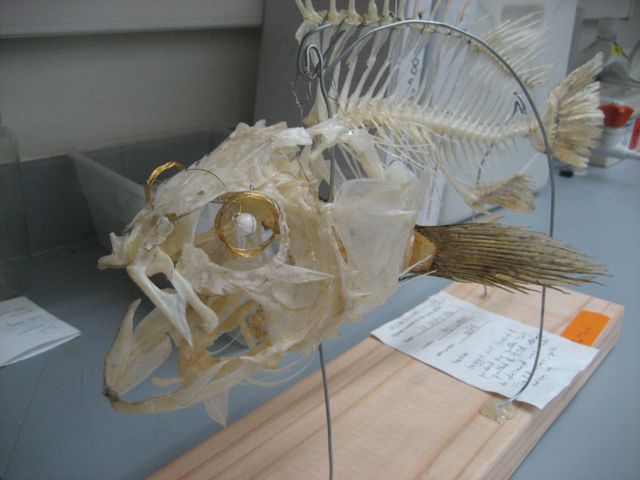
That’s why in Spring 2008, many of us set to the task of cleaning, taking apart and putting together fish skeletons for our Ichthyology class to better understand how the skeletal structures of these fish “work.” In honor of Halloween, check out some of our bone creations – I mean, preparations (affectionately known as “bone preps”):
Wolf Eel, prepared by Megan Winton and Jenny Kemper (photo: E. Loury)
Pacific Halibut, prepared by Clinton Moran (photo: E. Loury)
Vermilion Rockfish, prepared by Katie Schmidt and Kristin Hunter-Thomson. (photo: E. Loury)
Learning bones can have some practical bearing for research as well. While going through the stomach contents of my gopher rockfish, I have had to try to identify little fish prey items from their bones. As an example of cool cross-disciplinary collaborations, I and some other diet students have enlisted the help of Crisite Boone, an archaeologist from UC Santa Cruz who is an expert in fish bones from her study of California Indian middens. Who knew that identifying fish from bits of bone pieces could be a transferable skill?
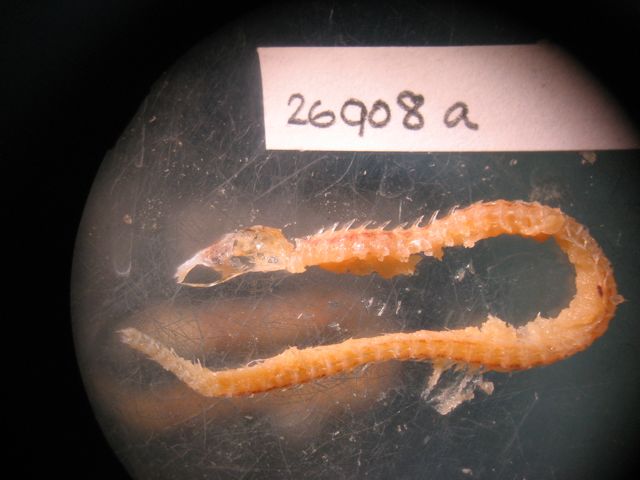
Here’s a look at one of the more unique skeletons I found, that of a prickleback of some kind. Note the really robust spines on its back – looks almost…prickley, wouldn’t you say?
Mind the spines! Prickleback skeleton found in gopher rockfish stomach (photo: E. Loury).
Authored by Deasy Lontoh, Vertebrate Ecology Lab; Edited by Brynn Hooton-Kaufman
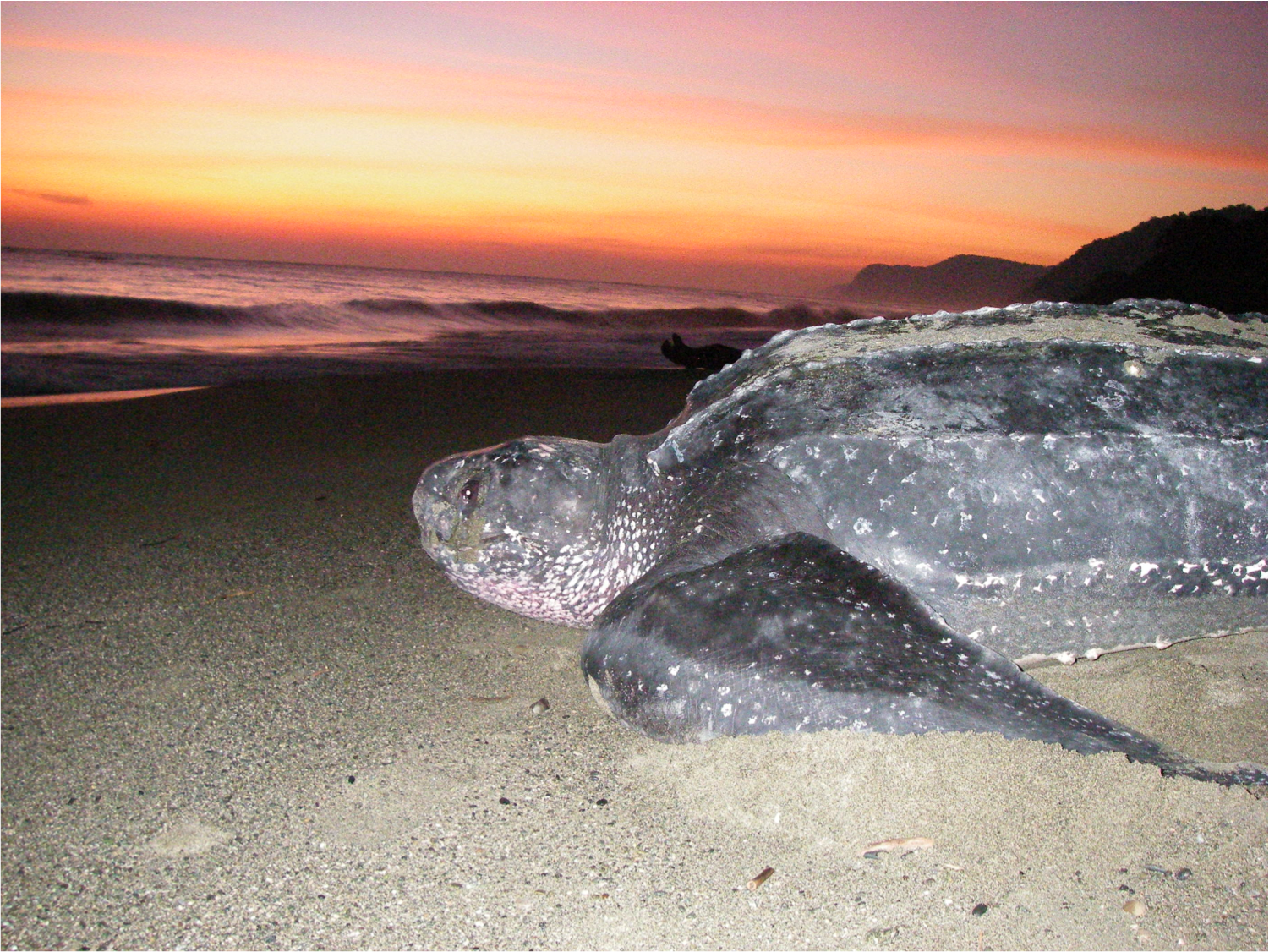
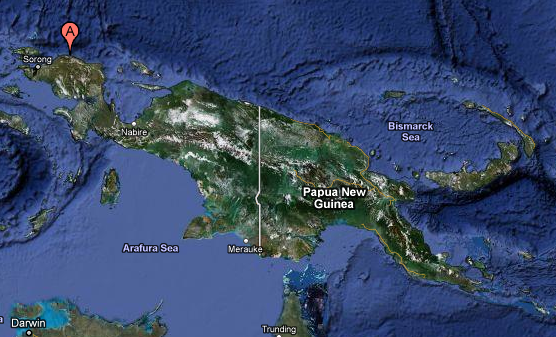
You may remember my story from last year, when I traveled to the Jamursba Medi beaches to see and learn about leatherback sea turtles. Well, this past summer I was able to go back. I spent about three months from June to August all the way across the Pacific, in the Bird’s Head Peninsula which is in the northwest coast of Papua, Indonesia. It’s close to the equator, so it’s hot and humid!
he island of New Guinea: Papua comprises the western half of the island, and the Bird's Head Peninsula, where Deasy spent her summer, is marked with an "A"
This time, I went back to collect data for my thesis. I am studying the variation in reproductive output of leatherbacks that migrate to different foraging locations. In other words, I want to know if where they go to eat before the nesting season influences how many eggs per clutch they lay, how many clutches of eggs they lay, how many years there are between breeding seasons, and how many hatchlings hatch. In general, leatherback turtles lay three to eleven clutches per breeding season, and their breeding seasons occur every two to three years. Unlike birds and mammals, leatherback moms do not guard their nests or provide food for their hatchlings. Instead, they lay multiple clutches of eggs spaced out over time and space to ensure that at least some the hatchlings make it to the sea.
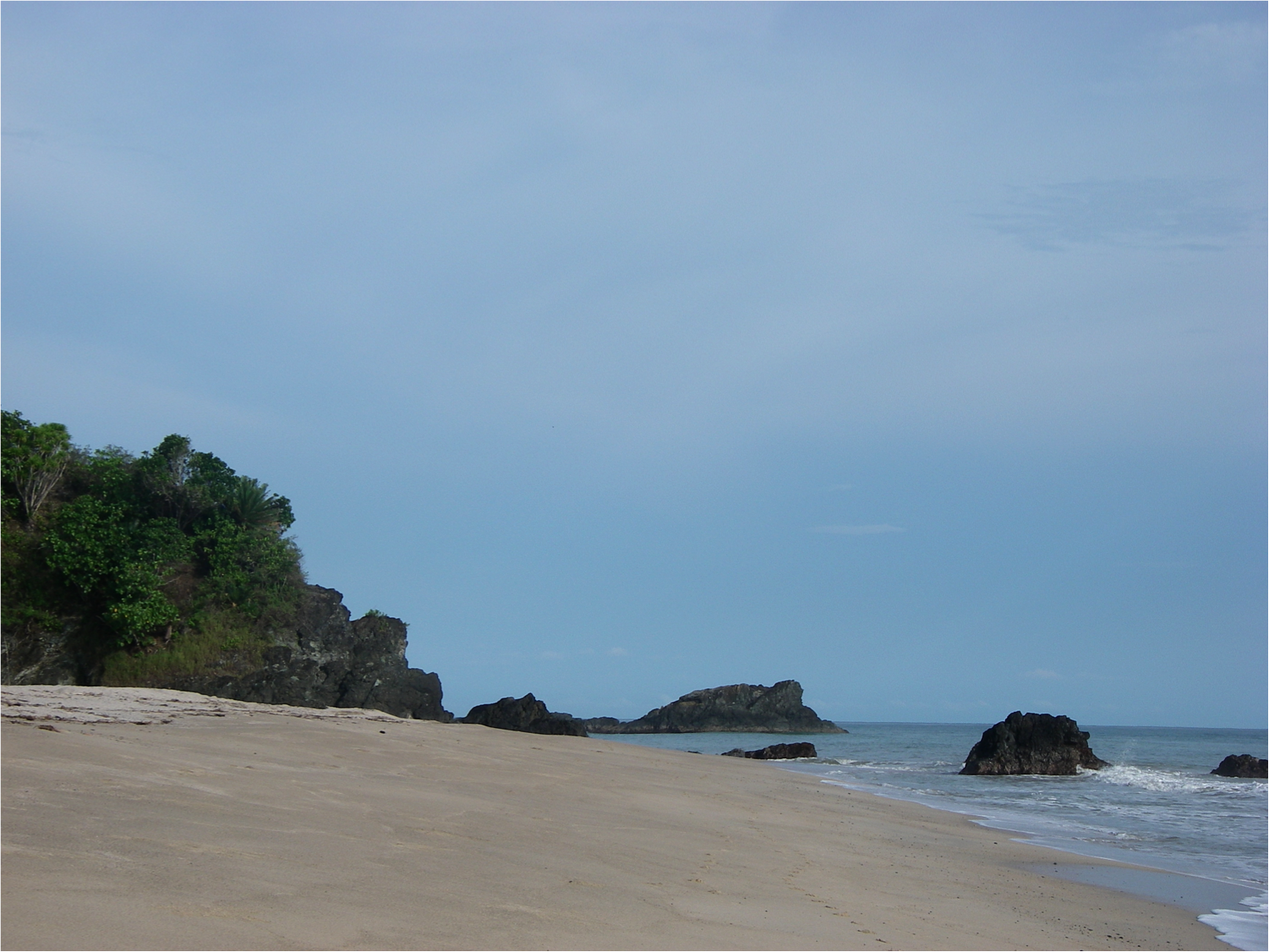
Warmamedi beach, the easternmost beach of Jambursa Medi. It is one of the beaches patrolled at night for turtles.
To gather all of this information may sound simple, but it takes a small army of people walking the beach nightly. I worked closely with State University of Papua students and alumni who monitor leatherback activities during the breeding season. Some of them were getting their first field experience, and others were collecting data for their undergraduate thesis project. In addition to general nightly leatherback monitoring, they helped me find my focal females. These are a proportion of the nesting females that I focused my data collection on. The beaches of Jamursba Medi are long, so each person is usually responsible for patrolling a stretch of beach about 1.5 – 2 km long from about 9 pm until 4 am. We go back and forth with only 15-30 minutes rests in between so as not to miss any turtles nesting.
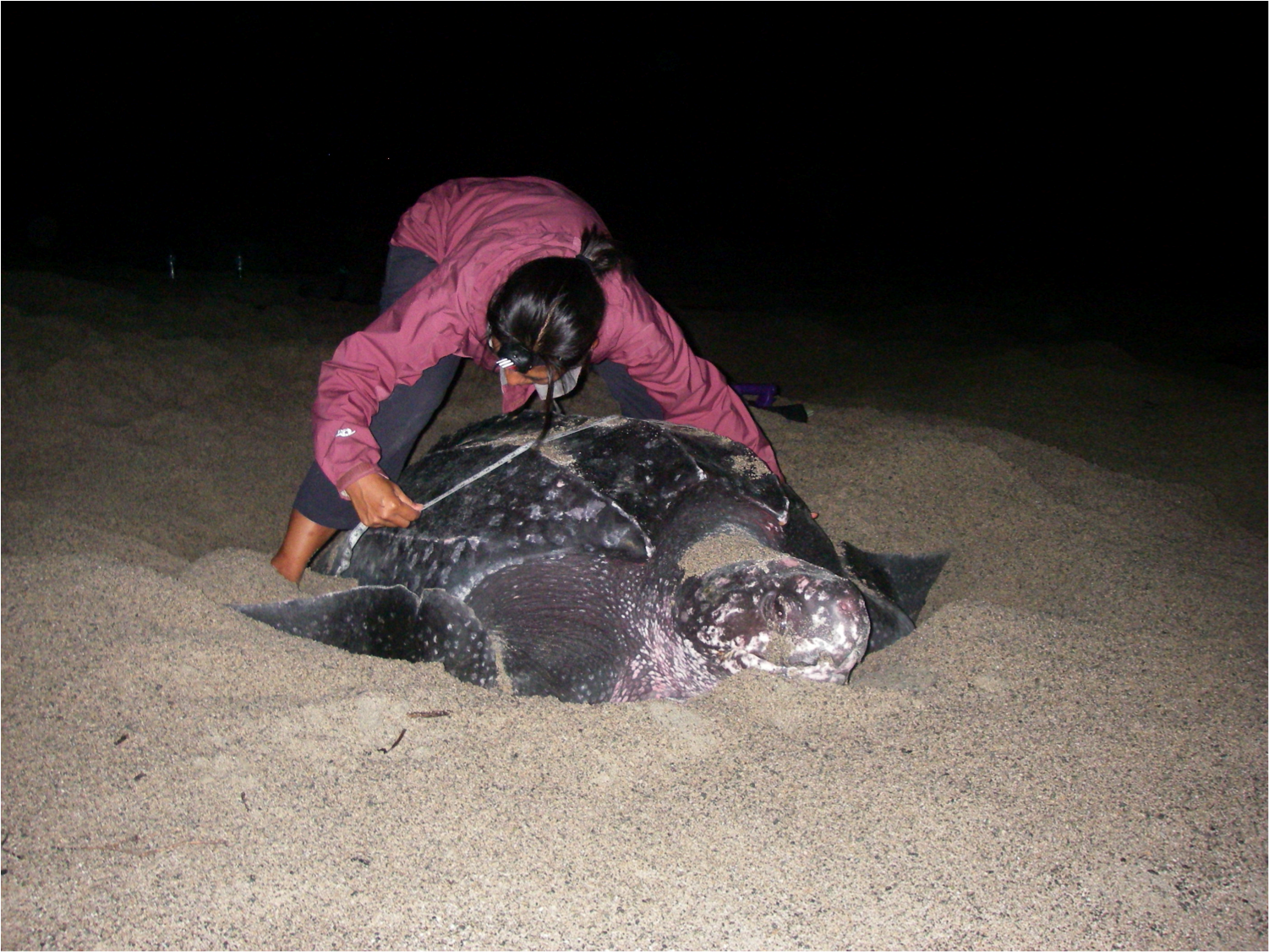
Deasy measures the carapace of a nesting leatherback turtle
When we encounter a focal female, we wait until she starts laying eggs to collect data. To identify each individual female, we insert a PIT tag, a small uniquely coded chip, into her shoulder. We also measure her carapace length and width, and collect a very small skin sample from the base of her hind flipper for stable isotope analysis. Using stable isotopes, I can figure out where she migrated from before arriving at the nesting beach.
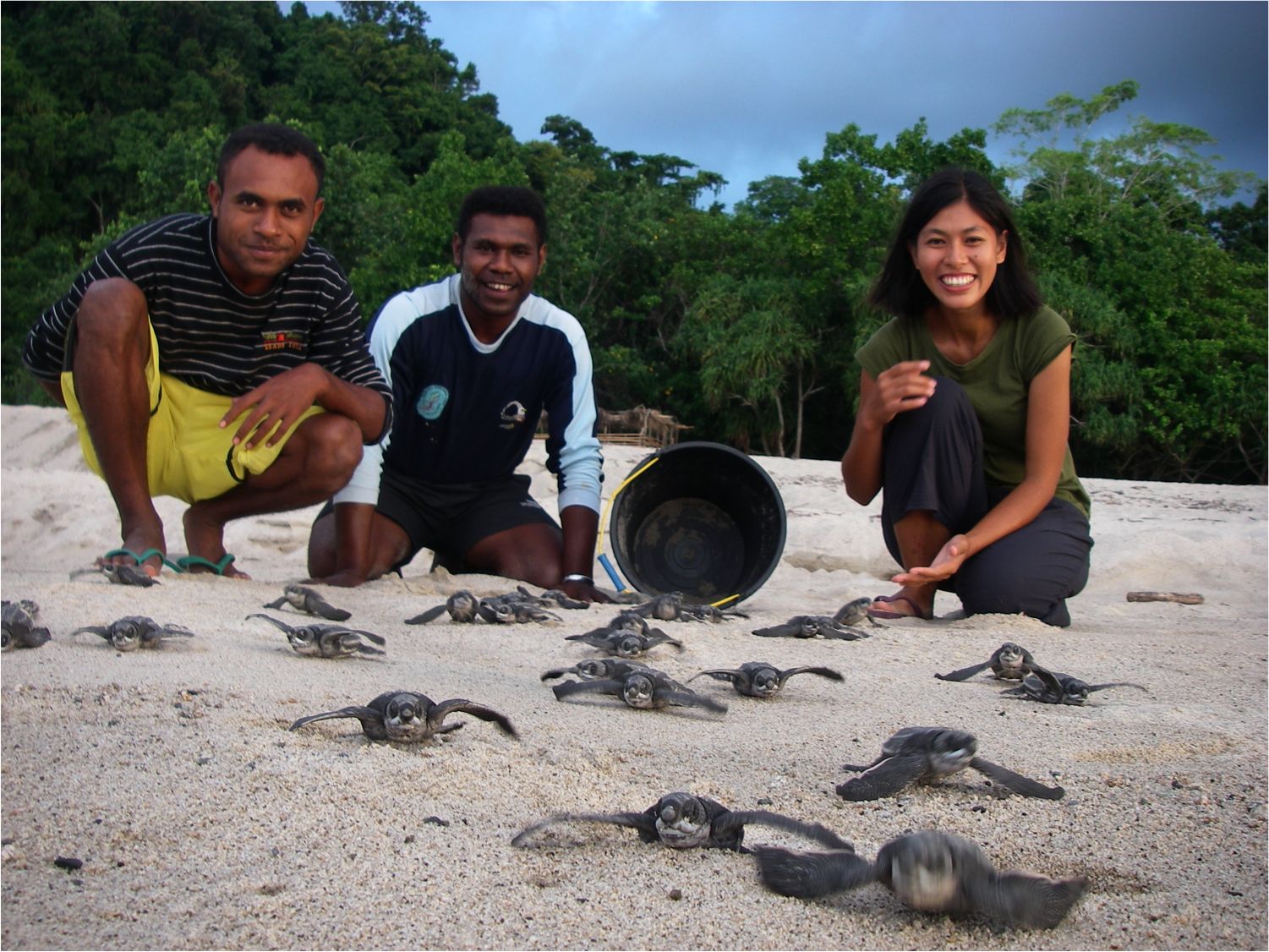
Some of the clutches from my focal females were carefully moved into a hatchery. Many clutches in Jamursba Medi don’t hatch because pigs and dogs eat the eggs. For some clutches, sand temperature is too high, which causes the developing embryos to die. By moving them into a hatchery, we protect them from predators and high sand temperature. During clutch relocation, eggs were removed from the nest, which allowed us to count the number of eggs in a clutch, and measure and weigh a sample of 20 eggs. When these eggs hatched, we counted the number of hatchlings that emerged, and measured and weighed another sample of 20 hatchlings. We transported hatchlings down by the surf line as soon as we were done measuring them. We tried to find and encounter each focal female three times during the breeding season to discover differences in the number of eggs laid, the size of eggs, and the size of hatchlings among clutches.
Deasy releases baby leatherbacks from the hatchery near the waterline on the beach
We did A LOT this past summer! The work was physically exhausting, but the experience was well worth it. The friendship with the local students and villagers truly enriched my experience. Thank you for letting me share my stories with you! Tune in for future posts!
In the midst of all the daily rigors of grad school life (endless sample processing, data analyses, literature reviews, etc.), forward progress seems sometimes to move like a snail through molasses. One rarely gets the chance to step back from it all and gaze upon the big picture. Instead, you’re usually so exhausted after yet another 14 hour field day, 8 hours of microscope work, or weekend spent studying for exams that you tend to forget that there will in fact be fruits of your labor…
Well, my bug-eyed, brain-frazzled, bone-weary grad school friends (and those of you students-to-be), I’m here to remind you to keep your eye on the prize and enjoy the ride. Science is one of very few professions that encourages pure creative thinking, allows for raw discovery, and, in the process, envelopes you into a tight-knit community of passionate, like-minded people. Brick by brick, its process and results expand and add to the conventional wisdom of humanity. Of course you know this… it’s what attracted you to this pursuit to begin with… but I know how easy it is to lose sight of this fact during the day-to-day ‘drudgery’. Well, let this be your public service reminder: you are so lucky to be part of this!
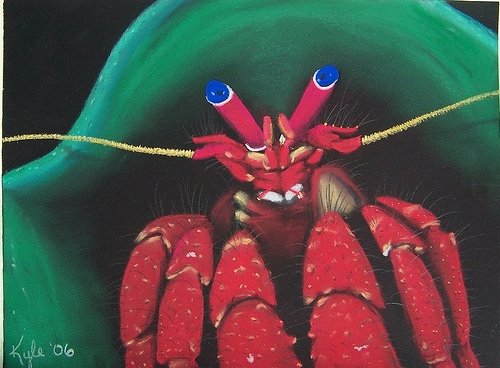
Grad school got you feeling bug eyed? You'll get to do other things you love again - when you graduate. (painting: K. Reynolds)
I can say this now, one year after graduating from Moss Landing Marine Labs. Now that a chapter of my thesis has been published and become an actual contribution to our knowledge of how the world works. Now that I’ve had a chance to slow my pace, get in some painting and gardening and realize… Hey! Wait! I need another fix! I’m not ready to get off this ride yet (or ever) – this stuff is addictive! There really are no words to describe the feeling of finally seeing your hard work published and, yes, even referenced by others in your ‘community’. This must be why there are very few ex-scientists out there.
And so, here I go, back into academia to get my next fix. Much like Michael Corleone, “Just when I thought I was out… they pull me back in.” Only willingly… very willingly. Don’t look at me like I’m crazy. You know you’ll do the same thing. Keep your eye on the prize.
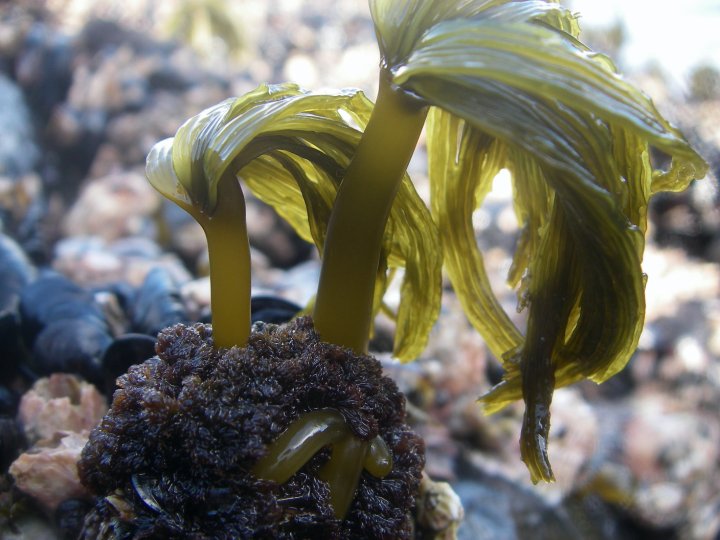
Postelsia palmaeformis, California's other palm, better known as the Sea PalmBrynn Hooton-Kaufman
by Brynn Hooton-Kaufman, Phycology Lab
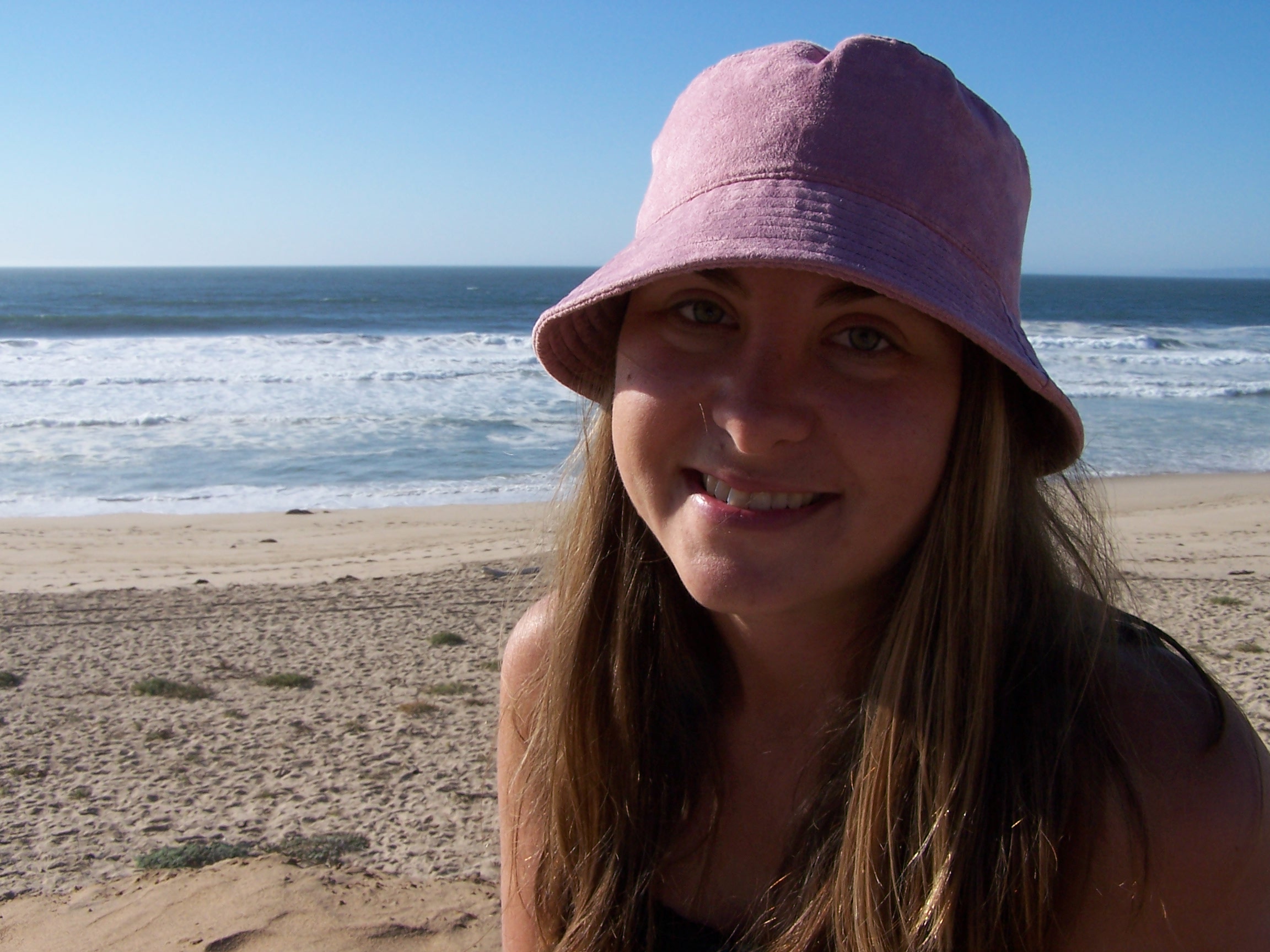
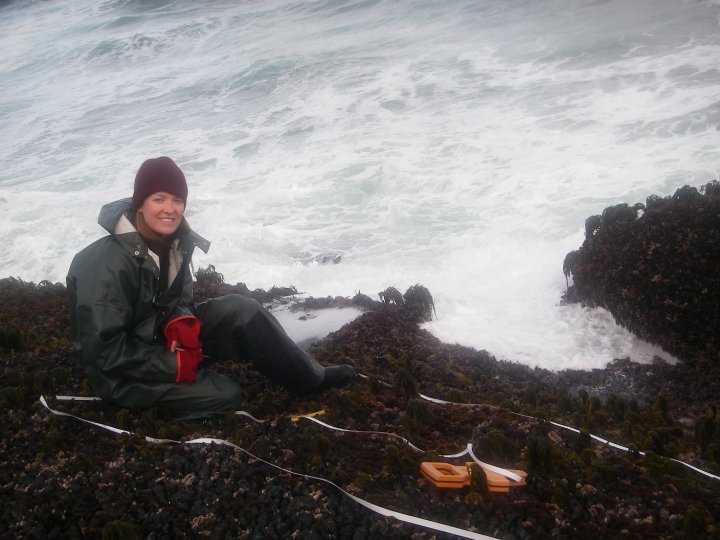
On any given month during a good low tide, you can usually find Sara scuttling amongst the crashing waves in the intertidal zone at Soberanes Point, searching on her hands and knees for palms. No, not palm trees, but Sea Palms, known by the scientific name of Postelsia palmaeformis. Rain or shine, day and night, Sara crawls around the boulders on the fringes of the tide pools to find new Sea Palm babies that have sprung up in her study area.
Sara sampling a plot in the wave-swept rocky intertidal, counting up Sea Palms
Sara is studying community interactions of seaweed in the rocky intertidal, and more specifically, she’s looking at what these baby Sea Palms grow on. In some places along the coastline of the Pacific Northwest, Sea Palms only grow on bare rock where they can get a super good grip on the rocks to avoid being ripped off by mighty waves. But here, along our Central California coast, Sara sees a different trend. She sees Sea Palms mostly growing on intertidal coralline algae that creates a turf. To find out more about Sara’s thesis project, and take a look at her Student Profile. Also check back often for Sara’s first hand account of sampling in the rocky, wave-swept intertidal.
Sara is deep into her third year at Moss Landing Marine Labs, but even before she started graduate school she had many amazing adventures. She studied for a semester abroad in the Galapagos Islands, worked as a behavioral ecologist, and studied humpback whales. You can read more about her exciting experiences here. Check back often for stories from Sara, and to hear more about her rocky intertidal endeavors with Sea Palms.